Home › Volumes › American Animals › Wolves and Foxes
Gray Wolf
Also called: Timber Wolf.
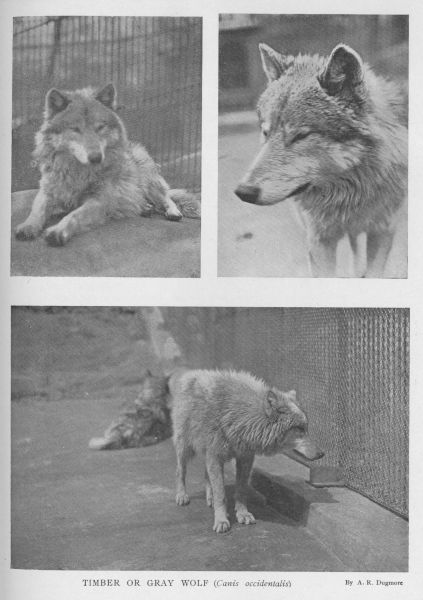
- Length
- 4 feet 9 inches.
- Description
- Prevailing colour gray; dark, almost black along the back, with a dusky patch on the shoulder and hips. Sometimes more rufous.
- Range
- Formerly over most of North America, now very rare east of the Mississippi River. The exact number of varieties of American ?olves has not been determined; probably the Black Wolf Canis ater Richardson, which still exists in the Florida everglades, is a distinct species, and also the Arctic Wolf C. albus (Sabine), which is pure white with a black tip to the tail.
The gray wolf that formerly ranged in great packs over every part of this country is practically the same as the dreaded wolf of Europe. Local varieties in both countries differ more widely from each other than typical specimens from the same latitude in Europe and America. Yet, while in Russia, Germany, and even France, the wolves still menace the peasantry whenever an exceptionally hard winter drives them to desperation, in this country they were quickly driven off and exterminated in most sections, even where heavy forest-growth and broken country afforded them the best protection.
Gray wolves were always wandering, unsettled beasts at times, especially in the winter, hunting up and down the country in great packs, and more rarely wandering alone or by twos and threes. Any sort of a country appears to suit them well enough, provided there is game to be had. If anything, they were more numerous in low, black swamps of hemlock and tamarack in the North and the everglades of Florida than in the dense forests of mountainous countries and uplands. But above all else they preferred the wind-blown prairies of the West, where they followed the bison herds in their wandering after new and green pastures. The wolves seldom molested the buffaloes unless they were disabled by wounds or sickness. The young calves were what they were after when they skulked through the herd, dodging the old bulls and angry cow-buffaloes in the tall bunch-grass of the plains. At present the alkali deserts and badlands and the barrens of the Hudson Bay country harbour the greater number of those that still run in the open. In the heavy timber of the Rockies those wolves that like to hunt in the shadow of the forest find abundance of deer and smaller game and good hiding that not only enables them to hold their own in numbers, but even to increase in many sections.
Whether going in packs or singly, they almost never resort to still-hunting or ambush, but run down their prey by combined speed and endurance.
While they have been said to adopt as a member of their own pack a dog that had deserted his master and taken to a wild life, evidently sensible of the kinship that exists between them, they look upon one that submits to the authority of man and acts as his servant as the henchman of their worst enemy, and their legitimate prey.
They will also run down and kill their cousins, the foxes, who, though swifter than the wolves for a short distance, lack their endurance and wind.
In summer the wolf packs separate to a certain extent into pairs that seek out secluded retreats, and dwell for a time in dens or burrows of their own digging, the she wolf nursing her whelps at home while her mate keeps her supplied with food. After the young wolves have learned to kill for themselves, the family joins the pack again, knowing that their peculiar method of hunting depends upon numbers for success.