Home › Volumes › American Animals › Wolves and Foxes
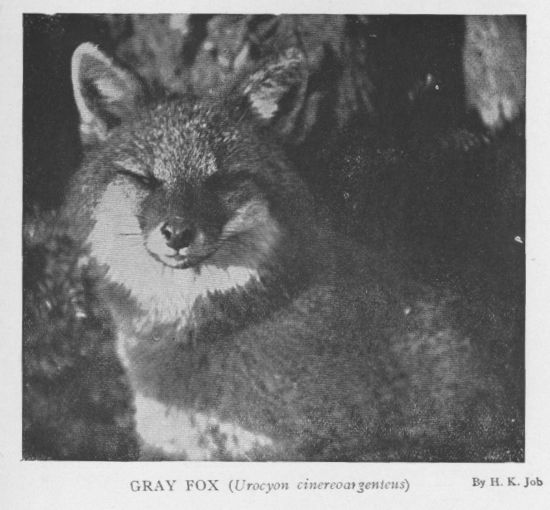
Gray Fox
- Length
- 39 inches.
- Description
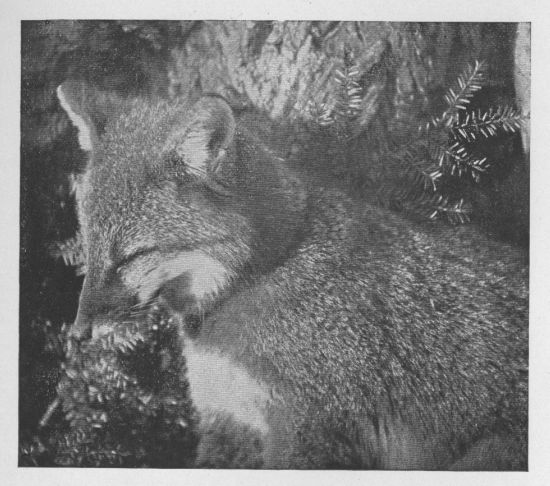
- General colour gray, hair banded black and white; darker on the back. Sides of the neck, ears and band across the breast rusty red; tips of ears black, feet and parts of leg rusty, as well as the under surface of the body. Inner side of legs, throat and middle of breast white. Tail much coarser than that of the red fox without the soft under fur.
- Range
- Southeastern New York and New Jersey to Georgia and north in the Mississippi Valley to Tennessee. Replaced in Florida and in the West by slightly different varieties.
- Range
- Southern Georgia and Florida.
- Range
- Upper Mississippi Valley.
The gray fox is a creature of the forest, incapable of holding his own for long in a cultivated country; not so much because of any inborn hatred of civilization, like that which drives the beaver and marten forever off into the wilderness. He would apparently be perfectly willing to dwell, like the red fox, as a free-booter on the borders of a plantation, living on mice and game birds, or stealing the farmer's chickens as occasion offered; but the farmer usually proves too much for him.
The gray fox is sly and cunning by nature, but he lacks that astonishing shrewdness and faculty for working out deep-laid schemes which enables the red fox to turn the tables on the hunter repeatedly in the most unpromising situations.
Physically the gray fox has the advantage in a number of ways; being smaller and less conspicuously coloured, he has a much better chance of tricking.
He can also climb trees better than the red fox, and is equally swift at running and more tireless, while his rough gray-brown fur is much less eagerly sought after than is the beautiful pelt of the red fox.
Gray foxes seldom live in burrows; most of them have their camps in hollow logs and old tree-trunks, where they can take refuge in rough weather or when chased by dogs. At other times they like to sleep in the open air, hidden among the bushes and undergrowth. They are clever hunters, and living as they do farther to the south, and avoiding those regions where the snow lies deep in winter, seldom lack for food at any season.
They catch and eat almost every small creature that lives in the forest--insects, fish, reptiles, birds, and small mammals; they also at times eat wild grapes and berries, and very likely acorns, chestnuts and mushrooms, like most of the carnivorous animals.
The female hides her young in a nest of leaves at the bottom of a hollow tree, and later brings them out to give them lessons in hunting and woodcraft. When they have learned to take care of themselves a little they separate, to wander where they will, unprotected, picking up a living here and there as best they may. The barking of the gray fox is thin and husky, fainter than that of the red fox, and serves chiefly to call the sexes together in the spring.
Varieties of the Gray Fox
Gray Fox. Urocyon cinereoargenteus (Schreber). Range and description as above.
Florida Gray Fox. U. cinereoargenteus floridanus Rhoads. Smaller, fur coarser, and fulvous of breast paler, with no white on the under parts.
Wisconsin Gray Fox. U. cinereoargenteus ocythous Bangs. Larger with more yellow and rusty tints and less pure gray than the eastern gray fox.