Home › Volumes › American Animals › Wolves and Foxes
Coyote
Also called: Prairie Wolf.
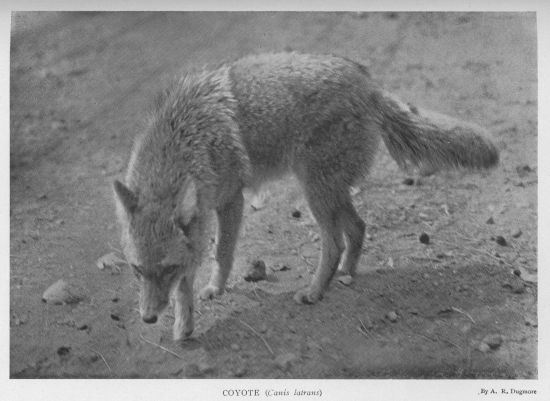
Length.—4 feet.
Description.—General colour fulvous, grizzled with black and white hairs; under parts whitish; tail tipped with black.
Range.—Northern Mississippi Valley to the Rocky Mountains, with allied species south to Texas and Mexico, and westward to California and British Columbia. Dr. C. Hart Merriam has shown that many of these coyotes are very different from one another, and as in many of our other larger animals, we find that instead of one wide ranging form of the older authors there are really several perfectly distinct species. The distribution of the various coyotes has not yet been satisfactorily worked out.
Coyotes are small, slinking wolves that live in burrows on the plains, where they feed principally on jack rabbits, ground squirrels and mice.
They are often called prairie wolves to distinguish them from the timber wolves or gray wolves. They combine the swiftness, shy cunning and greed of the wolf and fox tribes, but lack the ferociousness of their larger cousin, the timber wolf.
Being active, healthy brutes, they undoubtedly enjoy their wild, unrestricted life of action and adventure, and are happy in their own way, except when suffering from unusually hard luck at hunting. Yet somehow they always look distressed and miserable, and their whining howl at night seems to express all the hopeless despair of some wretched spirit of the blind "viewless wind" that whirls away before a storm "seeking for something lost, it cannot find."
Like the gray wolf, coyotes hunt in packs at night, yapping and howling as they run.
They often follow the hunter at a safe distance in the hope of picking up the offal of the game he has killed. The coyote is now rare east of the bunch-grass plains. In Arkansas, Missouri and Illinois, where they were once common, they are seldom seen. But in the Butte regions of the upper Missouri and the Colorado valleys they range in great numbers, making their dens among the broken sandstone ridges of that lonely country.
In the flat lands they dig burrows for themselves or else take possession of those already made by badgers and prairie-dogs. Here in the spring the half-dozen or more coyote pups are brought forth, and it is said that at this season the old ones systematically drive any large game they may be chasing as near to their burrow, where the young coyotes are waiting to be fed, as possible, before killing it, in order to save the labour of dragging it any great distance. When out after jack-rabbits two coyotes usually work together. When a jack-rabbit starts up before them one of the coyotes bounds away in pursuit while the other squats on his haunches and waits his turn, knowing full well that the hare prefers to run in a circle, and will soon come round again, when the second wolf takes up the chase and the other rests in his turn. In this manner the jack is finally tired out and overtaken. When some particularly shy old jack-rabbit starts off for a straightaway run instead of circling, the coyote in pursuit tears away to one side and generally succeeds in turning him back towards the spot where the other wolf is waiting.
When hunting antelope and deer the coyotes spread out their pack into a wide circle, endeavouring to surround their game and keep it running inside their ring until exhausted.
Sage-hens, grouse and small birds the coyote hunts successfully alone, quartering over the ground like a trained pointer until he succeeds in locating his bird, when he drops flat in the grass and creeps forward like a cat until close enough for the final spring.
It is a well-known fact that a coyote will follow a trapper or a party of roving Indians, picking up the scraps left about their camp-fire, or wherever they may have been skinning game. If unmolested at such times, he soon loses much of his native wildness and exhibits considerable boldness.
During hard seasons, when there is little food to be had and even gophers and field-mice are hard to find, the coyote, it is said, adopts a partially vegetable diet, eating the fruit of the prickly pear, and in winter wild-rose hips and Juniper berries.
Mr. Ernest Ingersoll, in the Popular Science Monthly, gives a most vigorous account of a coyote attacking a doe-antelope and her fawn. He says: "I remember at a place where I was encamped for two or three nights in Southwestern Wyoming, the rough ledge of a butte-face just across the creek was the home of a family of these wolves, and I often saw the mother lying at the mouth of their den, and the four whelps gleefully romping in the sunshine.