Home › Contents › The Longhorned Grasshoppers
The Longhorned Grasshoppers
Probably it was the longhorned grasshoppers that Charlie saw so many of in the meadow.
Look, next time, Charlie, and see if the swarms that start up before you have not long, slender antennæ.
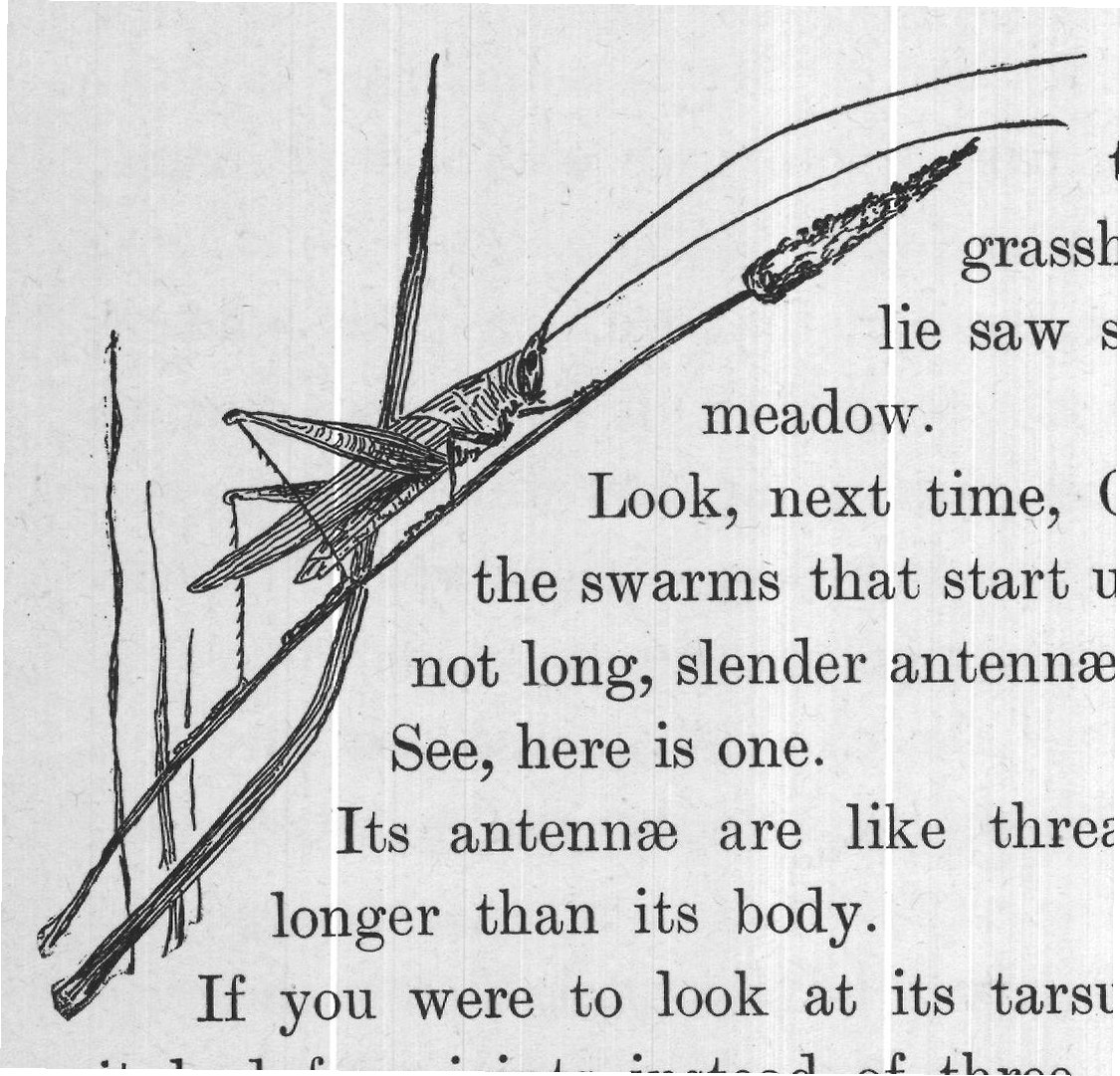
See, here is one.
Its antennæ are like threads, and they are longer than its body.
If you were to look at its tarsus, you would find it had four joints instead of three.
Otherwise, the longhorned, or meadow grasshoppers are very much like the locusts, or shorthorned grasshoppers. John says he thinks the meadow grasshoppers are more slender and delicate in shape.
That is true, as a rule, though there are some species of the locusts that are as slender as the longhorned grasshoppers. But there is one thing about these longhorned fellows that will amuse you. Some of them have ears on their front legs!
It is not uncommon for insects to have hearing organs on their front legs.
You know what an ear is. It is something to hear with. The hearing part of our own ears is way inside, out of sight.
The outer part of the ear, that we can take hold of, is only a sort of funnel to gather up the sound, and we could still hear if this part of our ears were cut off. Way back inside the ear is a little curtain, or eardrum, made of a thin membrane. When sounds enter the ear they cause the eardrum to tremble or vibrate, and this excites the nerve of hearing that is behind the eardrum. Now some grasshoppers have a little flat membrane on the tibia of each front leg. It is an eardrum. Behind it is the nerve of hearing. When sounds --Ear strike the eardrum it vibrates and excites the nerve of hearing.
A So you see the insects have ears, though they have no funnel-like outsides to them.
So, after all, there isn't so very much difference between the way the grasshoppers hear, and the way we hear, although they do hear with their legs.
Yes, Ned, it is about the same thing when they hear with sensitive spots on their antennæ.
The sounds strike the sensitive spots, which are tiny J