Home › The Grasshopper Tribes › The Grasshopper Tribes (Eardrums and cause the nerves)
The Grasshopper Tribes (Eardrums and cause the nerves)
eardrums, and cause the nerves that come to them to hear.
You see, after all, an ear is only a membrane able to vibrate when sounds strike it and a nerve sensitive to those sounds.
It does not matter much where the ear is located.
Our ears are on either side of our head, and so are the ears of all the higher animals.
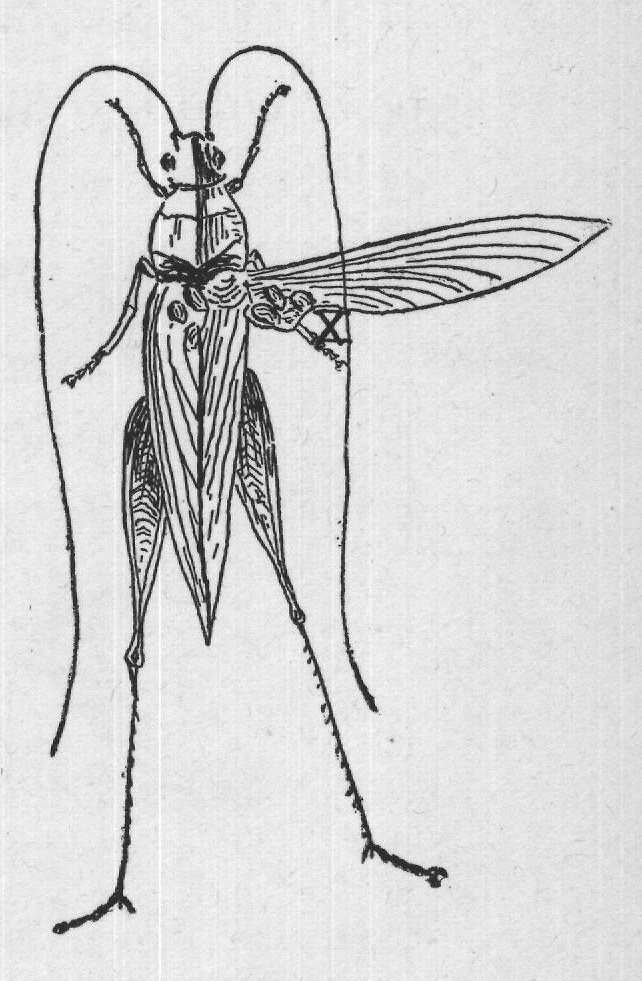
But the ears of the insects are more useful to them when on the antennæ, or the legs, or some have them on the abdomen. An ear is an ear wherever it happens to be, and the insects hear well enough with theirs.. In many species of the longhorned grasshoppers, the male has a curious musical instrument on his wing covers, close to where they grow from the body.
Little Mr. Grasshopper sings to his lady-love by rubbing the upper parts of the wing covers together. You see the round places at X, - those are the modified parts of the wing cover, by means of which he can make his music.
What is that, May? Your grasshopper has a long sword at the end of its body?
Yes, that is its ovipositor. Ovipositor means " eggplacer." With this long, sharp ovipositor the grasshopper can roughen the bark of twigs or make holes in the stems of plants or in the earth.
Then the eggs are guided down through the long ovipositor to the place prepared for them, and fastened there by a gummy substance.
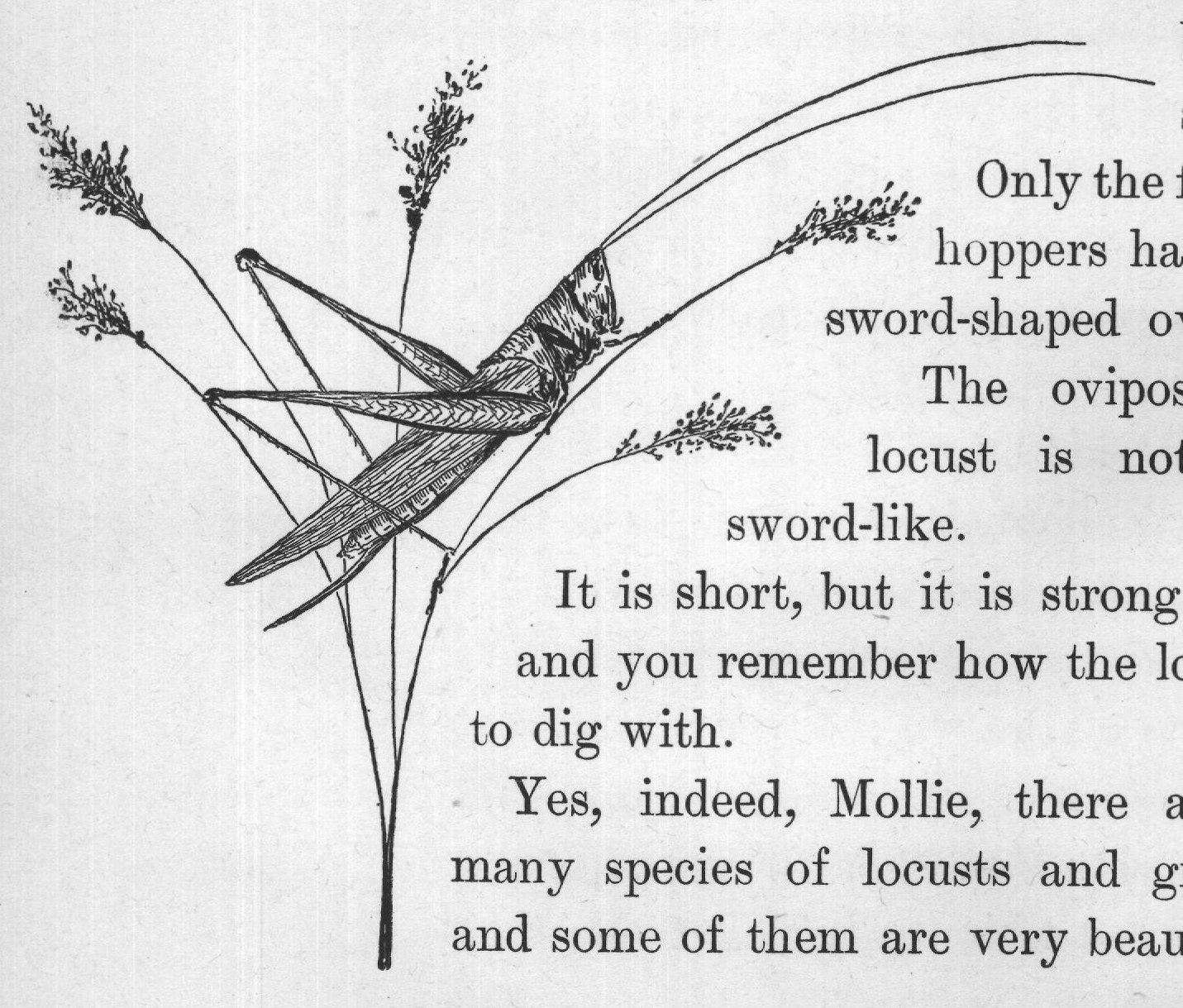
Only the female grasshoppers have the long, sword-shaped ovipositor.
The ovipositor of the locust is not long and sword-like.
It is short, but it is strong and sharp, and you remember how the locust uses it to dig with.
Yes, indeed, Mollie, there are a great many species of locusts and grasshoppers, and some of them are very beautiful.
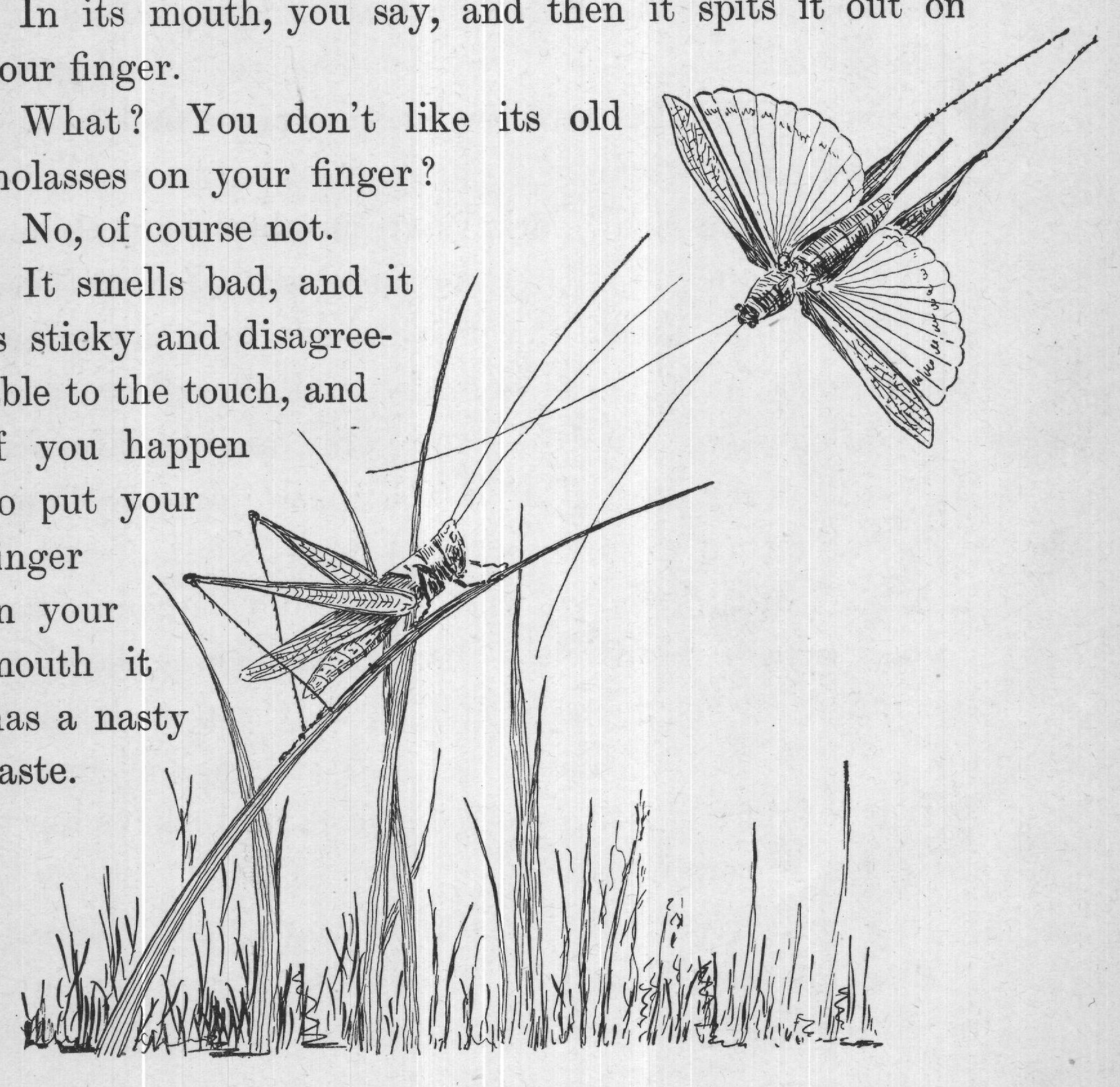
In hot countries they sometimes grow to an enormous size. May is asking why they make molasses.
No, Ned, of course it isn't molasses. Children call it molasses because it looks like it.
Now, May, where does it make its molasses?
In its mouth, you say, and then it spits it out on your finger.
What? You don't like its old molasses on your finger?
No, of course not.
It smells bad, and it is sticky and disagreeable to the touch, and if you happen to put your finger in your mouth it has a nasty taste. 3 John says he hates to touch the grasshopper on account of this molasses.
You all do?
Well, I guess that is why it makes its molasses; it doesn't want you to touch it.
It doesn't want birds to eat it, or other insects to bother it, and so it smears them with this ill-smelling, sticky liquid.
Some birds eat it, however, in spite of its molasses. Turkeys do.
What is that, Ned? turkeys are not birds, you think? What are they?
If you think about it, you will have to come to the conclusion that turkeys are birds.
Then chickens and ducks and geese must be birds ?
Well, so they are. They are all birds.
But to return to turkeys.
A flock of turkeys will spread out in a long line, and go across a field, driving the grasshoppers ahead of them, and eating them as fast as they can pick them up.
It is a funny sight to see a big flock of turkeys hunting grasshoppers in a meadow. It is not funny to the grasshoppers, though.
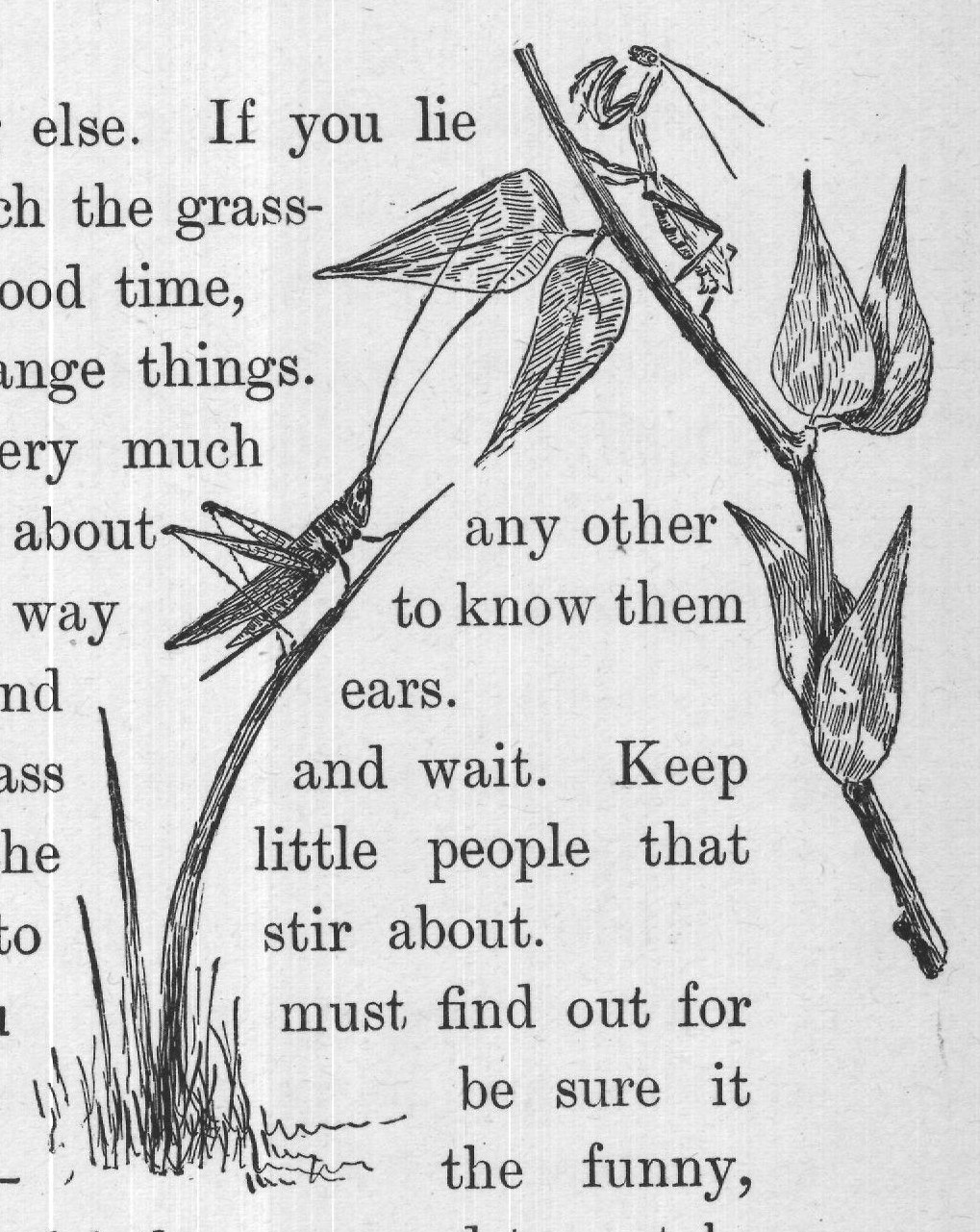
What is that, Charlie? The grasshopper somehow reminds you of the praying mantis?
Do you know it is a near relative of the mantis?
Now, I will tell you something funny about the mantis.
It makes "molasses" like the grasshopper. Yes, it is this harmless "molasses" that has given it the name of "mule-killer."
I will tell you something else. If you lie down in the grass and watch the grasshoppers, you will have a good time, and you will see some strange things.
Nobody can tell you very much about the grasshoppers - or about living creature. The best way is to use your own eyes and Just lie down in the grass perfectly still, and soon the live in the grass will begin to What they will do you yourselves; but you may will be worth finding out, any other to know them ears. and wait. Keep little people that stir about. must find out for be sure it the funny, clever, wise little people! - ah! they are good to watch. They will soon go on chirping and shrilling and rasping and kricking and tapping and whizzing and whirring and buzzing all about you; and if you listen sharp, perhaps you can understand some of the things they say.
And this I am sure of; if you really watch and listen, you can learn to know the different insects by their sounds, just as you can know the birds by their songs. You can even tell whether you are listening to the meadow grasshopper, or the locust.
If I thought you were not tired of hearing how grasshoppers are made, I should tell you some more.
John says he would like to know some more.
Well, then, I will tell you about their rings.
You can see the rings of the grasshopper people very plainly in their abdomens. 10 10 9876543 1 2 9 8765432 ८ Here is a picture of a grasshopper. It is not all drawn. The legs and wings are not shown, and the abdomen is drawn by itself so you can see it easily. There are ten rings, you see.
The rings are covered with a hard, horny substance.
This horny substance is what makes the body of the insect so stiff. It would be soft but for the chitin, as the horny substance is called.
It is better for the insect to have a chitinous covering. If you had no bones, you would be glad to have your skin hardened with chitin.
You see how it is, you wear your skeleton inside.
Your skeleton is of bones; it is an inside skeleton. The grasshoppers and all the insects wear their skeleton outside. It is made of chitin; it is an outside skeleton.
Insects have no bones.
They do not need any. They are kept stiff by the chitin.
Each ring in the insect's abdomen is made of four pieces, the back piece, the side pieces, and the under piece. You can see the back piece and one side piece in the picture, but you cannot see the other side piece nor the under piece without turning the insect over.
The rings are made in pieces so the insect can move. Suppose each ring were made of one stiff piece like a finger ring. What a poor stiff, old grasshopper it would be! The rings are called segments.
Segment number one has only a back piece, you see.
All the other segments have four pieces.