Home › The Grasshopper Tribes › The Grasshopper Tribes: John (Says he has heard there)
The Grasshopper Tribes: John (Says he has heard there)
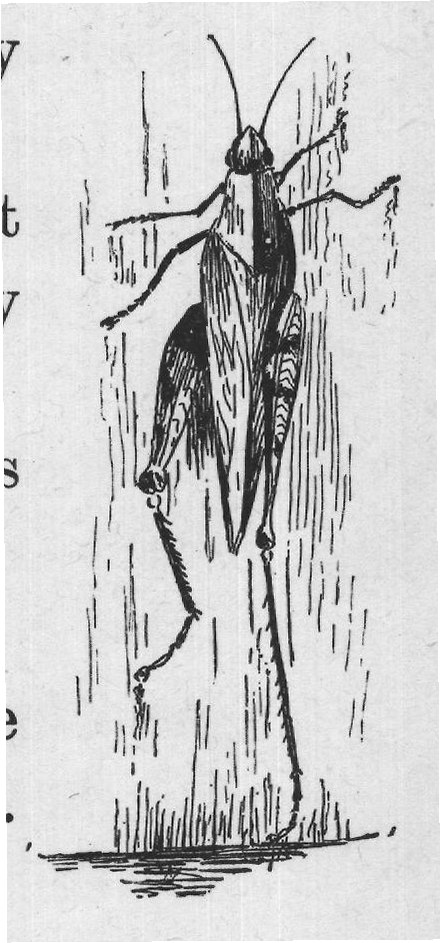
John says he has heard there is little pad in the fly's foot that enables it to walk on glass.
Yes, and it is the same with the grasshopper.
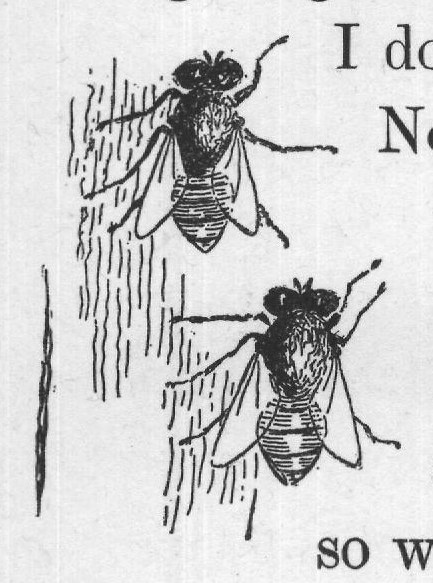
The little pad between the claws is fringed with hairs. You can see them with a good magnifying glass.
Out of the tip of each hair comes a little drop of sticky liquid.
This fastens the foot to any smooth surface.
Many insects have these sticky hairs on their foot pads.
When a fly walks up a window pane, it does it by gluing its feet, one after the other, to the glass.
I don't wonder you laugh.
No, Mollie, the glue does not harden and hold it fast.
The fly can easily pull its foot loose.
The grasshopper cannot walk on glass quite as well as the fly. Its foot pads do not cling so well.
Would you not like to know the name of these curious little foot pads? We call the foot pad a pulvillus.
Some insects do not have sticky nairs on the pulvillus. There are beetles that simply put the pulvillus so flat against a smooth surface that it stays there by the pressure of the air above.
Some people think that is the way the pulvillus on the fly's foot acts.
Perhaps it acts both ways, sucking fast and sticking by hairs.
John wants to know if the beetle's pulvillus does not act just like the "sucker" that boys make.
The sucker, you know, is a round piece of leather with a string attached to the middle.
When the leather is wet and laid flat on the floor or on a smooth stone, all the air below it is pushed out, and the air above presses so hard that a boy cannot pull the leather up from the floor.
You can peel it up from one edge and let the air under easily enough, and then a baby could lift it.
When the insect wants to move, it peels its foot loose.
It can do this very quickly.
Mollie wants to know what all these little sharp spines on the back of the tibia are for.
Let us look at them.
There is a double row of them.
Do they not look a little like a comb?
I suspect that is what they are, the grasshopper's comb.
Insects are very neat little folks.
They are always cleaning their wings and their legs and their antennæ and their bodies.
The spines on their legs are very convenient for that. Charlie says he thinks the grasshopper's legs are as good as a whole box of tools. do.
So they are, and you have not yet heard all they can The funniest is to come.
Mr. Grasshopper sings his song with his hind legs!
He rubs the inside of his femurs against the outside of his wings.
There is a row of very fine spines down the inside of the femur for the use of the little fiddler.
He scrapes away with these on his wing covers.
Yes, Ned, his femur is his violin bow, and his wing cover is his violin.
The noise he makes does not sound much like a violin, little Nell thinks. No, indeed, it does not.
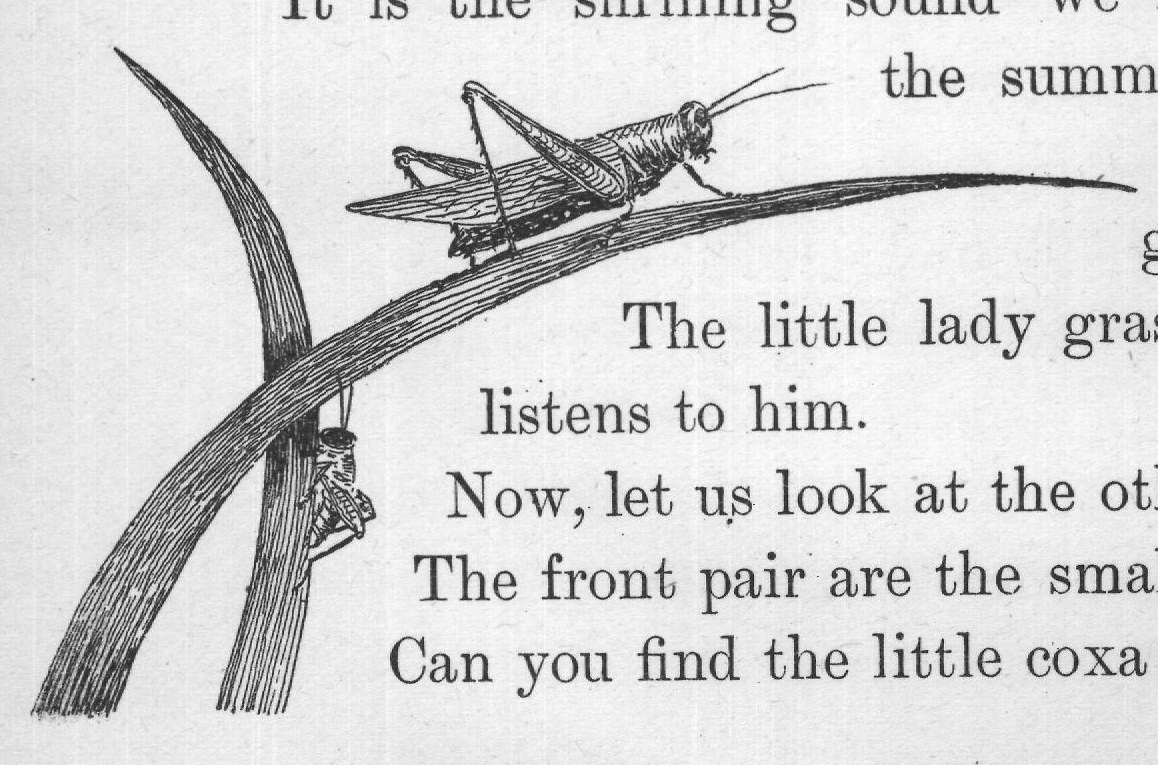
It is the shrilling sound we hear in the grass in the summer time.
It is only the male grasshopper that sings.
The little lady grasshopper sits still and listens to him.
Now, let us look at the other legs.
The front pair are the smallest.
Can you find the little coxa and trochanter ?
Yes, Charlie, we will draw the little front leg.
Let us number the segments as we did those of the hind leg.
V III II See, the femur is larger than the other segments, but it is small as compared to the femur of the hind leg.
The tibia is shorter, too, than the tibia of the hind The little tarsus is like the tarsus of the hind leg with its claws and its pulvillus, only, of course, it is smaller.
The middle pair of legs is like the front pair, only larger.
Now, see how the legs are placed on the grasshopper's body.
The front pair are directed forward. When the insect walks, they pull.
The middle and hind legs are directed backward.
When the insect walks, they push.
Well, little legs, you all have your own work to do, and you surely do it very well.
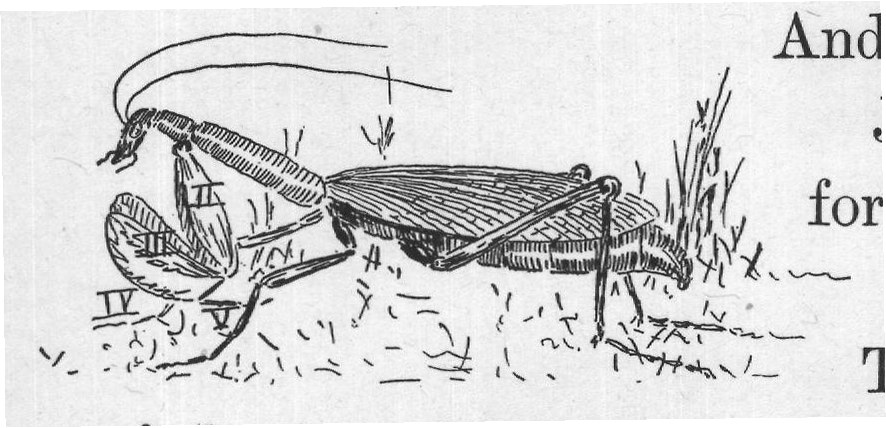
Let me see, who has front legs as odd as the grasshopper's hind legs. Yes, Mollie, the mantis has.
Let us look again at the mantis.
Here is another picture of it.
Its hind legs are just common walking legs, you see. And so are its middle legs.
John says they are directed forward instead of backward.
You can see why.
They have to take the place of the front legs, that do not touch the ground at all. They have to hold Mr. Mantis up, and pull him along when he wants to walk.
Now, let us see if we can make anything out of these front legs.
The coxa is small and close to the body.
The trochanter, II, is very large and long.
Yes, Charlie, it increases the size and strength of the leg very greatly, by being thus enlarged.
The femur, III, is large and strong, too, and it has a row of sharp, spiny teeth down the inside.
The tibia, IV, is also well supplied with cruel teeth, and at the end of it is the tarsus, as you see.
You know how the mantis uses these legs. The joint between the tibia and femur is a strong hinge joint. It can shut the tibia close to the femur, the spiny teeth of the one locking into the spiny teeth of the other, and forming a terrible trap for the insects that are so unfortunate as to get caught in its merciless grip.
Altogether, you see, it is quite a terrible leg, though it has no more segments than a common leg.
The segments are changed in shape and size from the regular leg segments.
When any part is changed from the regular shape or size, we say it is modified.
The front legs of the mantis are modified to catch and hold its prey.
Yes, John, the hind legs of the grasshopper are modified too. They are modified to jump with.
Ned says he didn't know there was so much to learn about a little thing like an insect's leg.
Yes, indeed, there is a great deal to learn about all living things.
I wonder how you would like to look at the grasshopper's wings for a little while.
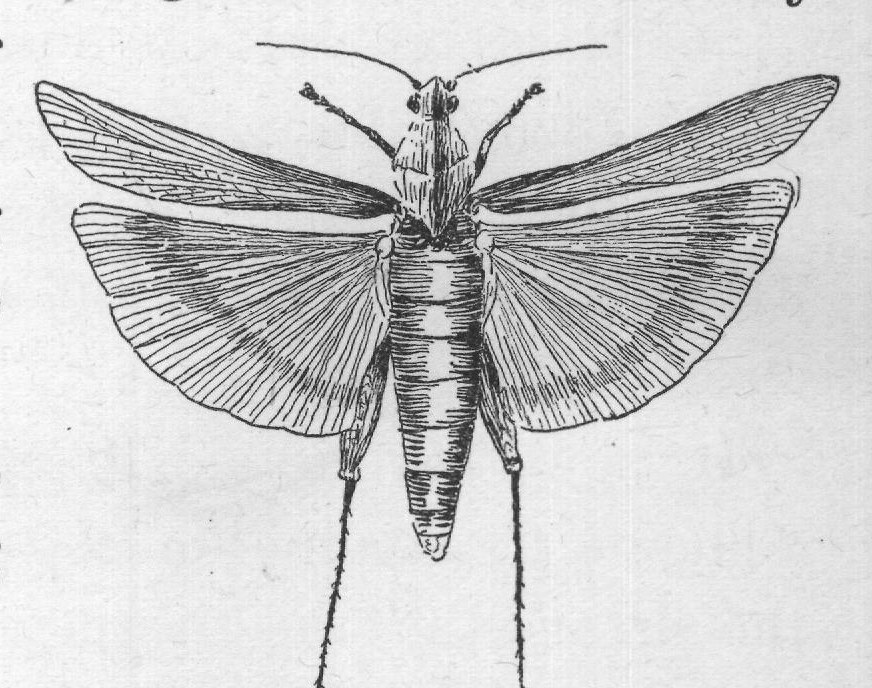
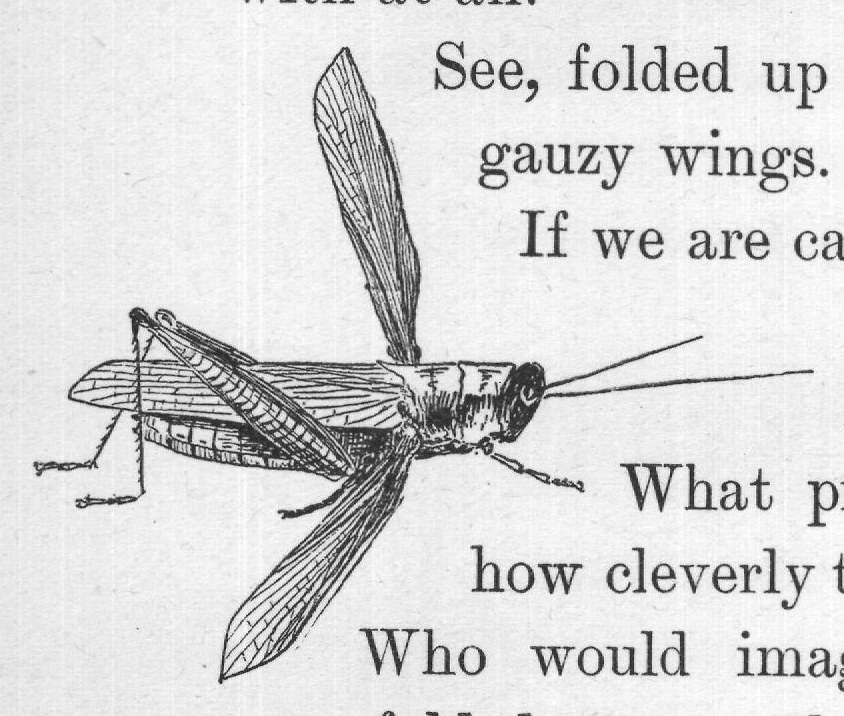
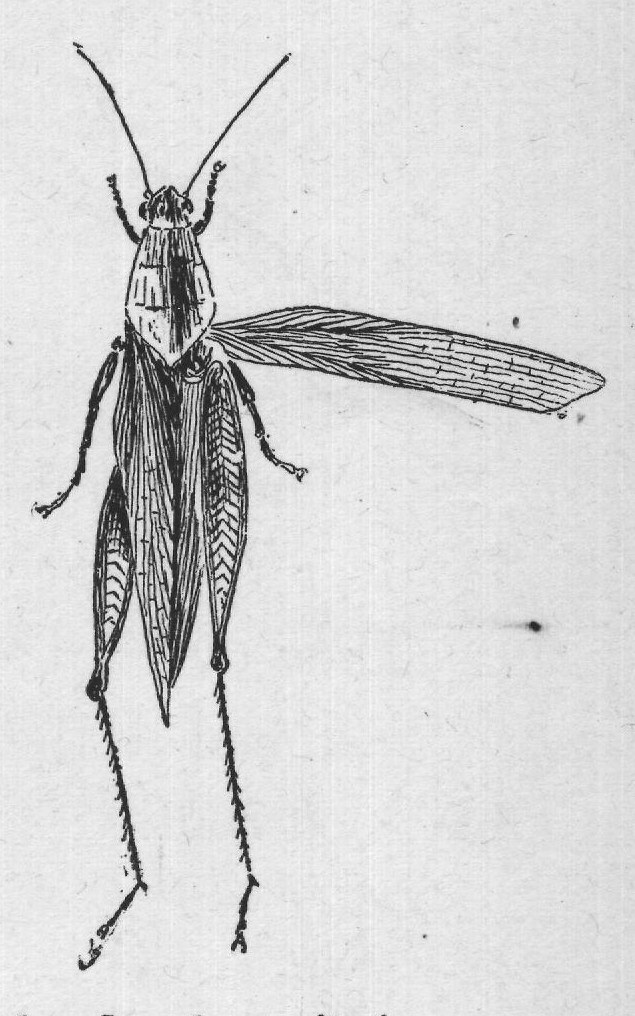
Here is one with large wings. ५५ See how they lie along each side of the body.
They come together on top like the ridge of a sloping house roof.
Yes, May, they are the roof to the grasshopper's body, and they help to protect it.
Let us gently spread them out.
Ah! these roof wings are not what the locust flies with at all.
See, folded up under them is a pair of delicate gauzy wings.
If we are careful, we can spread them out.
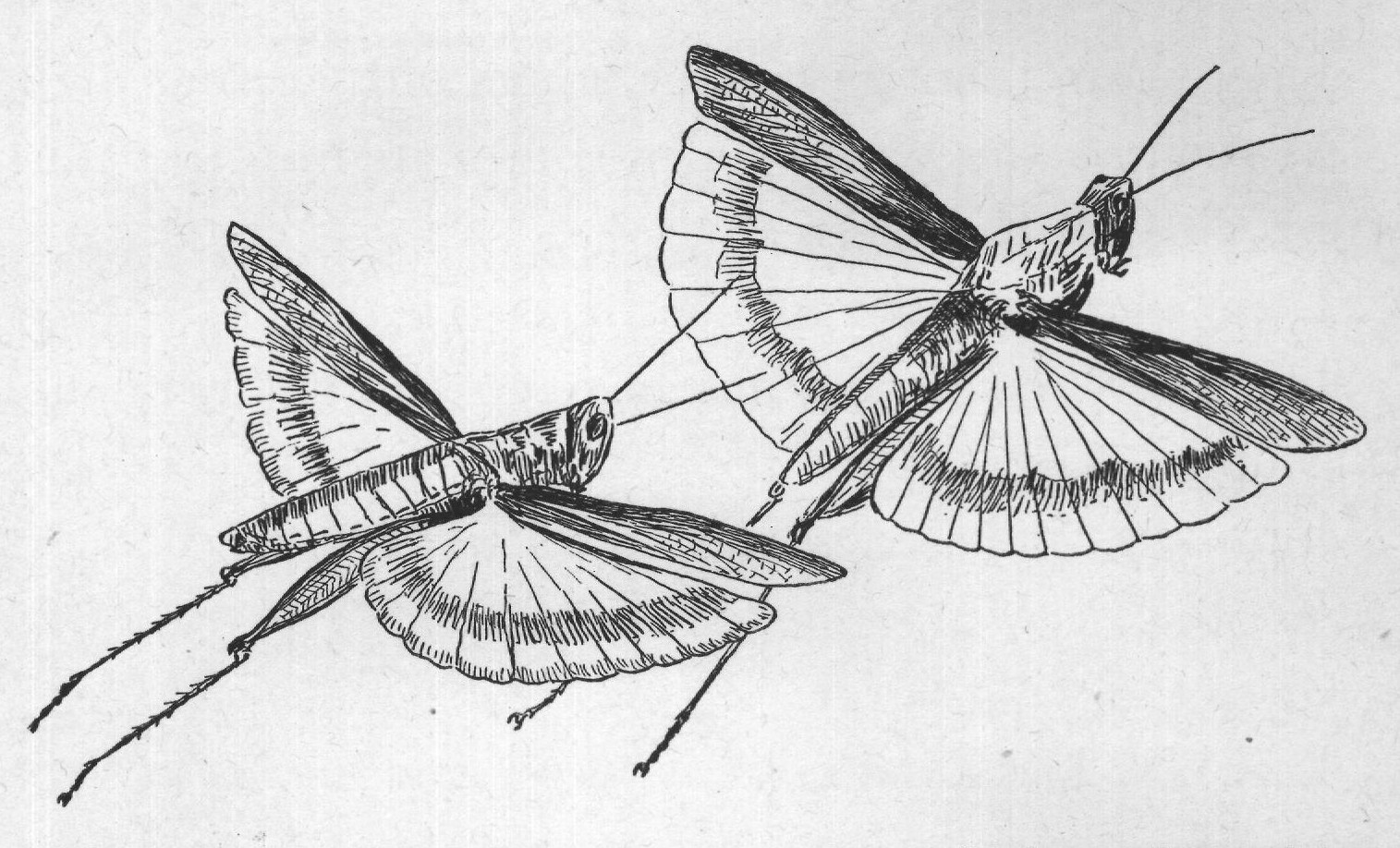
We will use this dead grasshopper that Charlie has found. What pretty wings! So dainty! And how cleverly they are folded up, like little fans.
Who would imagine such delicate gauzy wings were folded away under the hard, stiff roof wings.
The roof wings are called wing covers, because they cover up these pretty inner wings.
The locust does not fly with the wing covers.
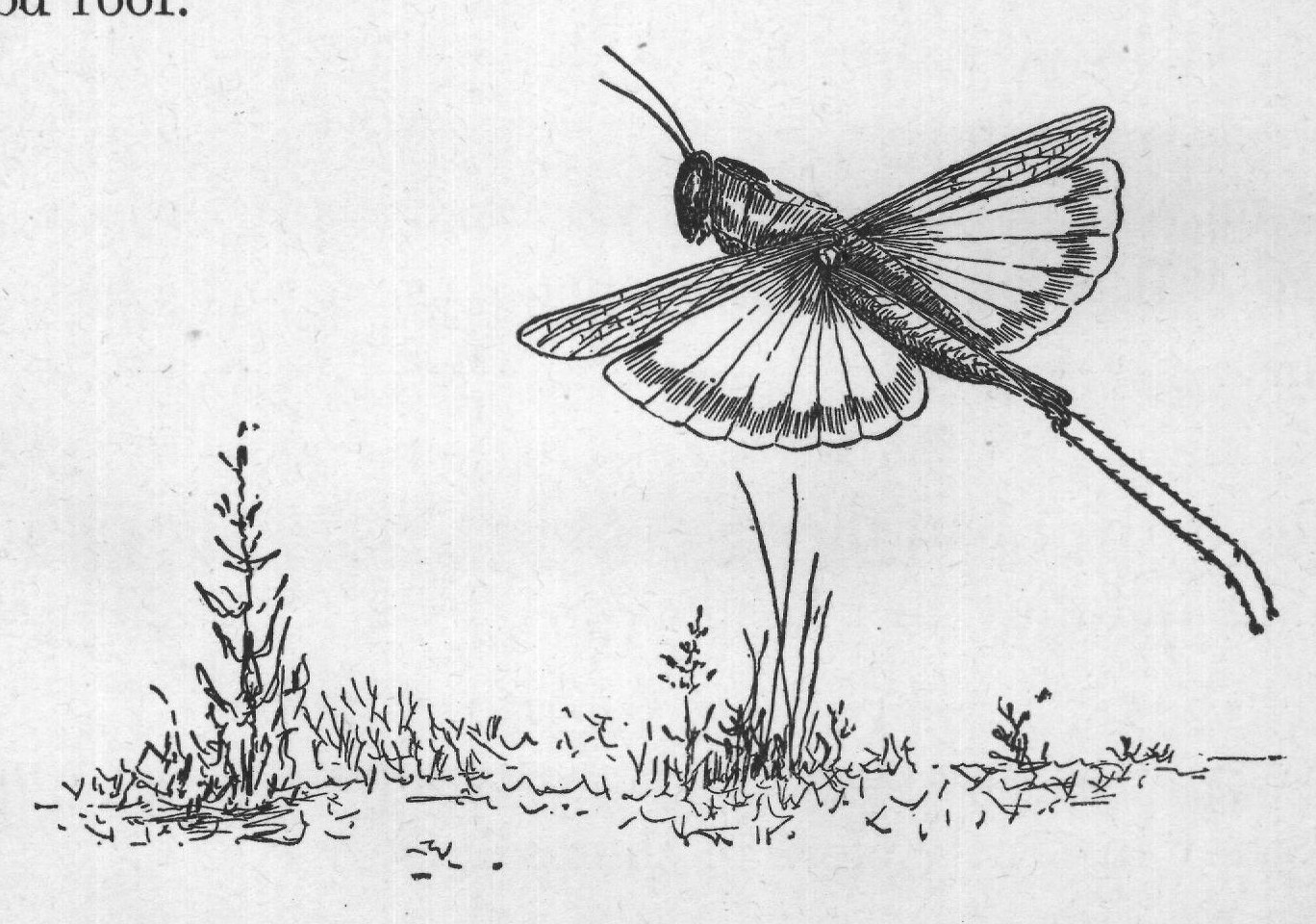
It spreads them out wide to get them out of the way. It flies with the inner wings.
How pretty the flying wings are when they are spread out!
See, over there goes a grasshopper whose flying wings are bright yellow.
And there goes another with red flying wings.
Some of the grasshoppers are almost as pretty as butterflies when they are flying.
They show their gay inner wings only during flight.
As soon as the grasshopper comes to rest the inner wings close of themselves.
The wing joints act like springs.
The grasshopper does not have to think about shutting up its wings. John says it has a spring in its wing covers too.
Open the wing cover.
There, it locks itself, as it were, and stays open without any effort on the part of the grasshopper.
You see the grasshopper wants its wing covers to stay open and out of the way of the inner wings when it flies.
So it just opens them, and there they are.
It moves the inner wings very fast indeed when it is flying. It would not do at all for them to be fastened open.
If it did not move them, it could not fly. The wings fairly whirr, they go so fast. They beat against the air, and thus the grasshopper is pushed along through the air.
As soon as it is done flying it stops moving the wings, and they instantly close of themselves.
Then it unlocks the wing covers and they shut down over the inner wings. They shut down very tightly.
They overlap, as you can see, just below where they are fastened to the insect's body. Thus they form a very good roof.
What wonderful wings the grasshopper has!
And there is something more to be said about them.
Some species of locusts use their wings as musical instruments. When they wish to, they rub the upper end of the inner wings against the upper end of the wing covers when they are flying.
This makes the crackling sound we sometimes hear when the locusts fly.
What is that, Mollie? You have caught a locust that has no wings at all?
Who can guess why?
Ah, yes, our wise John says he thinks it is because it is a young one.
What makes you think so, John?
I know, you remembered the larva of the dragon fly and of the May fly.
Those larvæ had no wings at first, but the wings grew, and finally at the last moult they were full-sized. When first hatched, the locust larva is like the fullgrown locust, only, of course, it is very small, and it has no wings at all.
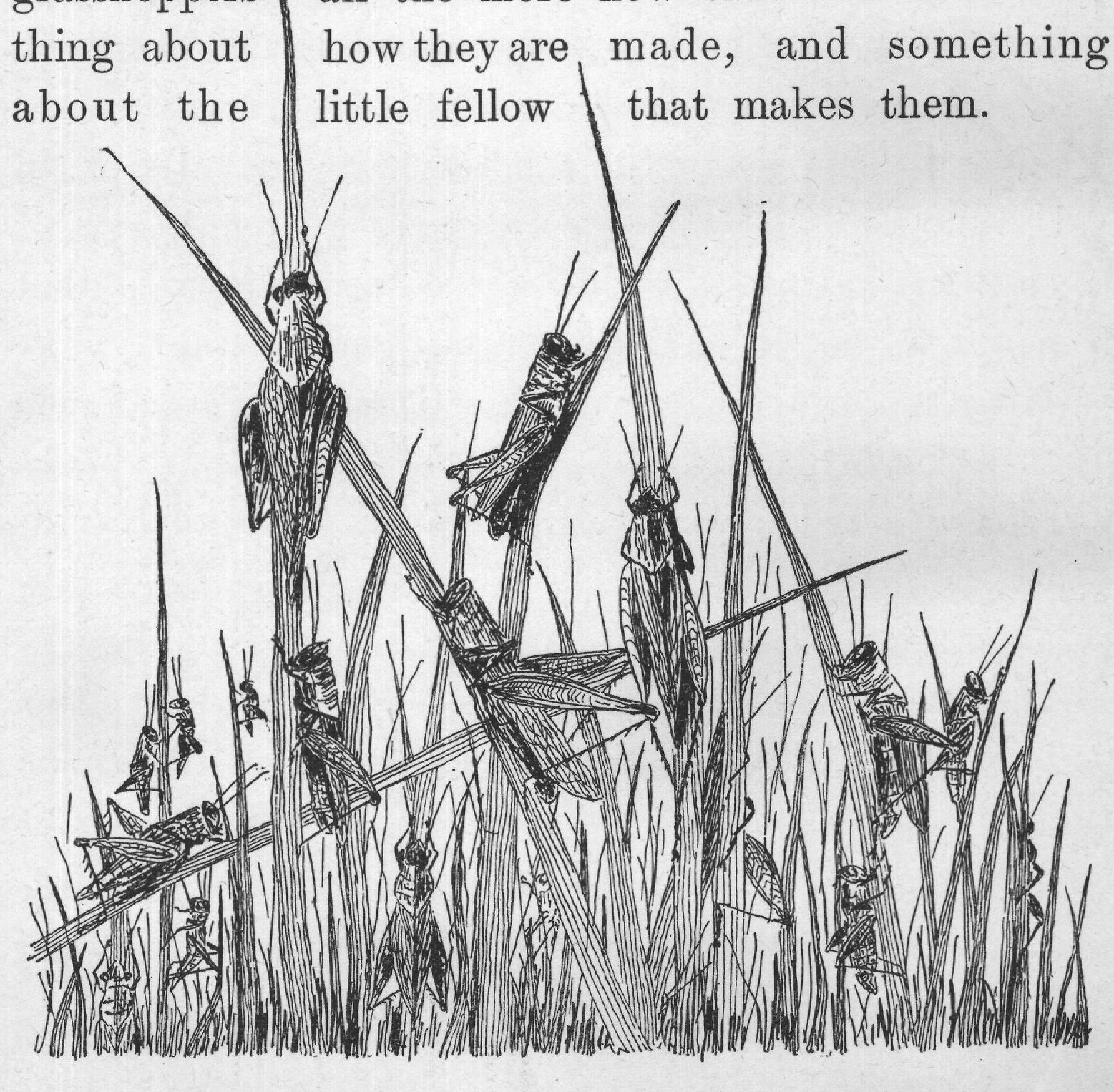
It is a little dot of a thing with an enormous head. Here are three clinging to a blade of grass.
Are they not funny little rascals !
The baby locust eats and grows and moults until, finally, the wings begin to show as little pads at its sides. It is easy to find these half-grown grasshoppers in the middle of the summer. Here is one that little Nell has caught.
See its wing pads.
Mollie says they are rudimentary wings. - It continues to eat and grow and moult, and the little wings are moulted off with the rest of the skin for the wings of the insect are only modified parts of the skin.
But there are new and larger wings underneath, and these grow and are moulted off with the next skin, until, at last, the grasshopper is full-grown, with full-grown wings.
It will not moult any more after that.
When full-grown, the females lay their eggs.
Where do you suppose they lay their eggs?
Some of them make a hole in the ground.
The end of the abdomen is very strong and sharp, and the locust can make a hole with it quite easily. When the hole is made, then the eggs are laid in it, and the locust covers the opening to the hole with a sticky substance to keep out the wet.
The eggs usually lie in the ground all winter.
Eggs Just think of the locust eggs there are under our feet as we cross the fields!
Millions and millions of little eggs are hidden in the ground.
Early in the next summer the little eggs hatch, and then tiny locusts creep up out of the earth and go hopping about everywhere.
Most of the full-grown locusts die in the fall.
As you know, the young ones have no wings, and this is why there are so few winged locusts early in the summer.
Some locusts make their holes in fence rails or in old stumps.
It is the locusts, or shorthorned grasshoppers, that sometimes come in swarms that darken the sun.
There is nothing the Western farmer dreads so much as a swarm of locusts.
I have heard how the grasshoppers came in Kansas one year.
They appeared all of a sudden in countless millions. They were piled up against the fences clear to the top. They swarmed into the houses, and in places on the railroad track they were piled so deep the trains could not run through them.
Think of a railway train being stopped by grasshoppers! They stripped every leaf from the trees and left them as bare as in winter.
They ate up every blade of grass.
But in the East they do not do so much damage, though they sometimes cause the farmers serious loss. When summer comes we may listen to their cheery din with pleasure.
I am sure we shall enjoy the merry sounds of the grasshoppers all the more now that we know something about made, and something that makes them. about the how they are little fellow 5