Home › The Grasshopper Tribes › The Grasshopper Tribes: Charlie
The Grasshopper Tribes: Charlie
Charlie says we are taking a good deal of trouble over the hind legs of a grasshopper.
Very true, Mr. Philosopher, but let me tell you something.
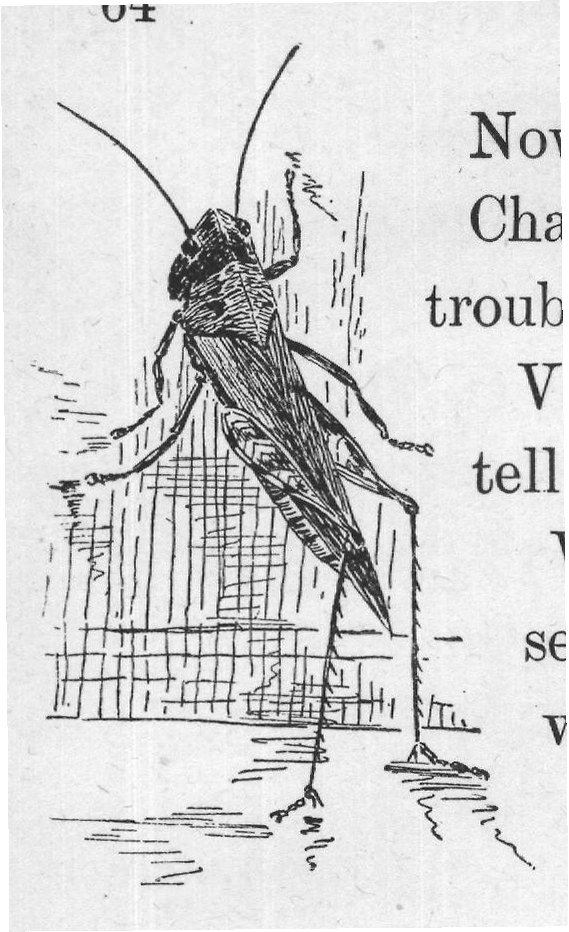
When we have learned the names of the segments in the grasshopper's hind leg, we have learned the names of the segments in the legs of all insects. You see all the legs are made on one common plan, and it is very convenient, as you will soon see, to have the parts named.
What a fine set of drawings of the grasshopper's hind leg we have!
Why do you suppose the coxa and trochanter are so small?
Yes, John, it is in order that the leg can move easily.
The grasshopper can turn its leg in almost any direction because of these small upper segments. It can put its leg up over its head if it wants to.
Next to the little coxa and trochanter is the longest and largest segment in the grasshopper's leg; I suppose. nobody remembers its name.
Listen to little Nell, "number three the femur stands."
So it does, and what a very useful femur it is!
If it were not for the long femur and the long, slender tibia, the grasshopper would not be a grasshopper - it could not hop at all.
Watch the grasshopper, and see how he uses those long segments to jump with.
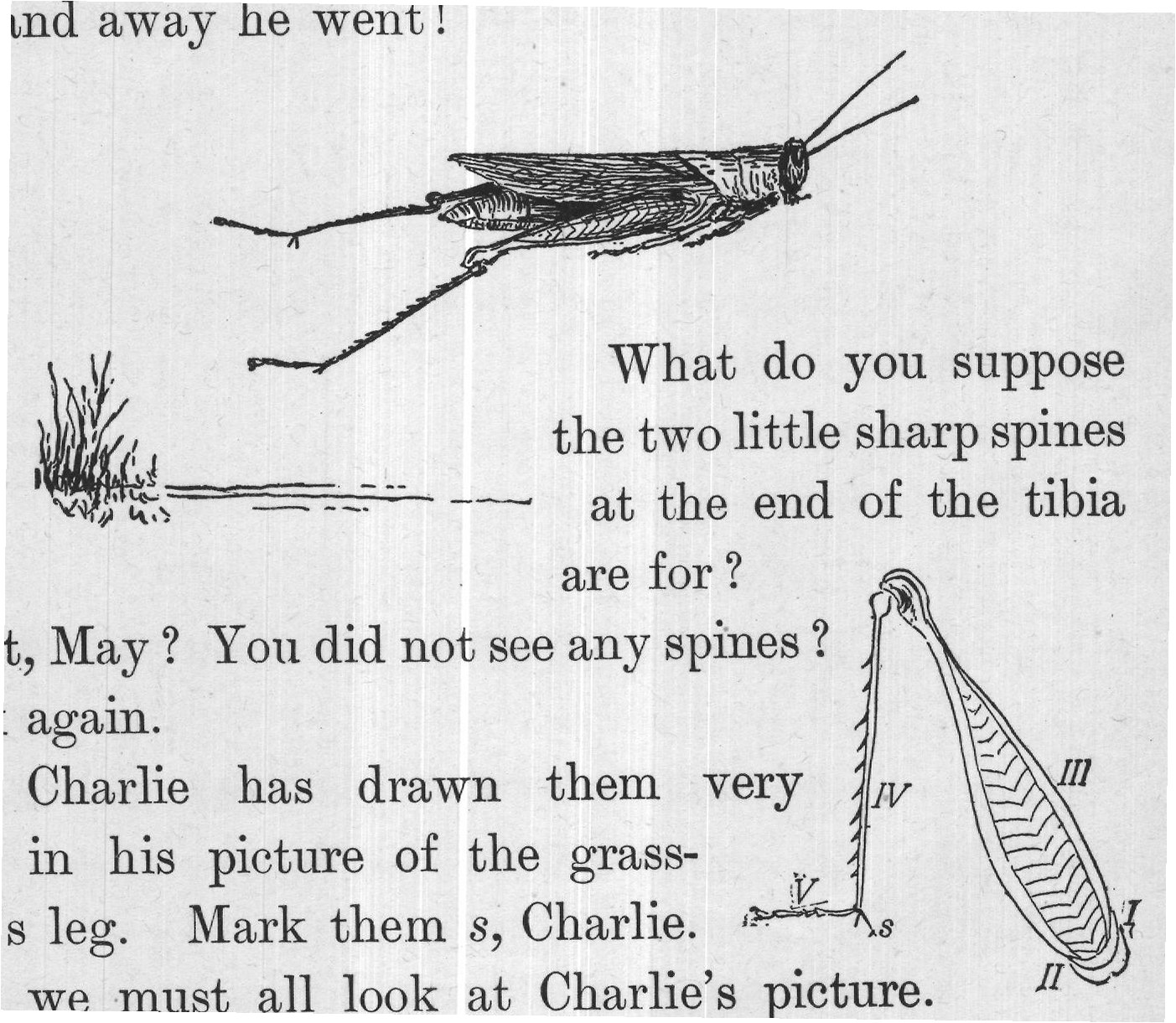
First he draws the tibia close up to the femur he is off! - now He just straightened those long hind legs out with a jerk, and away he went!
What do you suppose the two little sharp spines at the end of the tibia are for?
What, May? You did not see any spines?
Look again.
See, Charlie has drawn them very IM IV S plainly in his picture of the grasshopper's leg. Mark them s, Charlie. Now we must all look at Charlie's picture.
He says he thinks he knows what the spines are for - they are to keep the grasshopper from slipping when he makes his leap forward.
I have no doubt Charlie is right.
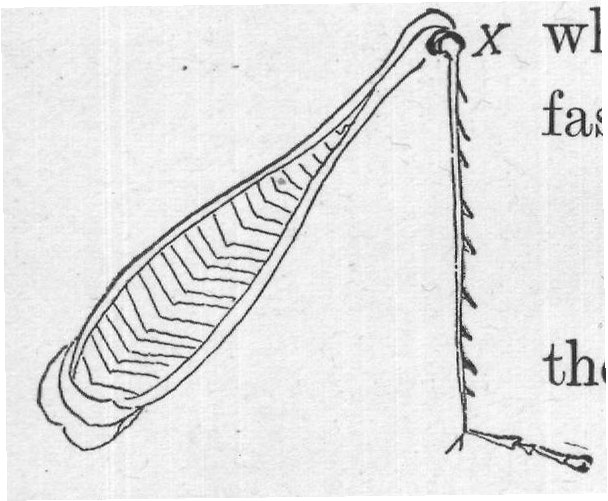
May wants us to look at the beautiful little hinge x where the femur and the tibia are fastened together.
Let us mark it X.
See the little ball on the end of the tibia. How well it fits into the hollow on the end of the femur.
In order to see this hollow or groove, you must look on the under side of the leg.
Yes, John, it reminds us of the ball-and-socket joint, only this is a hinge joint, and does not move in so many directions.
The tibia can move towards the femur and away from it on this hinge.
When our little friend gets ready to jump, he draws the tibia close up to the femur. When he jumps, he pushes the femur quickly away from the tibia.
If you watch the grasshoppers, you will soon understand just how they use their hind legs in jumping. The tarsus bends easily.
It has three joints.
The last segment is a cunning little foot.
What is John doing?
He is looking at the grasshopper's foot through the magnifying glass. Wise John!
Let us all look.
Yes, Charlie, we will try to draw it.