Home › The Swallow-Tails › The Zebra Swallow-Tail (Iphiclides ajax Iph-i-cli'des)
The Zebra Swallow-Tail (Iphiclides ajax Iph-i-cli'des)
Iphiclides ajax (Iph-i-cli'des a'jax) PLATE V, FIG. I, 2 This butterfly differs from all other swallow-tails found in the eastern half of the United States in having the wings crossed by several bands of greenish white. This is one of the most interesting of our butterflies, as it occurs under three distinct forms, two of which were considered for a long time distinct species. Without taking into account the more minute differences these forms can be separated as follows: (1) The early-spring Form, Iphiclides ajax marcellus (marcel'lus). This form expands from two and six-tenths inches to two and eight-tenths inches; and the tails of the hind wings are about six-tenths inch in length and tipped with white. (Plate V, Fig. 1.) This form was described by Mr.- Edwards under the name walshii and is still often incorrectly so called. (2) The Late-spring Form, Iphiclides ajax telamonides (tela-mon'i-des).- This form is a little larger than marcellus and has tails nearly one-third longer; these tails are bordered with white on each side of the distal half or two-thirds of their length. (3) The Summer Form, Iphiclides ajax ajax. -The summer form is still larger, expanding from three and two-tenths inches to three and one-half inches, and has tails nearly twothirds longer than the early-spring form. (Plate V, Fig. 2.) Owing to an unfortunate error this form is often called marcellus.
The life-history of this species has been carefully worked out by Mr. W. H. Edwards. He has shown that there are several generations each year, and that the winter is passed in the chrysalis state. But the early-spring form and the latespring form are not successive broods; these are both composed of individuals that have wintered as chrysalids, those that emerge early developing into marcellus, and those that emerge later developing into telamonides. All of the butterflies produced from eggs of the same season, and there are several successive broods, are of the summer form, ajax ajax. CATERPILLAR.-Length about two inches. Largest at the third thoracic segment, which is made conspicuous by a wide black velvety band edged with yellow. The rest of the body is pea green with narrow cross bands of yellow and black. Food-plants. Pawpaw, spice bush, and upland huckleberry. This gorgeous butterfly is well named, for its wings are cross-striped in a way that at once suggests a zebra or a tiger. To accentuate the beauty of these colors and markings two purplish-blue crescents ornament the anal angle of the hind wing, and above each there are one or two spots that look like drops of blood; on the lower surface the "blood" trickles across the entire wing. This species responds to the influence of the seasons. The first form to appear in the spring with the peach blossoms is called marcellus; it has the "swallow-tails" of moderate length. The form that appears next is telamonides, which has longer tails; while the form that occurs in midsummer, ajax ajax, has still longer tails, and the 2 Plate V. tips of the front wings are also extended. It is as if summer in a pleasant mood had seized this butterfly by the tips of each pair of wings and stretched them out, making it larger and far more gracefully proportioned than the forms which came from the winter chrysalis. Though it may be more beautiful in form, this later variety, ajax ajax, has almost buried its purple crescents in black and has but one drop of "blood" on the upper surface of each hind wing. It seems to have neglected its colors in order to produce tails an inch long.
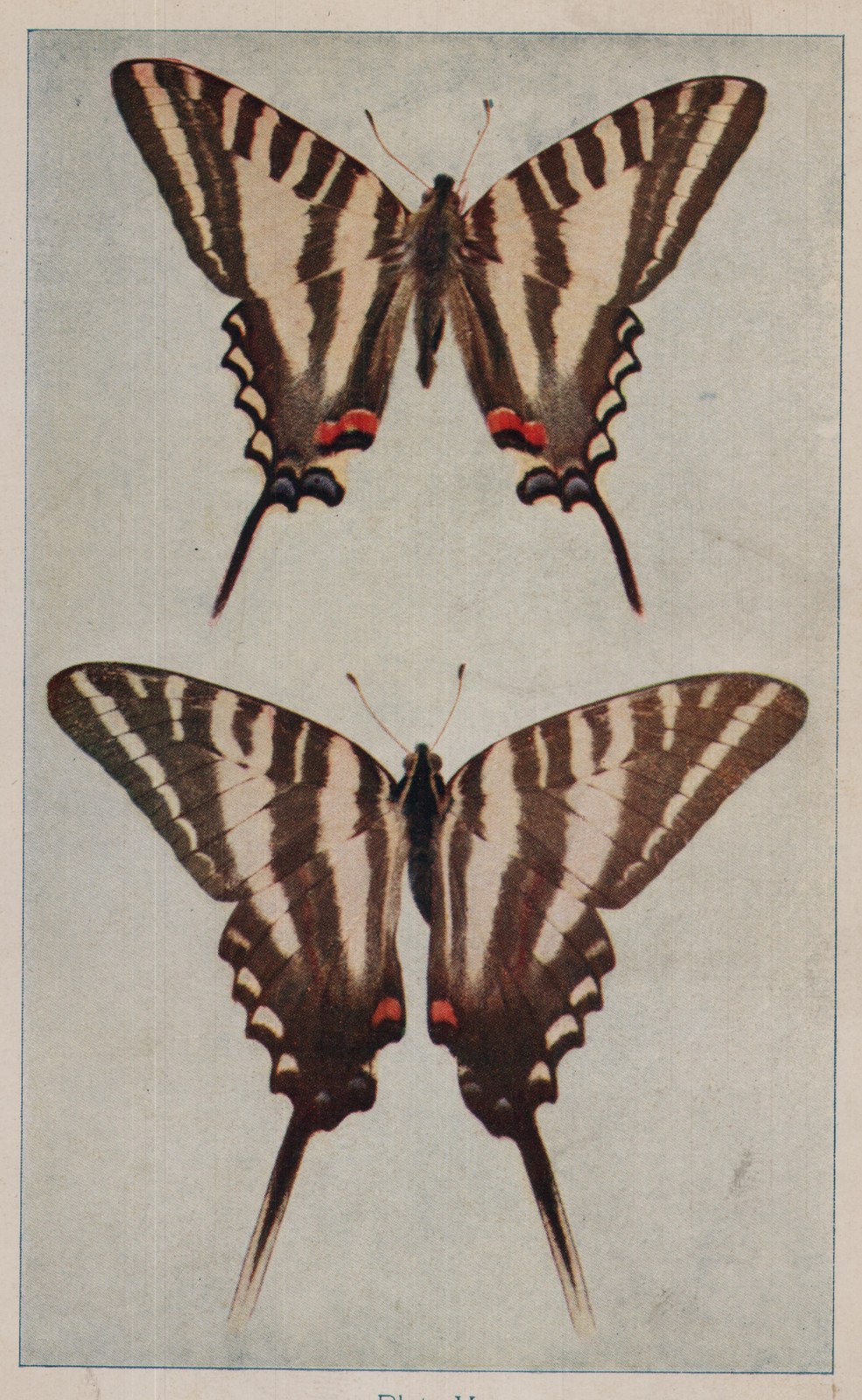
The zebra swallow-tail is common in the southeastern United States. It flies low with much fluttering and is found about low thickets. The caterpillar is well protected by its scent organs, which when protruded give off a sickish odor.
The winter is passed in the chrysalis stage.