Home › The Swallow-Tails › The Giant Swallow-Tail (Papilio thoas Pa-pil'i-o)
The Giant Swallow-Tail (Papilio thoas Pa-pil'i-o)
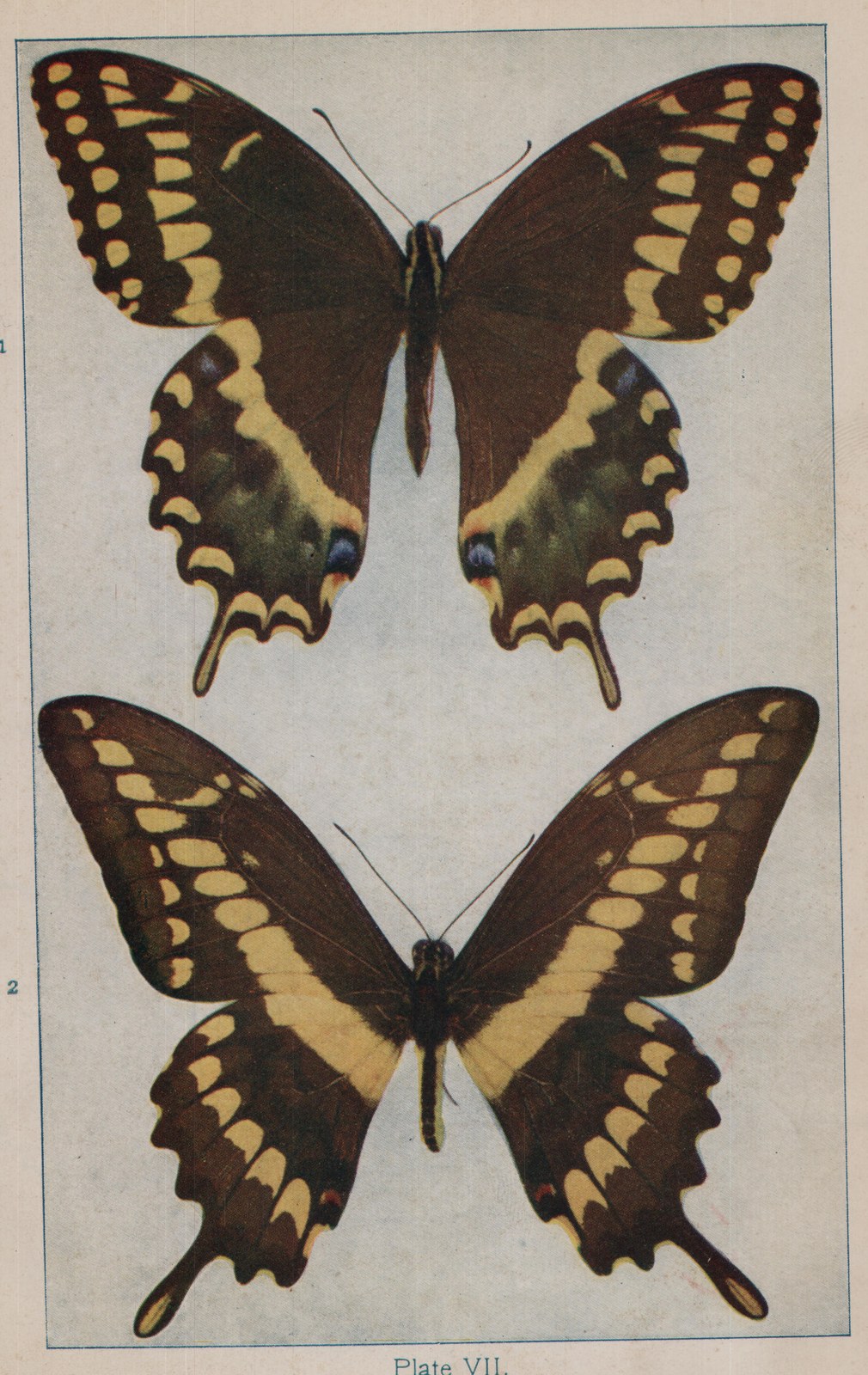
Papilio thoas (Pa-pil'i-o tho'as) PLATE VII, FIG. 2; PLATE VIII This is the largest North American butterfly known, expanding from four inches to five and a half inches. The wings are black above and yellow beneath. The front wings are crossed on the upper side by a row of ten, more or less 2 Plate VII. confluent, yellow spots extending from the apex to the basal half of the inner margin. There is near the base of the hind wings a yellow band, which, when the wings are spread, is continuous with the longitudinal row of spots of the front wings. There is also a row of yellow spots extending from the middle of the longitudinal row on the front wings to near the anal angle of the hind wings.
This species pertains especially to the South; but it appears to be slowly and steadily invading the North. There are four broods of this butterfly in Florida and two at the northern limit of its distribution. This is the species commonly known as Papilio cresphontes; but it was first named thoas by Linnæus.
CATERPILLAR.-Length about two inches. The front part of the body is much expanded. In color it is reddish mottled brown; a saddle at the middle, the two or three rear segments, and the stripes at the side near the front are dirty cream white. There is a row of more or less obscure eyespots across the swollen thoracic segment. Food-plants. Orange and other citrus foliage, rue, prickly ash, Lombardy poplar, and others.
On broad and leisurely wing the giant papilio is invading the North. It is still sufficiently rare in the New England and Middle States, so that there the heart of the butterfly lover stands still when he gets a glimpse of these magnificent black wings crossed with brilliant yellow, wings that look on the under side as if they were lined with some delicate lemon-colored fabric which allows the markings to show through. It is ever an indolent beauty, and loves to settle on flowers and let its wings droop while it luxuriates in a sun bath. When disturbed, no butterfly of them all has a flight so dignified and haughty as that of the giant swallow-tail; it scorns to escape the net by a margin of more than three or four inches.
The caterpillar (Plate VIII) is a most unprepossessing creature in appearance. At best it is an elongated brown and white blotched object pinched in the middle and looking far more like bird-lime than like a thing of life. However, if disturbed it lifts the head and throws out a pair of long orange horns which exhale a stench that renders its immediate neighborhood quite uninhabitable by man or bird. The species is threeor four-brooded in the Southern States, and occurs there in such numbers as to be most destructive to the citrus fruit trees. In the North it feeds upon wild plants; so we here may with a clear conscience give ourselves up to the enjoyment of this largest and most striking butterfly of our fauna. It was taken in New York first in 1864. The first specimen was taken at Ithaca in 1899, and since then a limited number of the butterflies have appeared here each year.
This species is found throughout the United States and in the southern part of Canada.
Owing to an unfortunate mistake this species is commonly known under the specific name asterias.
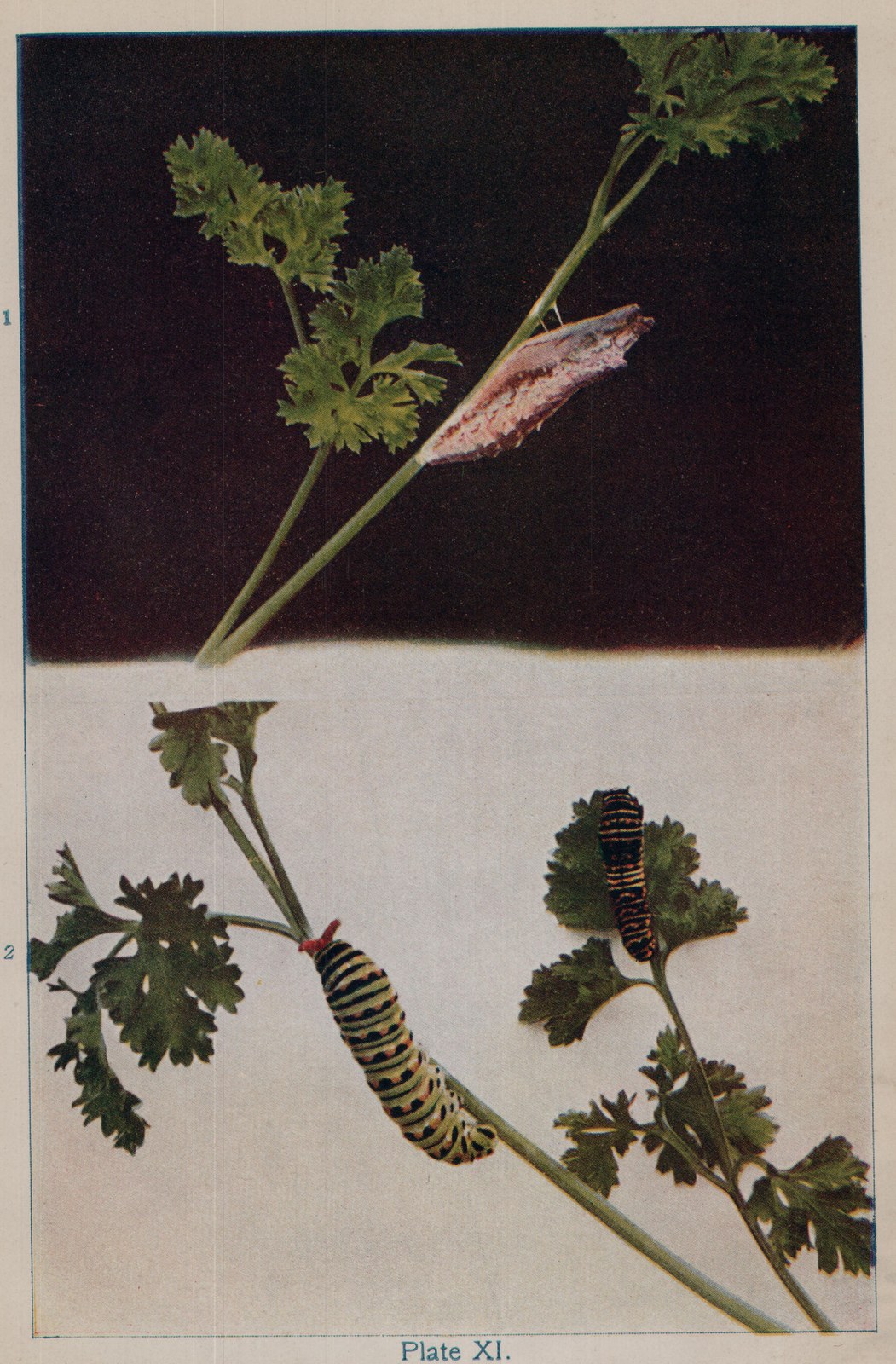
CATERPILLAR. - Length about two inches. In the early stages it is angular and covered with spiny warts; the color is black with a white saddle at the middle. When fully grown it is green and each segment has a black band across it which near its front edge encloses six yellow spots. The scent-horns are orange.
Food-plants. - Parsley, wild carrot, caraway, celery, and other Umbelliferæ.
This graceful butterfly haunts the weedy waysides, the flower beds on lawns, and the kitchen gardens in every state in the Union, though it is found but rarely in the Rocky Mountain region.
The female is more familiar to us than is the male, perhaps because her habits of egg-laying make her bolder when visiting the garden herbs on which her young must feed. Her wings are so much darker and have so much more metallic blue on them than do the yellow banded wings of the male that the two sexes are often regarded as different species by the amateur collector.
When we were children "caraway-worms," as we called the caterpillars that fed on that spicy herb in our backyard, were favorite playmates of ours; at least we played with them, though we have never known how they esteemed us. We watched them by the hour from the time they were little black spiny creatures until they attained the gorgeous green, gold and black velvet costume of mature larvahood. We saw them shed their "dresses" on little silken carpets which they seemed to weave for the purpose. We admired the neat and methodical way in which they trimmed off the caraway leaf, taking a leaflet at a time up one side, and making a "clean job" of it down the other. We poked them with straws to make them push out their orange horns, and we understood that this was an act of defiance; but we never thought of connecting with it the strong, sickening odor of caraway which we often perceived when playing with the caterpillars. Once we saw two large ones marching with slow, dignified tread toward each other on a slender stem; on they came until they were in actual contact and then they drew back spitefully and butted each other like a pair of billy goats; we heard the whacks distinctly three or four times, when both suddenly turned around in a panic and fled in the opposite direction with all possible haste.
The "caraway-worms" were the ones that revealed to us the mystery of the pupa and butterfly. We saw one climb up the side of a house 2 2 Plate XI. and watched it as with many slow, graceful movements of the head it wove for itself the loop of silk which we called the "swing" and which held it in place after it changed to a chrysalis. We wondered why such a brilliant caterpillar should change to such a dull-colored object, almost the color of the clapboard against which it hung.
Then one day we found a damp, crumpled black butterfly hanging to the empty chrysalis skin, its wings "all mussed," as we termed it, and we gazed at it pityingly; but even as we gazed the crumpled wings expanded and then there came to our childish minds a dim realization of the miracle wrought within that little dingy, empty shell. .
In the North this species is double-brooded, and winters as a chrysalis. The adults of the first brood appear in May, those of the second brood about the middle of July.
Thou winged blossom! liberated thing!
What secret tie binds thee to other flowers Still held within the garden's fostering?
Will they, too, soar with the completed hours, Take flight and be like thee Irrevocably free, Hovering at will o'er their parental bowers?