Home › The Swallow-Tails › The Tiger Swallow-Tail (Papilio glaucus Pa-pil'i-o)
The Tiger Swallow-Tail (Papilio glaucus Pa-pil'i-o)
Papilio glaucus (Pa-pil'i-o glau'cus) PLATE VI, FIG. I, 2 In the adult state two distinct forms of this insect occur. These differ so greatly in appearance that they were long considered distinct species. They may be distinguished as follows: (1) The Turnus Form, Papilio glaucus turnus (Plate VI, Fig. 1). The wings are bright straw-yellow above, and pale, faded straw-yellow beneath, with a very broad black outer margin, in which there is a row of yellow spots. On the fore wings there are four black bars, extending back from the costa; the inner one of these crosses the hind wings also. This species is represented by both sexes, and is found in nearly all parts of the United States and Canada. (2) The Glaucus Form, Papilio glaucus glaucus (Plate VI, Fig. 2). In this form the disk of the wings is entirely black, but the black bands of the Turnus form are faintly indicated, especially on the lower surface, by a darker shade. The marginal row of yellow spots is present, and also the orange spots and blue scales of the hind wings. This form is represented only by the female sex, and occurs only in the more southern part of the range of the species, i. e., from Delaware to Montana and southward. In this region both yellow and black females have been reared from eggs produced by a single female.
CATERPILLAR.-Enlarged at the third thoracic segment and about two inches long when fully grown. In color it is deep green, and the enlarged thoracic segment bears on each side a large greenish-yellow spot edged with black enclosing a black streak above and having a pupil of blue bordered with black. The hind edge of the first segment of the abdomen is banded with yellow and the front edge of the next segment is banded with black.
Food-plant.-Birch, poplar, ash, wild cherry, fruit trees, and many other trees and shrubs.
The tiger swallow-tail disports itself on its great yellow wings from the Atlantic to the Pacific and from Canada to the Gulf of Mexico.
And as if to demonstrate that it is truly at home wherever it may be and that it has no race or color prejudice, it has in the South wives that are black. It is a brave flyer and lifts itself easily over houses and trees. It is especially a habitant of the latter; from our upper windows we have watched it fluttering about among the tip-top branches quite as much at home as on the lilac bushes or on the peonies of the lawn. It has a catholic taste in the matter of odor, and is equally devoted to fragrant flowers and to waste matter by no means fragrant. Its especial weakness is tobacco smoke. When fishing in the Adirondacks it was one of the daily diversions of the senior author, while resting to smoke a cigar, to watch the tiger swallow-tails come one by one out of the wilderness and flutter about him with every sign of enjoyment; if he held quite still, they would settle comfortably on his forehead or shoulders a little to the leeward so as to enjoy to the utmost the luxury of a second-hand smoke.
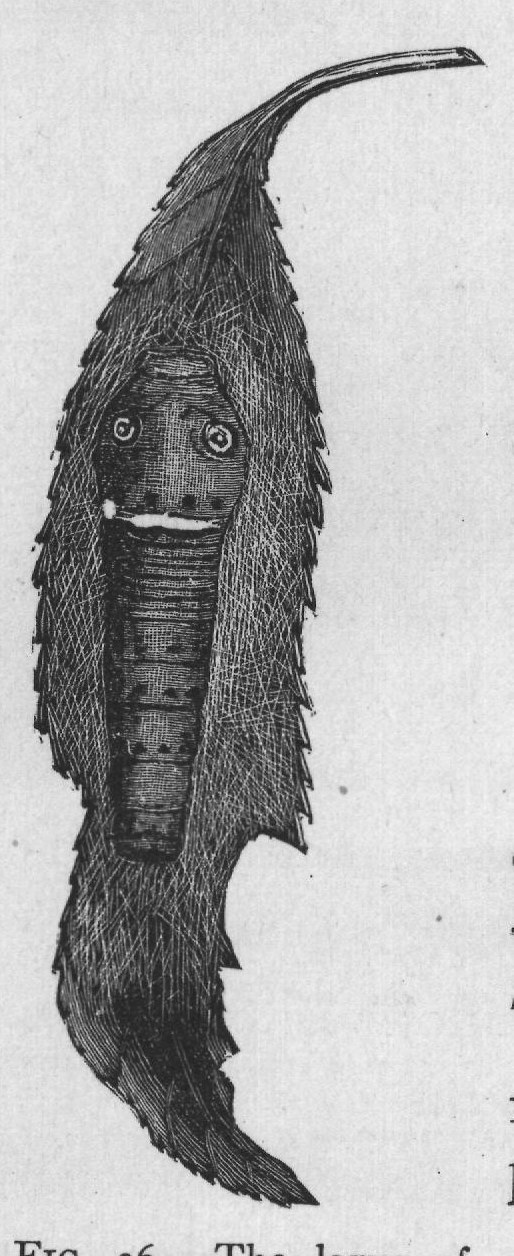
The caterpillar has most interesting ways: it makes at first a silken rug on the leaf where it rests when not feeding (Fig. 26). When fully grown it pulls the edges of the leaf together slightly and weaves a web across, thus making for itself a spring mattress on which to doze; it keeps its bed very clean and never bites into the leaf on which it is spread. That bird would be brave indeed which would touch one of these caterpillars if it simply saw the front end of the body; the thorax with its fierce yellow eye-spots looks like the head of a wicked little green snake; and this deceptive appearance is heightened when the scent organs are shot out forked, like a snake's tongue, while the caterpillar rocks itself to and fro with a most insidious motion.
This false face deceives even the novice in entomology who believes these spots are true eyes, whereas the latter are mere dots on the head of the caterpillar.
FIG. 26. The larva of the tiger swallow-tail upon its bed.
In the far North the tiger swallow-tail is single-brooded; it is double-brooded in New York State and triple-brooded in the Gulf States. It passes the winter as a chrysalis.
Yes! There came floating by Me, who lay floating too, Such a strange butterfly!
Creature as dear as new:
Because the membraned wings So wonderful, so wide, So sun-suffused, were things Like soul and nought beside.
BROWNING.