Home › The Nymphs › The Viceroy (Basilarchia archippus)
The Viceroy (Basilarchia archippus)
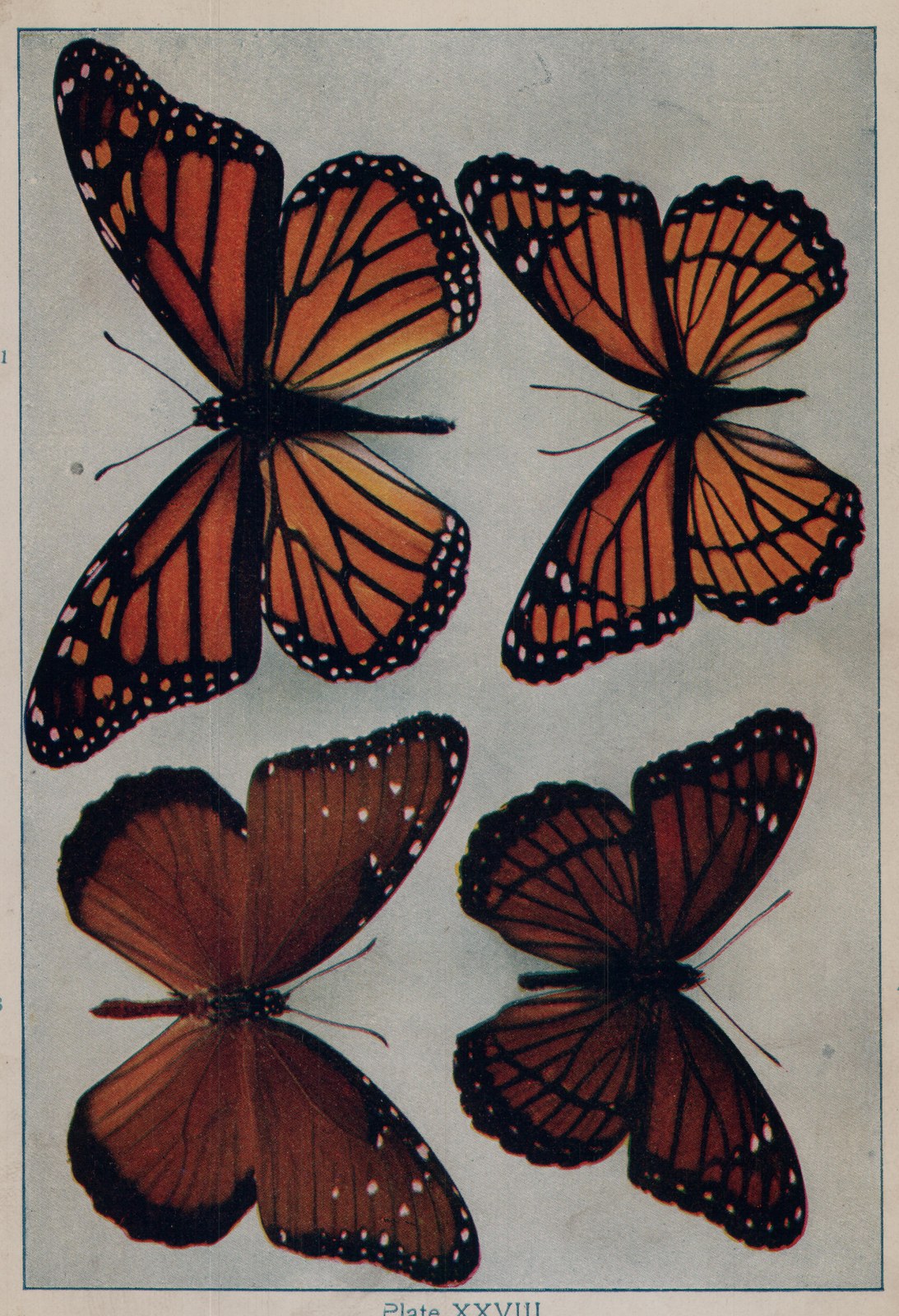
Basilarchia archippus (Bas-i-lar'chi-a ar-chip'pus) PLATE XXVIII, FIG. 2 The wings vary in color from a dull yellow orange tinged slightly with brown to a dark cinnamon color; they are bordered with black, and all the veins are edged with the same color. The fringe of the wings is spotted with white, and the black border on the outer margin contains a row of white spots.
CATERPILLAR.-Length about an inch; body humped and naked, with many tubercles. In color it is dark brownish yellow or olive green, with a pale buff or whitish saddle on the 3 XX Plate XXVIII. 4 middle segment of the abdomen. The tubercles on the second thoracic segment are club-shaped and spiny.
Food-plants. Willow and poplar.
This species is remarkable for its resemblance to the monarch (Anosia plexippus). But aside from the structural characters separating the two subfamilies which these butterflies represent, the viceroy can be easily distinguished from the species it mimics by its smaller size, and by the presence of a transverse black band on the hind wings.
It is believed that the resemblance of these two species is not merely accidental, but is a result of the action of the law of natural selection. The butterflies of the family to which the monarch belongs, the milkweed butterflies, are exempt from the attacks of birds. It is supposed that this exemption is due to the possession by these butterflies of a disagreeable odor. With such an odor the conspicuous coloring of the butterflies is protective, the birds soon learning that such butterflies are not fit for food. And it can be seen that these birds will naturally leave undisturbed any other butterflies that resemble the ill-smelling ones, even though they do not possess a similar odor. According to the theory of natural selection these resemblances have been produced as follows: In the case of a variable species that is unprotected by any disagreeable quality, any variation toward a protected species will tend to preserve the life of the individual possessing it.
And in turn such offspring of these individuals as still more nearly resemble the protected species will be most likely to be preserved. The continued action of this natural selection will result in producing a species that closely resembles the protected one, even though it may be very different structurally from the one that it mimics. Many instances of unconscious mimicry of this kind are known. They are especially abundant in the tropics where the foul-smelling heliconians are most abundant. The bad odor of these butterflies when living is so marked that it can be detected by the human nose; and it is found that many species of them are mimicked by other butterflies, and especially those of the Pieridæ.
The mimicry is not confined to similarity in coloring, but extends to the shape of the wings and manner of flight.
The larva of the viceroy feeds upon willow, poplar, balm of gilead, aspen, and cottonwood.
The species is two- or three-brooded, and hibernates as a partially grown larva in a nest made of a rolled leaf. This nest is lined with silk, and the leaf is fastened to the twig with silk so that it can not fall during the winter. Mr. Scudder states that so far as is known to him all of the species of the sovereigns hibernate as larvæ in nests of this kind. It is worthy of note that only the autumn brood of caterpillars make these nests.
So that the nest-building instinct appears only in alternate generations, or even less frequently when the species is more than two-brooded. B. archippus is found over nearly the whole of the United States as far west as the Sierra Nevada Mountains, and has been found sparingly even to the Pacific coast near our northern boundaries.
As Anosia plexippus has been termed the mon arch, this species is aptly called the viceroy.