Home › The Classification of Butterflies › The Swallow-Tails (Family Papilionid)
The Swallow-Tails (Family Papilionid)
Family Papilionidæ (Pa-pil-i-on'i-dæ) THESE magnificent butterflies are easily recognized by their large size and the tail-like prolongation of the hind wings. The ground color of the wings is black, which is usually marked with yellow, and often with metallic blue or green.
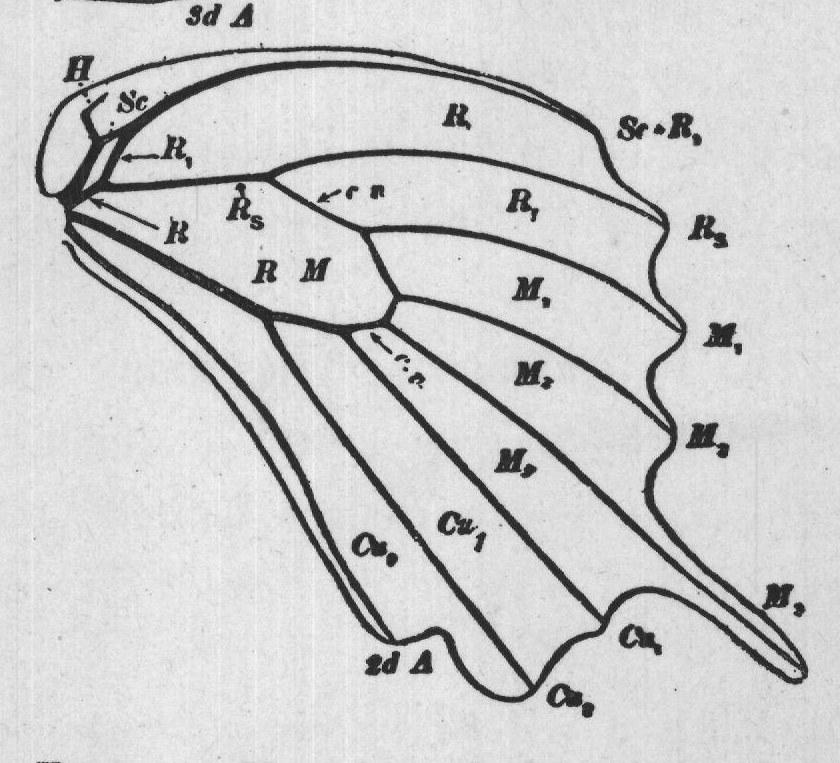
The swallow-tails agree with the parnassians and differ from all other butterflies in the fact that vein M2 of the fore wings appears to be a branch of cubitus, making this vein appear to be fourbranched (Fig. 25), and also by the fact that the anal area of the hind wings is more reduced than the anal area of the fore wings, the former containing only a single anal vein, R-M 1x8 A ピン BR B Sc R C.D.
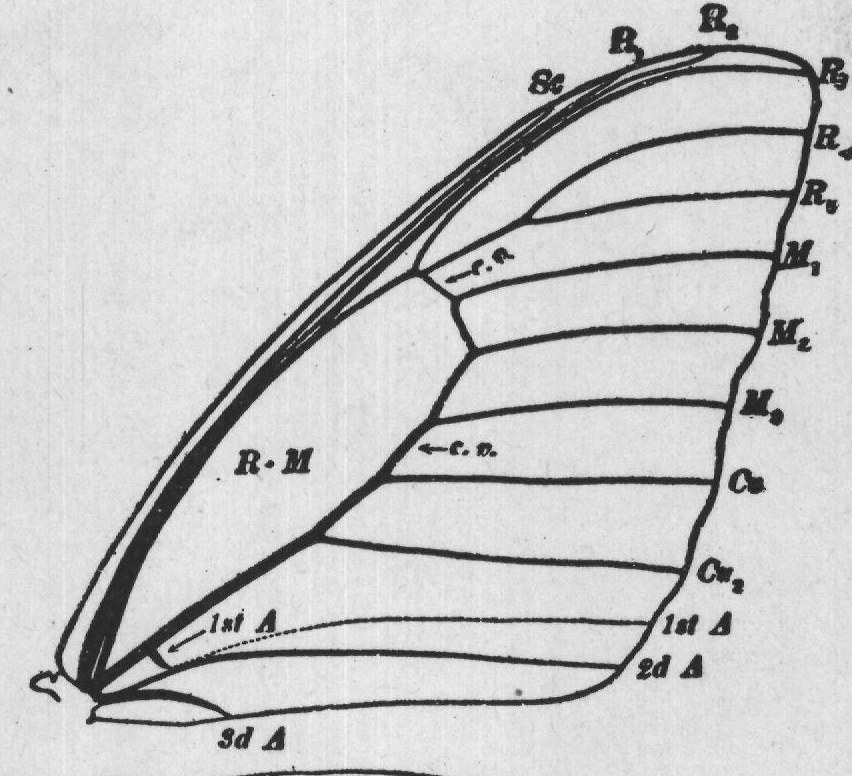
M, a C 1st A 2d 4 3d 4 Sc R Sr-R, R R R R S R RM M, M M M, C1 2d 4 4 R FIG. 25.-Venation of the wings of a swallow-tail. the latter two in the parnassians and three in the swallow-tails. In the swallow-tails radius of the fore wings is five-branched, veins R₁ and R2 being distinct although closely parallel. The caterpillars are never furnished with spines, but are either naked or clothed with a few fine hairs. In a single species in our fauna (Laertias philenor) the body of the larva bears fleshy filaments.
A striking peculiarity of the larvæ of this family is the presence of a pair of bright-colored fleshy "horns," which can be projected from a slit in the dorsal wall of the prothorax. (Plate XI, Fig. 2.) These have been termed osmateria (os-ma-te'ri-a), and are supposed to be organs of defense; for they exhale, when pushed out, an odor which in some species is exceedingly disagreeable. They are little long pockets which are turned wrong side out when used, thus throwing out in the atmosphere all of the odor that has been secreted in them. These caterpillars are the polecats of the insect world.
The chrysalids are thickened in the middle and taper considerably at each end; they are more or less angulated, and have certain parts excessively produced; they are suspended by the tail and by a loose girth around the middle. (Plate XI, Fig. 1.) The Papilionidæ includes many species; more than twenty of them have been found in America north of Mexico, and eight occur in the eastern United States. The following table will aid in the determination of these:
A. With a red or orange-colored spot on the upper side of the hind wings near the anal angle; club of antennæ usually strongly curved upward.
B. Front wings crossed by several bands of greenish white. (I. ajax), p. 49.