Home › The Classification of Butterflies › The Parnassians (Family Parnassiid)
The Parnassians (Family Parnassiid)
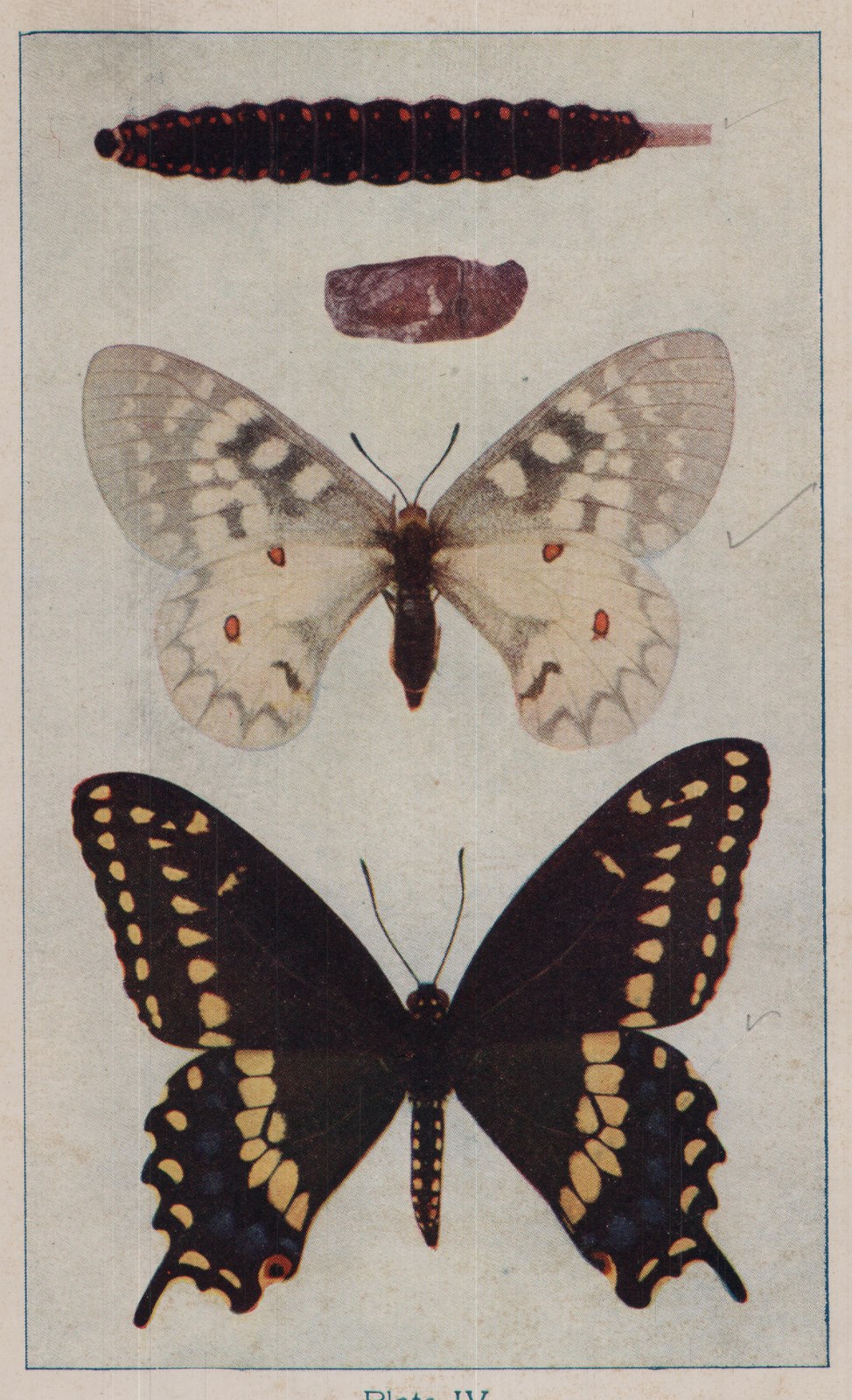
Family Parnassiidæ (Par-nas-si'i-dæ) THE parnassians are butterflies of medium size in which the ground color of the wings is white shaded with black, and marked with round red or yellow spots margined with black R R M M. 2 Cu R Cu2 2 Sc+R Se Cu, Cuz 2d A H FIG. 24. Venation of the wings of Parnassius. (Plate IV, Fig. 3).
In structure the parnassians are closely allied to the swallow-tails; but in their general appearance they show little resemblance to them, differing in the ground color of the wings, and in lacking the tail-like prolongation of the hind wings.
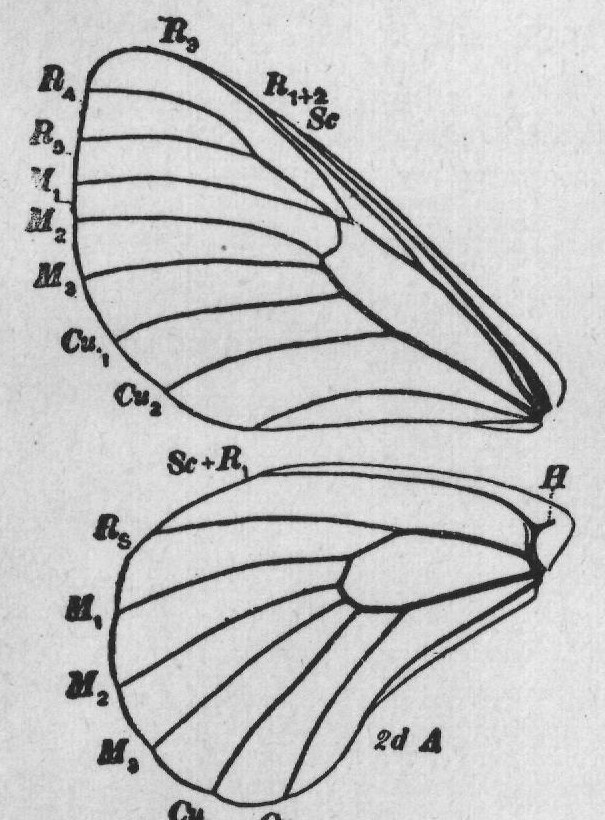
The most striking characteristics of the venation of the wings are that the cubitus appears to be four-branched, and the anal area of the hind wings is more reduced than the anal area of the fore wings (Fig. 24); in both of these respects they resemble the swallow-tails and differ from all other butterflies. The apparently four-branched condition of cubitus is due to the fact that vein M₂ as well as vein M3 is joined to cubitus, while in other butterflies, except the swallow-tails, vein M₂ is 2 3 4 Plate IV. joined to radius. In the anal area of the hind wings only a single vein remains; while in the anal area of the fore wings two anal veins are distinctly preserved. In the fore wings veins R₁ and R2 coalesce, which reduces the number of the branches of radius to four.
The larvæ (Plate IV, Fig. 1) possess the peculiar scentorgans known as osmateria; these are also possessed by the larvæ of swallow-tails and by no other butterfly larvæ. The osmateria are described later, in the discussion of the larvæ of swallow-tails. The larva when about to pupate either draws a leaf or leaves about its body by a few threads or it merely hides under some object on the ground.
The pupa (Plate IV, Fig. 2) is cylindrical and rounded, not angulate like those of the swallow-tails.
Only four species have been found in North America; they all belong to the genus Parnassius. Of the four species, two are Alaskan; the others occur in the mountains of the Pacific States, in Wyoming, and in the Rocky Mountains. One of these, Parnassius smintheus (Par-nas'si-us smin'the-us), is represented on Plate IV, Fig. 3.
Though the butterflies of the tropics may delight our eyes with their beautiful colors, yet we must needs climb high mountains to realize the possibilities of beauty which these little creatures possess. We would naturally suppose that those butterflies found on high mountains and in cold regions would be leathery of wing and dull of color; but this is a wrong supposition, for we find on the wings of these mountain-top butterflies a beautiful combination of white with a lemon-yellow tinge and soft brownish gray enlivened by spots of vermilion margined with black. The upper gray portion of the wing is quite transparent, so that the writing on the labels beneath the museum specimens may be read easily through this delicate medium; and we wonder again at the exquisite frailty of these insects which endure the rigor of high altitudes and arctic conditions.