Home › The Nymphs › The Silver-Bordered Fritillary
The Silver-Bordered Fritillary
Brenthis myrina (Bren'this my-ri'na) PLATE XXII, FIG. I, 3 This species differs from the meadow fritillary in having on the under side of the hind wings two transverse series of silver spots, one marginal and one submarginal; there are also several larger silver spots on the base of the wing. CATERPILLAR.-Length three-fourths inch. In color a mottled green, brown and purple, with spines like the caterpillars of Argynnis except that in this species the pair of spines on top the first thoracic segment are several times as long as the others.
Food-plant. Violets.
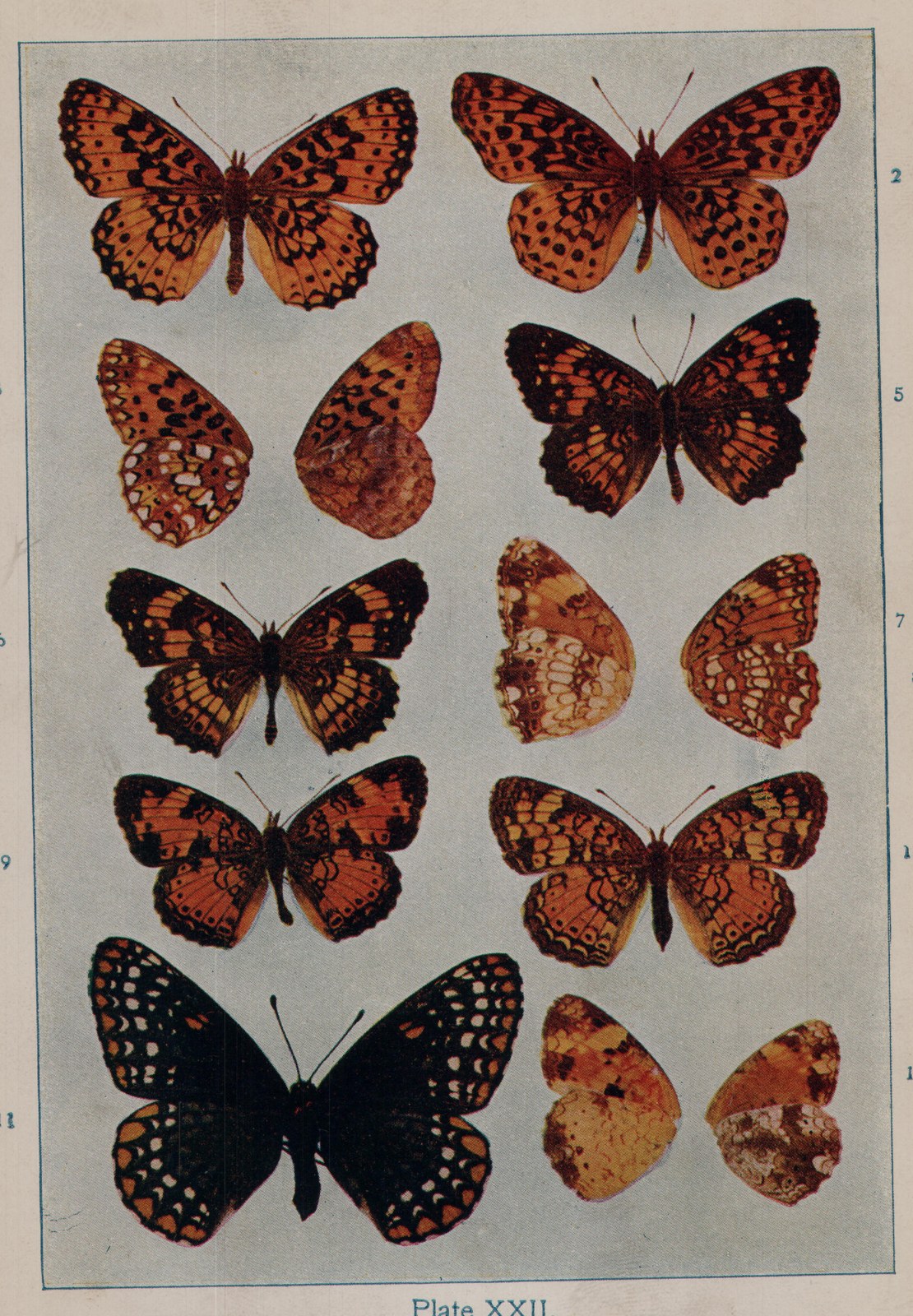
When in our childish ignorance we regarded a small butterfly as not yet fully grown, we often found on thistle blossoms in the pasture certain small butterflies that carried "money" under their wings and we thought them too young to be trusted with so much silver. These small Cræsuses were the silver-bordered fritillaries.
The silver-bordered fritillary is a pretty little creature decorated in rather conventional squares, dots and scallops of black and orange that suggest canvas embroidery. On the lower side of the wings the silver spots are set in with brown and yellow squares and lines; the border of "half coins" on the hind wings is especially prominent 4 3 5 6 7 6 11 Plate XXII. 3 10 12 13 and ornamental; a border of black points shot with silver margin the fore wings and make one of the most decorative patterns ever found on a butterfly wing, the place where Nature is at her best as a decorator. Despite the small size and slight form of this fritillary it is rather lazy in its flight and is much more given to resting on flowers than to dancing in the air.
The caterpillars that hatch late in the fall pass the winter as they leave the egg. Other caterpillars half grown pass the winter in that stage and produce butterflies early in the next season.
The species is presumably three-brooded, but owing to the desultory egg-laying habits of the butterflies the broods are not distinct. It is a butterfly that is decidedly shiftless in family affairs. The chrysalis looks a little like a stout hook, it being bent forward somewhat.
The species occurs throughout Canada and in the northern portions of the United States.