Home › The Nymphs › The Regal Fritillary (Speyeria idalia Spey-er'i-a)
The Regal Fritillary (Speyeria idalia Spey-er'i-a)
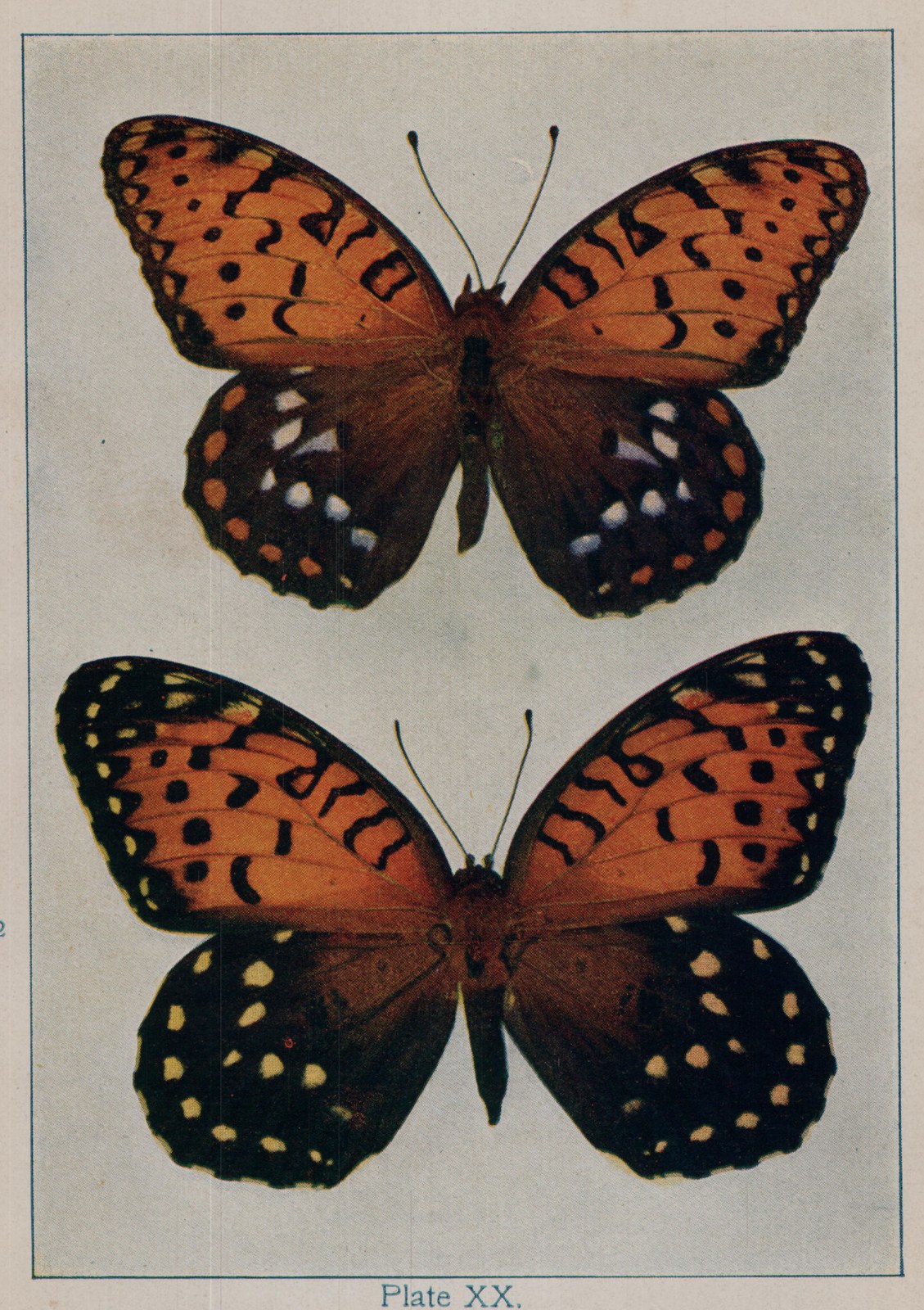
Speyeria idalia (Spey-er'i-a i-da'li-a) PLATE XX, FIG. 1, 2 This species can be distinguished from our other fritillaries by its having the fore wings fulvous and the hind wings black. The sexes differ somewhat in markings. In the male, the upper surface of the fore wings is marked with black spots and bars arranged as in typical fritillaries. The black markings, however, are less prominent, except that there is a distinct black band on the outer margin as in the mountain silverspot. The hind wings are black, with violet reflections; the base of the wings is tinged with fulvous. There is a black spot in the cell R+M, a transverse row of yellowish spots 2 Plate XX. beyond the cell, and a submarginal row of fulvous spots. In the female the outer marginal band of the fore wings is broader; it contains a row of white spots, and there are six additional white spots near the apex; on the hind wings the outer row of spots is of the same color as the inner. Beneath in both sexes the fore wings are orange and the hind wings a rich olive brown, with nearly thirty large silvery white spots. Expanse three and one-half to four inches.
CATERPILLAR. -Length one and three fourths inches.
Velvety black in color with dull yellow or reddish stripes. It bears six rows of thorny spines, which are fleshy at the base. The spines along the back are silvery or yellowish white tipped with black. Sometimes the bases of the spines along the sides are orange.
Food-plant, Violets.
This butterfly has honestly earned its name, for it is truly a regal creature. Its broad large wings are beautifully and richly colored above with velvety orange and blue-black.
The silvery spots beneath the wings are tinged with green and are angular in shape; and set against an olive background, they shine like the bangles against the dark breast of some Oriental beauty. Even its flight is characterized by the dignity and deliberation of a royal personage, and its favorite resting-place is on a goldenrod throne. It seems somewhat capricious as to the localities it frequents, often being quite abundant in one place and not to be found a few miles distant, even though the physical features of the two places are similar.
The caterpillar hatches from the egg in the autumn and winters in its first stage. It feeds by night, and Mr. Scudder thinks it is likely to have another food-plant than violets.
The species is single-brooded, and occurs from Maine to Delaware and westward to Nebraska and Arkansas.