Home › The Nymphs › The Great Spangled Fritillary (Argynnis cybele Ar-gyn'nis)
The Great Spangled Fritillary (Argynnis cybele Ar-gyn'nis)
Argynnis cybele (Ar-gyn'nis cyb'e-le) PLATE XXI, FIG. I, 2 There occur in the eastern United States three species of the larger Fritillaries, representing the genus Argynnis, which can be separated at a glance from their allies occurring in this fauna, but which so closely agree in color and in markings that it is with difficulty that they can be distinguished from each other. These are represented on Plate XXI; and the distinctive characteristics are given in the table above. The males of these insects can be distinguished by a fringe of long hairs in the basal two-thirds of cell R, of the hind wings. CATERPILLAR. -Length one and three-fourths inches. Black more or less velvety, bearing on each side the characteristic three rows of black thorny spines which in this case are polished; the base of these spines may be orange. Its habits are nocturnal.
Food-plant. Any species of violet.
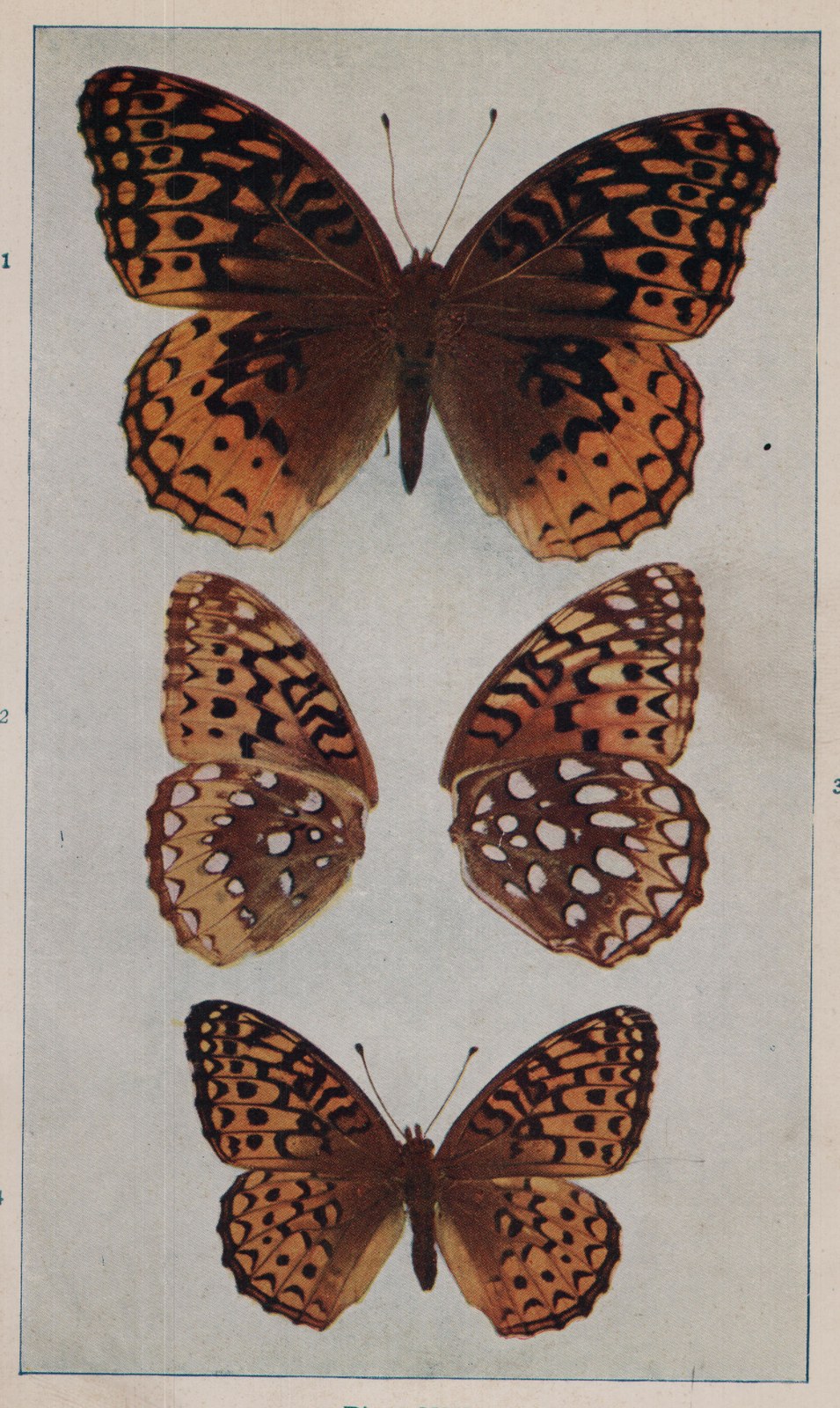
Cat 2 4 Plate XXI. 3 When we were children a familiar sight to us on our journeys to and from school were certain large round-winged tawny butterflies settling themselves as best they could on the thistle blossoms. When finally engaged in exhausting the sweets offered at this roadside restaurant, their wings were lifted and closed and we saw on their lower sides what we called "butterfly money."
This currency was of various denominations, and near the edges were what we called "dollars " broken in halves and set in a row, a fact which puzzled us until we discovered the lost halves set in a row on the opposite wing; a charming lesson in short division this. Some of these butterflies were much larger than others, and we never doubted that the smaller ones were not yet grown up. It had never been revealed to us that butterflies. cease growing when they attain their wings. The largest of these butterflies that carried their wealth under their wings were undoubtedly great spangled fritillaries; and the smaller ones were silver-spots. We never saw that buff band just inside the "coins" along the edge of the lower side of the hind wings which is as wide in its narrowest place on the great spangled species as is the diameter of the largest "dollar" on the wing; and which in the silver-spot is narrower decidedly than the width of the larg. est "coin." The great spangled varies so in size that specimens of it are often not larger than the silver-spot, so this wide buff band is the only thing that distinguishes the species.
The history of the great spangled caterpillar is an interesting one. It hatches from the egg in the fall as a tiny olive caterpillar; it may take a bite or two of the egg-shell, but never another mouthful; with this scanty breakfast to sustain it it meets the rigors of winter. It lies dormant until spring melts its coverlet of frost and snow and spreads an early banquet of new violet leaves for this fasting baby. It is always a shy insect, feeding only during the night and hiding by day; it changes to a dark-brown chrysalis beneath stones or sticks or other objects on the ground which may give it shelter.
The species is single-brooded in the North and probably double-brooded in the South. It occurs in Canada and the northern half of the eastern part of the United States.
The mute insect fixed upon the plant On whose soft leaves it hangs, and from whose cup Draws imperceptibly its nourishment, Endeared my wanderings.
WORDSWORTH.