Home › The Common Skippers › The Otho Skipper (Thymelicus otho Thy-mel'i-cus)
The Otho Skipper (Thymelicus otho Thy-mel'i-cus)
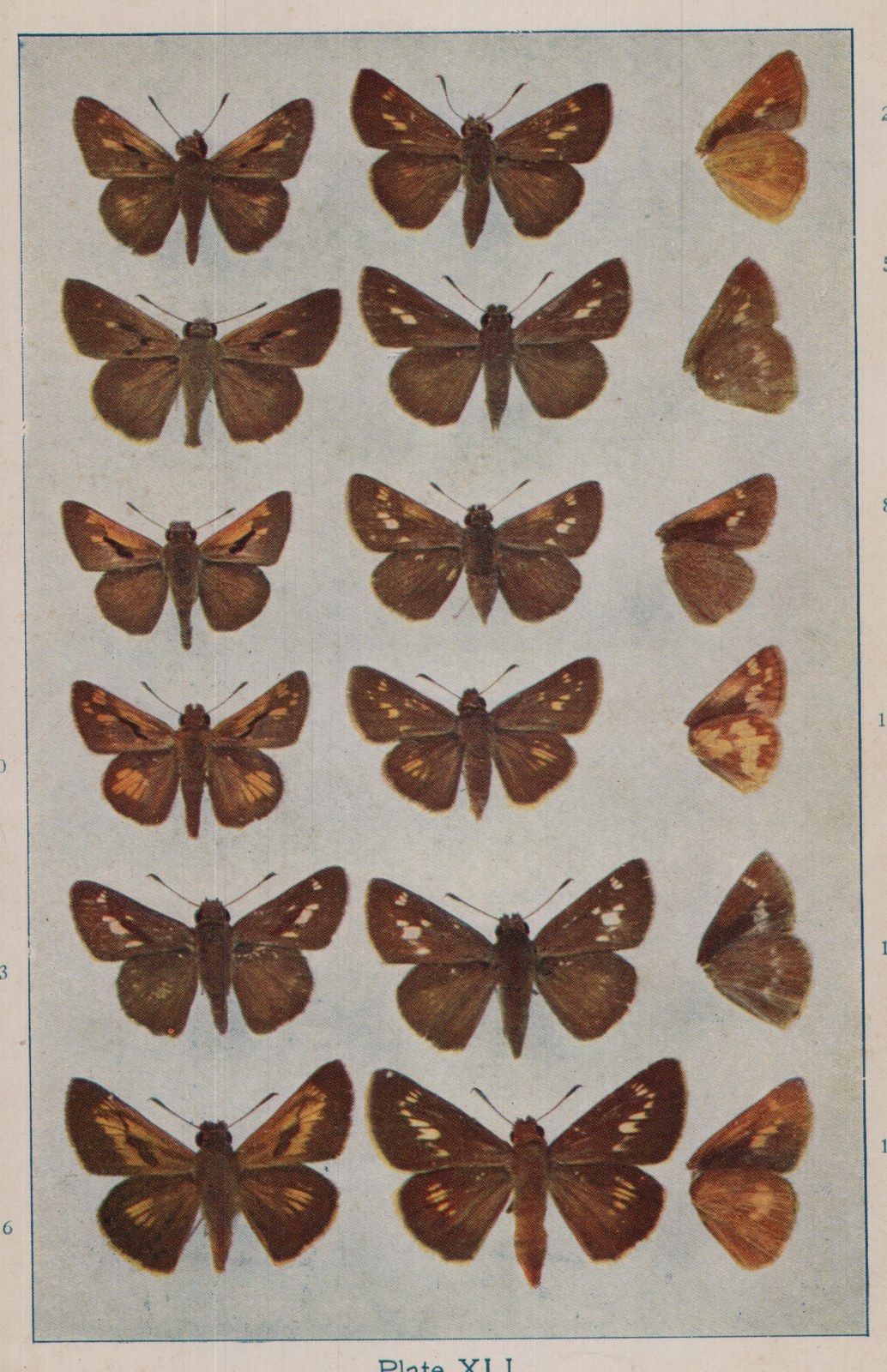
Thymelicus otho (Thy-mel'i-cus o'tho) PLATE, XLI, FIG. 1, 2, 3, 4, 5, 6 (1) The Typical Form, Thymelicus otho otho. The upper surface of the wings is dark brown more or less shaded with 3 tawny and with tawny spots. In the male the upper surface of the fore wings bears a brand which consists of two velvety black patches separated by a patch of large scales of a lighter color; the dark outer border of the wing extends to the brand except that there is a yellow spot in cell M, and Cu₁; between the brand and the costal margin of the wing there is a more or less distinct band of yellow which extends from the base of the wing nearly to the subapical row of spots; the central portion of the hind wings is tinged with yellow but without well-defined spots. In the female the yellow border along the costal margin of the wings is much less distinct. The lower surface of the wings in both sexes is yellowish brown; on the fore wings there is a dark shade parallel with the inner margin and covering nearly half of the wing; and the yellow markings of the upper surface are faintly indicated. Expanse of wings one and one-fifth to one and one-fourth inches. (2) The Dark Form, Thymelicus otho egeremet (e-ger'emet). This form is represented by both sexes. The upper surface of the wings is a blackish brown with almost no tawny shading, there are, however, long greenish-yellow hairs near the base of the inner margin of the fore wings, and over a large portion of the hind wings; the transverse row of spots beyond the middle of the fore wings is present but is abbreviated, lacking the spot at each end of the row. The species is found throughout the eastern United States; the larva feeds on grasses. Otho is a Roman surname. 4 7 10 13 16 அதிக ** Plate XLI. 5 8 11 14 17 12 6 9 15 18