Home › The Common Skippers › Skippers with a Brand and Their Allies
Skippers with a Brand and Their Allies
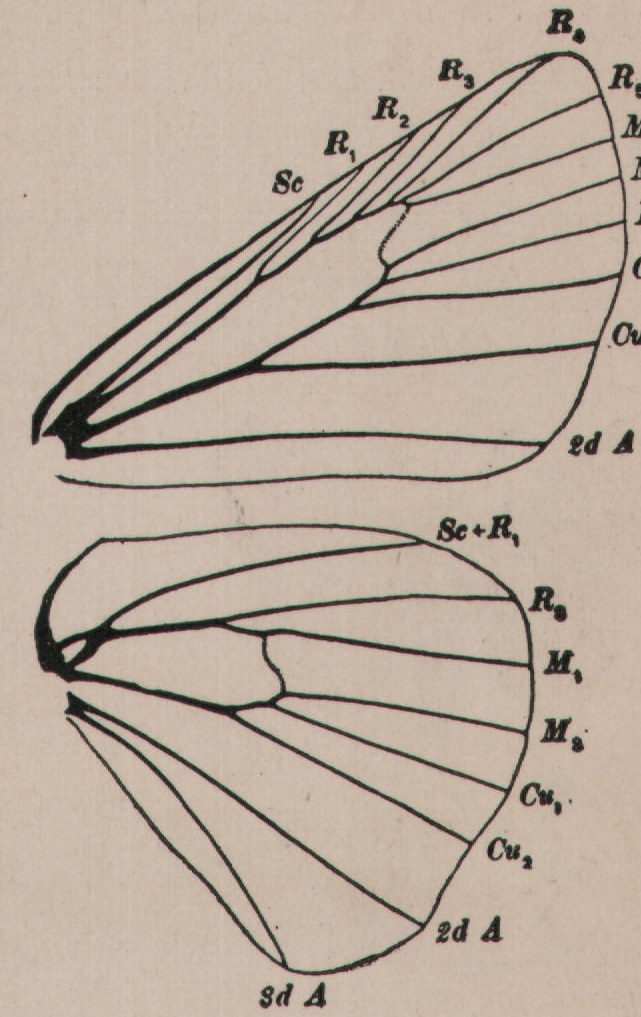
AA. Vein M, of the fore wings retaining its primitive position midway between veins M, and M,, or nearer to vein M₁ than to M, at base (Fig. 3 3 3d 4 Sc+R, M Cu Ou ed A R C Cu, 2d A M FIG. 44.-Venation of the wings of Erynnis sassacus. 41); antennæ usually with a long club which is bent at a considerable distance from the tip; males almost invariably with a costal fold, never with a brand. (Hesperiina), p. 288. SKIPPERS WITH A COSTAL FOLD AND THEIR ALLIES.
Subfamily Pamphilinæ (Pam-phi-li'næ) This subfamily includes the greater number of our smaller skippers; some of the species, however, surpass in size many of the Hesperiinæ. To the Pamphilinæ belong all of our common tawny skippers, as well as some black or dark- 2 3 brown species. The antennæ usually have a stout club, with a short recurved tip; sometimes this tip is wanting. Vein M, of the fore wings arises much nearer to vein M, than to vein M₁, the base of the vein usually curving noticeably toward vein M, (Fig. 44). In the majority of our species the males can be recognized at a glance by a conspicuous patch crossing the disk of the fore wings, which usually appears to the naked eye like a scorched, oblique streak, and which, on this account, is termed the brand (Fig. 45). The brand is a complicated organ, composed of tubular scales, the androconia, that are the outlets of scent-glands, and of other scales of various shapes; in some species the brand is wanting.
This subfamily is an exceedingly difficult one to study, as the differences between allied species in many cases is very slight. Another confusing feature is the fact that in very many cases either sex resembles the same sex of other species much more closely than it does the opposite sex of the same species; and, too, in several species there are two distinct forms of females which differ in appearance from each other more than either does from the females of certain other species. In the latter case the species is represented by three distinct forms, one male and two female.
FIG. 45.-A male skipper with a brand.
More than one hundred species have been described from America north of Mexico; the more common species that occur in the East are described below and can be separated by the following table :
A. Fringe of wings conspicuously marked with alternating colors. (Amblyscirtes.) B. The pale markings on the under surface of the hind wings obscure, the whole wing flecked with lilac scales on a purplish ground. (A. vialis), p. 270.