Home › The Common Skippers › The Canadian Skipper
The Canadian Skipper
Erynnis comma (E-ryn'nis com'ma) PLATE XXXIX, FIG. 17, 18, 19 In the male the upper surface of the wings are dull yellow with the outer margins brownish; there is a distinct brand. In the female the yellow color is more obscured by brownish scales, but there is a transverse row of spots beyond the middle of both fore and hind wings. On the lower surface of the fore wings the markings of the upper surface are repeated, and the hind wings are greenish with white spots; the green is more pronounced than in any other species occurring in the East. Expanse of wings one inch to one and one-fourth inches.
Occurs in Canada from the Atlantic to the Pacific, and in the mountains of the western United States.
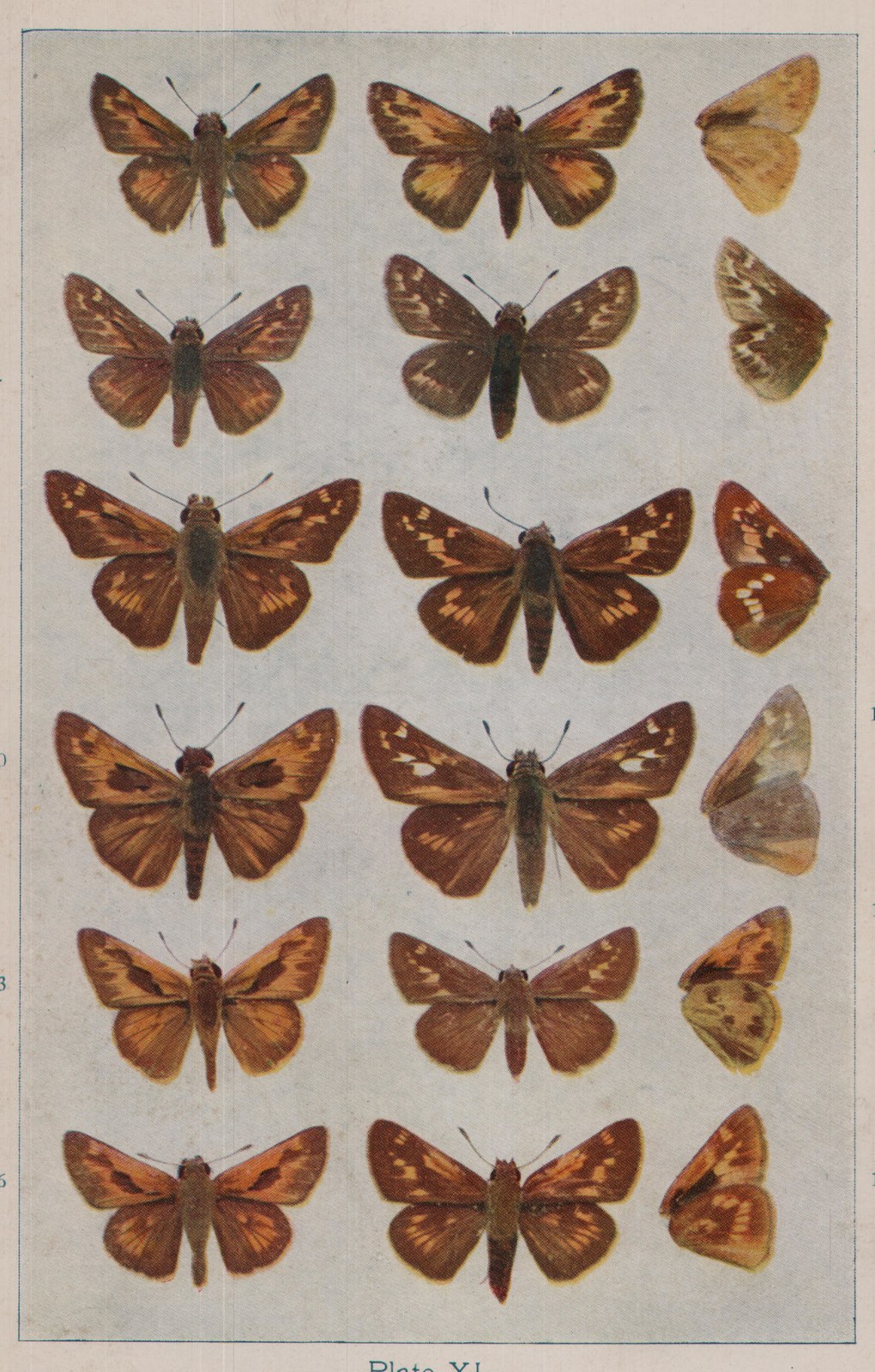
Erynnis sassacus (E-ryn'nis sas'sa-cus) PLATE XL, FIG. I, 2, 3 The upper surface of the wings is largely yellow in both sexes, with the margins, except the costal margin of the fore wings, brown, and with a brand in the male. The lower surface of the wings is pale, dull, greenish buff with the lighter markings of the upper surface more or less distinctly repeated. The upper surface of this skipper resembles quite closely the male and the yellow female of the mormon, but the central, light-colored patch of the lower side of the hind 4 5 8- 7 10 13 16 Plate XL. 11 14 17 6 9 12 15 18 wings is much less distinct in this species than in the yellow forms of the mormon.
Occurs in the Atlantic States and westward to Colorado. Larva feeds on grasses. Sassacus was the name of an Indian warrior.