Home › The Swallow-Tails › The Blue Swallow-Tail
The Blue Swallow-Tail
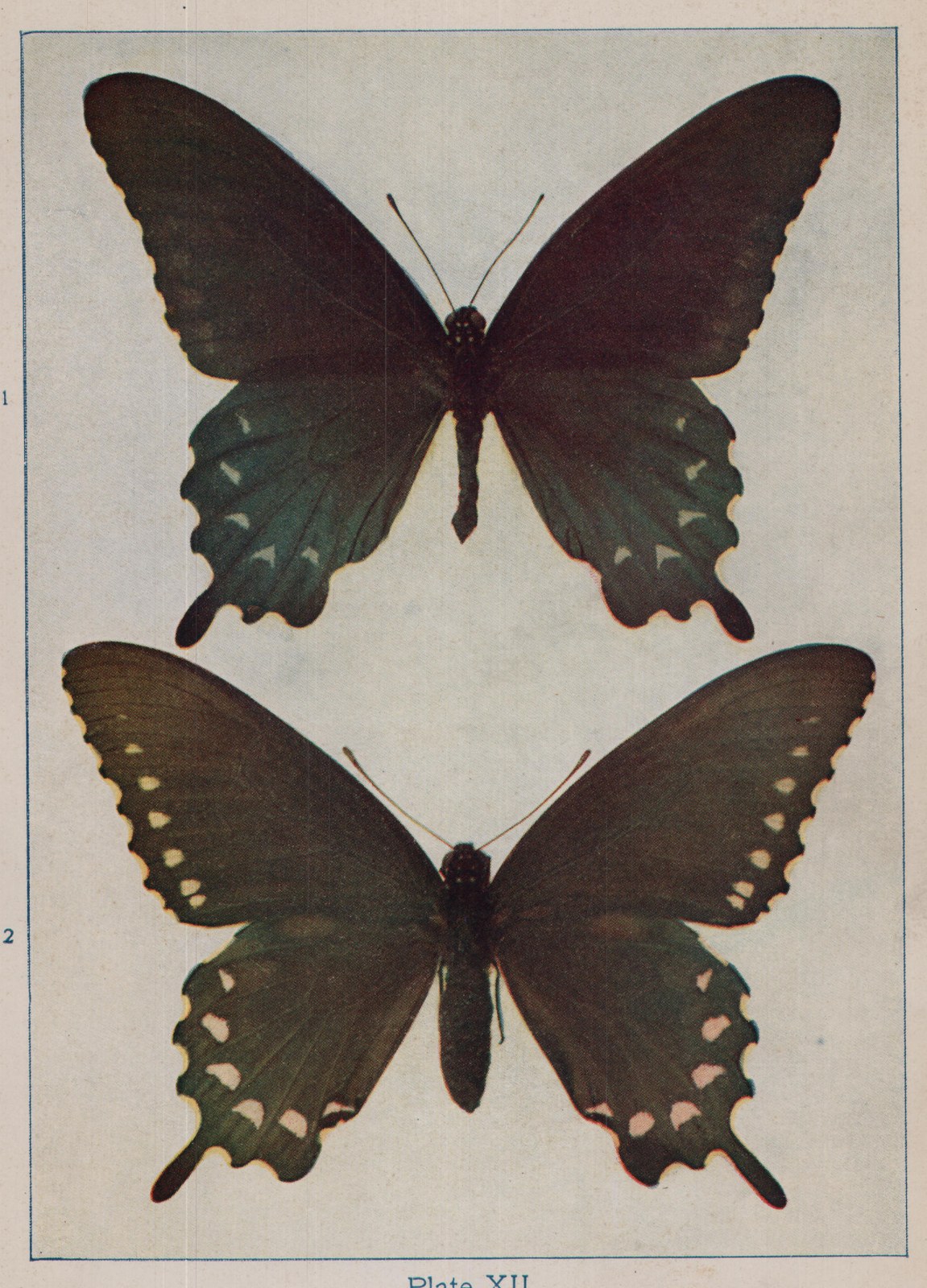
Laertias philenor (La-er'ti-as phi-le'nor) PLATE XII, FIG. 1, 2 The front wings are lustrous blackish brown; the hind wings are blackish with green or blue reflections. The fringe on the outer margin of the wings is alternately black and white, the white appearing conspicuous by contrast. Parallel to the outer margin is a row of whitish spots; these may be very indistinct or wanting on the front wings. Beneath, the spots are more distinct, especially the row on the hind wings, which consists of seven large orange spots. The discal half of the hind wings is very bright by reflected light. Expanse of wings from three and one-half inches to four and one-half inches.
CATERPILLAR.-Length nearly two inches. The body is nearly cylindrical and naked. In color it is dark purplish brown, almost black, with a row or two of coral-red dots along each side. On the segments at either end of the body are pairs of brown fleshy filaments prolonged and extended like horns.
Food-plants. Dutchman's-pipe, the Virginia snakeroot, black bindweed.
Once an individual of this species was our comrade during a June sojourn in Virginia. Day after day we watched it floating about close to the ground in the open space of the park about the hotel. It visited all the flowers in the beds and spent long periods sunning itself near the piazza, where we were able to observe it close at 2 Plate XII. hand at our leisure. This was a fascinating occupation, for at every movement of the graceful body a blue-green wave of metallic sheen would start somewhere in the blackness of the velvet front wings and surge and break over the hind wings in a shimmering glow that sent a thrill of delight to our color-loving senses. When we followed it around we found that though it fluttered lazily and aimlessly on, it knew quite well what it was about and did not choose to let us come too near.
An interesting fact about the male of the species is that he has the inner margin of the hind wing folded over, including scent-scales. This unique pocket full of perfume he undoubtedly carries for the purpose of attracting and delighting his lady-love. These butterflies, being very fond of nectar, visit many flowers and are especially useful in carrying the pollen baskets of the orchids.
When we look at the weird flower called the Dutchman's-pipe and see how curiously it is arranged to be an effective death-trap to smaller insects, we feel that poetic justice is meted to the plant which produces it, when we find its large round leaves eaten greedily by a robust caterpillar. The long projecting filaments give the caterpillar an untidy and funguslike appearance; its scent-organs give off little odor so far as we can detect. In its northern range the species is double-brooded, and winters sometimes as a butterfly and sometimes as a chrysalis. It is rarely found in New England, but is common in the Southern States and on the Pacific Coast.
The velvet nap which on his wings doth lie, The silken down with which his back is dight, His broad outstretched horns, his hairy thighs, His glistening colors and his glorious eyes.
SPENSER