Home › The Nymphs › The Compton Tortoise (Eugonia j-album Eu-go'ni-a)
The Compton Tortoise (Eugonia j-album Eu-go'ni-a)
Eugonia j-album (Eu-go'ni-a j-al'bum) FIG. 34 This butterfly resembles in its general appearance those of the genus Polygonia, but it is sharply distinguished from them by the inner margin of the fore wings being nearly straight, by the heavier markings of the fore wings, and by the presence of a whitish spot on both fore and hind wings, near the apex between two larger black patches. On the lower surface of the hind wings there is a small L-shaped silvery bar. CATERPILLAR.-Length one and one-half to two inches. It is greenish in color, more or less speckled and striped with lighter hues. Its head and its body bear black, bristly spines like the caterpillars of the preceding genus. The caterpillars feed in flocks and are rarely found.
Food-plants-White birch and willow.
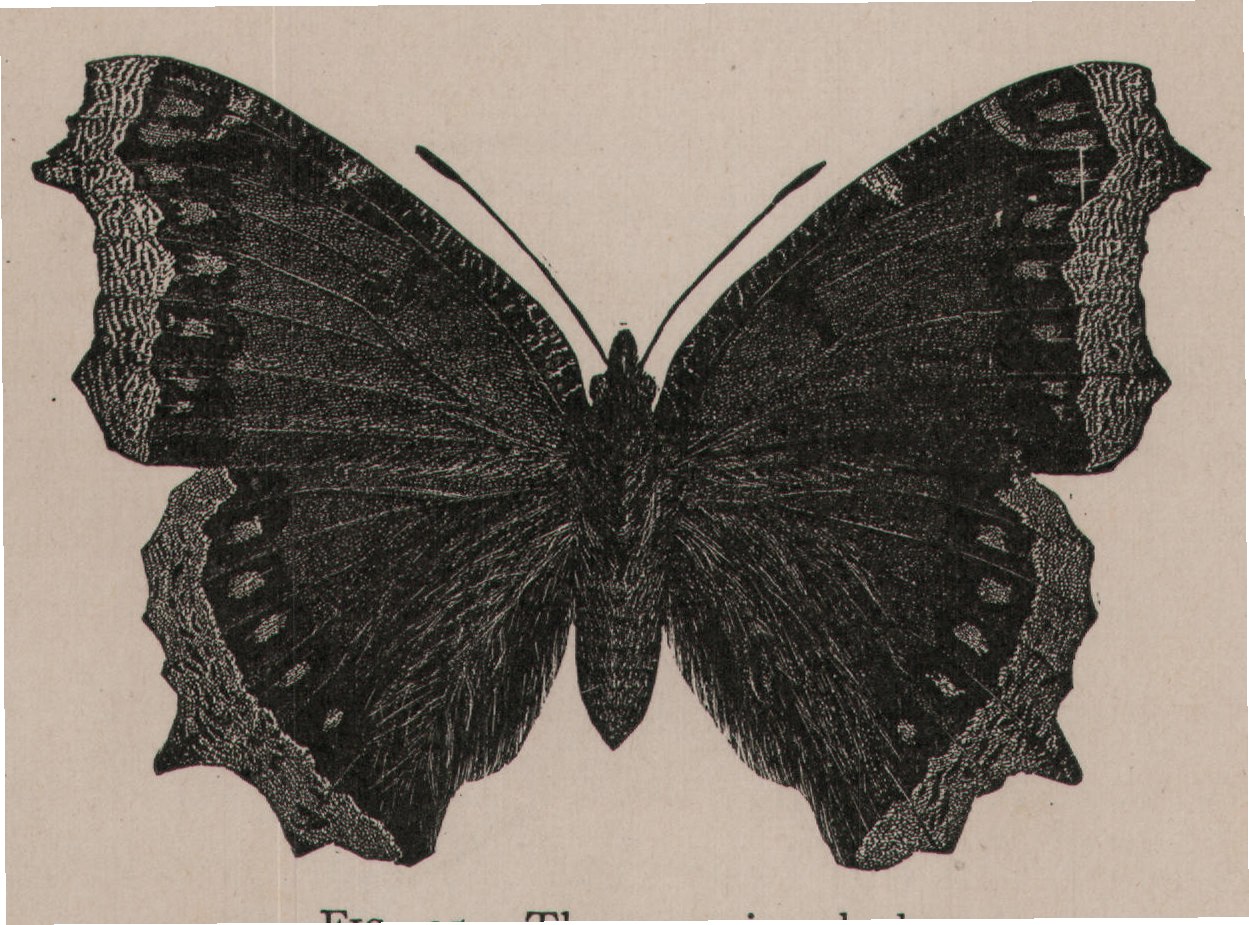
This butterfly, though larger than the Polygonias, strikingly resembles them in the cut of the wings, except that the inner margins of the front wings are straight. Not because it is so slow is it called tortoise, but because of the shades of brown and red and ochre yellow beautifully blended on the upper surface of its wings which resemble the tints of the tortoise-shell. The white spot on each wing is so placed as to heighten by contrast the rich velvety hues. While its coloring above is quite different from that of the Polygonias, it is very like them in the intricate patsoms out of their blankets, or the pussy-willow lifts its fur, the mourning-cloak bravely leaves its winter quarters; it flutters out into the sunshine that filters down through the leafless trees, and seeks a little refreshment wherever the sap-tides push through bruised bark; or it rests on some bare mossy mound with a southern exposure and sun.
FIG. 35. The mourning-cloak. spreads out its yellow-banded purple wings in an effort to get what warmth it may from the March How the winter-tired eyes are gladdened by this courageous flutterer must be known by experience rather than by description. We are glad that our European neighbors also have the mourning-cloak as a sign of returning spring.
The wider its cheer is extended the better for all.
Our English Cousins call it "The Camberwell Beauty."
The eggs are laid in clusters and are often placed in a compact mass around a twig. Very beautiful eggs are they; but Madam Antiopa is a careless mathematician. Sometimes her egg is eight- and sometimes seven-sided, the areas marked with ridges in a highly decorative manner, as may be seen in Plate XXV. As soon as the caterpillars emerge from the egg they arrange themselves side by side, close together, heads just reaching the edge of the leaf on which they feed, making an orderly eating class in the green school-room. They are sociable little fellows for all their bristly spines, and live together all their lives and often hang up near each other when they change to chrysalids. Once when a brood was reared in our insectary it was discovered that when a noise was made on a tin pan or anyone with a bass voice sang, these caterpillars would rise as one, lifting the front half of the body from the leaf, and would shake or tremble as if they had the palsy. They were not disturbed by a very loud noise, but within a certain range they would immediately respond, and when all were thus trembling and shaking they presented an absurd spectacle.
The species is two-brooded in most localities, the second brood of caterpillars appearing in August. It is distributed from the Atlantic to the Pacific, and from the arctic circle to the Gulf of Mexico.
From time to time have seen the large Vanessa antiopa resting on the black willows, like a leaf still adhering. THOREAU.