Home › The Swallow-Tails › Family III
Family III
THE PIERIDS (Pi-er'ids) Family Pieridæ (Pi-er'i-dæ) THESE butterflies are usually of medium size, but some of them are small; they are nearly always white, yellow, or orange, and are usually marked with black. They are the most abundant of all our but- R3 terflies, being common RA+S 4+5 R2 everywhere in fields M1 and roads.
Some spe- Sc R M2 cies are so abundant as to be serious pests, the larvæ feeding on cultivated plants.
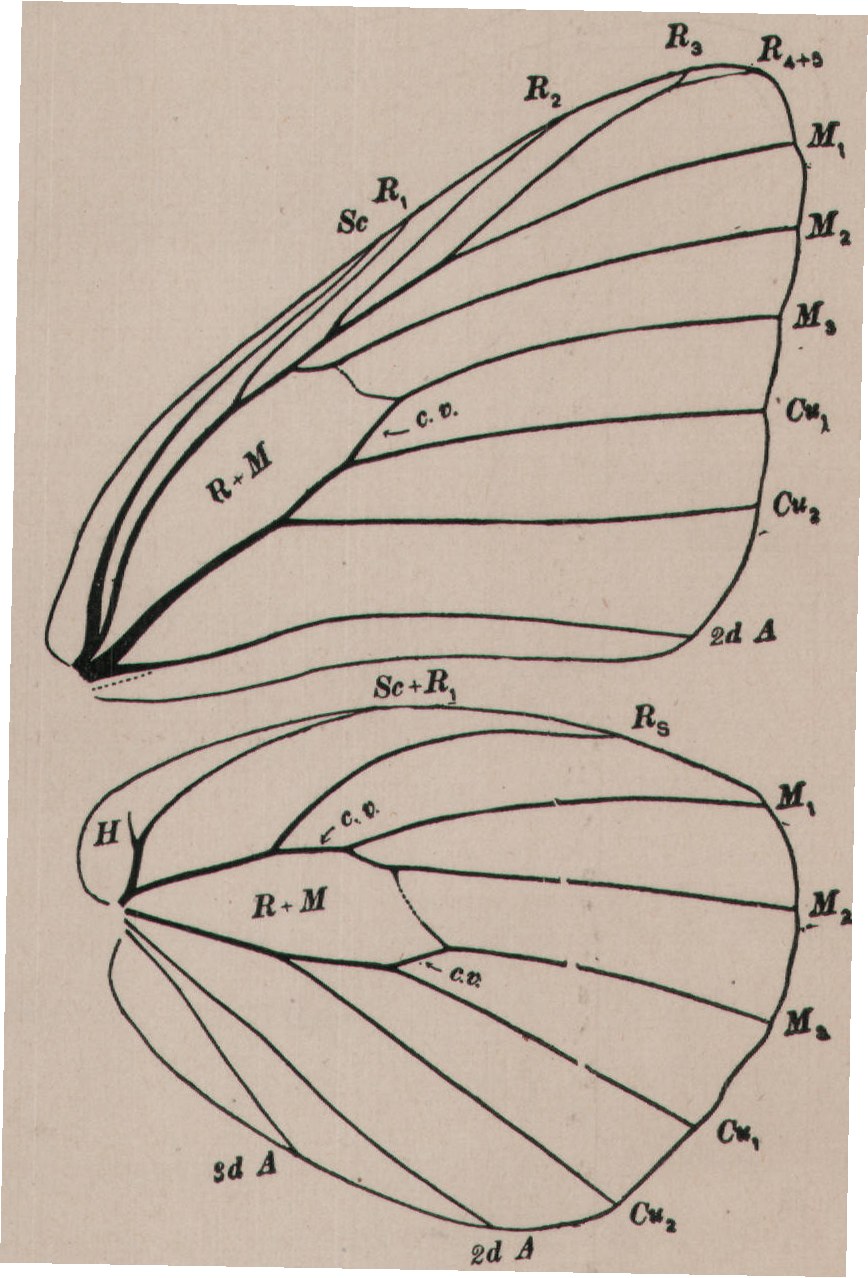
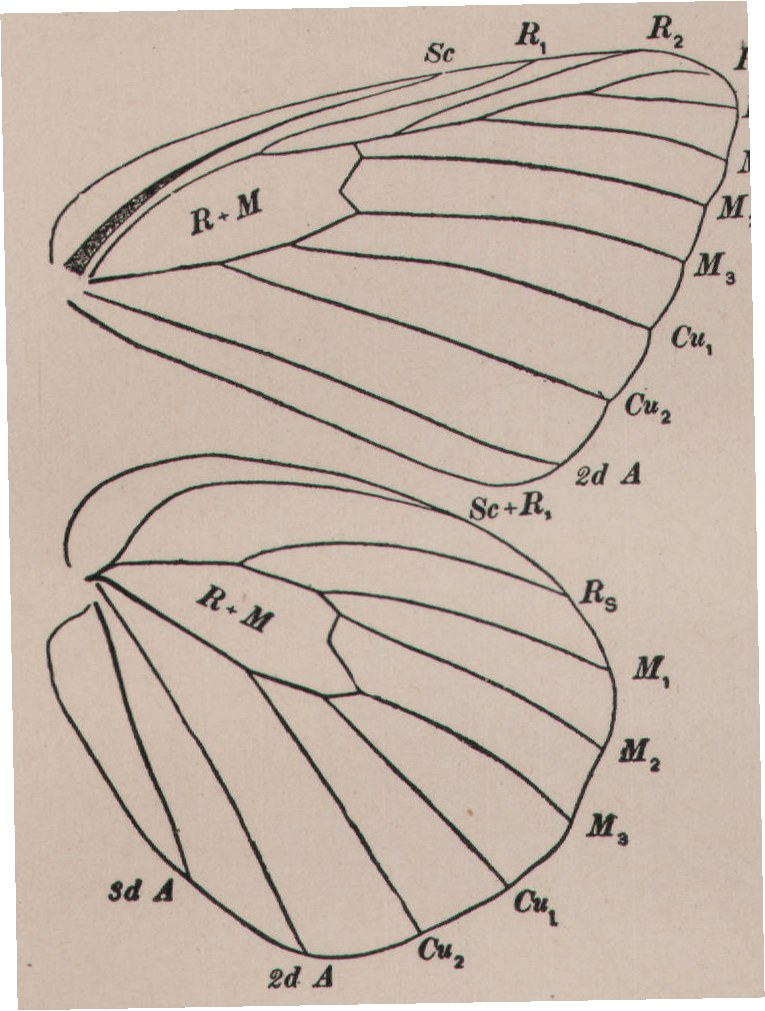
The characteristic features of the venation of the wings are the following (Fig. 27): vein M2 of the fore wings is more closely connected with radius 2 than with cubitus, the H R+M C. D.
Sc+R C.D.
R+M CO latter appearing to be 3d A three-branched; vein Rs C C2 2d A 2d A M C Cu2 M M2 M M₁ of the fore wings FIG. 27. - Venation of the wings of Pontia coalesces with radius protodice. for a considerable distance beyond the apex of cell R+M; and only three or four of the branches of radius remain distinct. In this family the fore legs are well-developed in both sexes, there being no tendency to their reduction in size, as in the R+M following families.
R R2 Sc R The larvæ are usually R4+5 M slender, green worms M2 M3 clothed with short, fine hairs; the well-known cabbage-worms are typical illustrations. 3d A R+M 2d A Sc+R, Cu2 Cu2 2d A Cu Rs Cu M M2 M3 3 FIG. 28. Venation of the wings of Eurymus philodice.
The chrysalids are supported by the tail and by a loose girth around the middle. They can be distinguished at a glance by the presence of a single pointed projection in front. (Plate III, Fig. 3.) In order to facilitate the study of the family, our genera can be separated, somewhat arbitrarily, into three groups; these are the Whites, the Orange-tips, and the Yellows. In the first two groups the prevailing color is white; in the third, it is either yellow or orange. These groups can be separated as follows : 2 A. Vein M, of the front wings arising from radius, and cutting off obliquely the apex of cell R+M; radius of the front wings only three-branched, or if four-branched with one branch (vein R₂) exceedingly short, arising just before the margin of the wing (Fig. 27). Prevailing colors white, p. 71.