Home › The Gossamer-Winged Butterflies › Scudder's Blue (Rusticus scudderi Rus'ti-cus)
Scudder's Blue (Rusticus scudderi Rus'ti-cus)
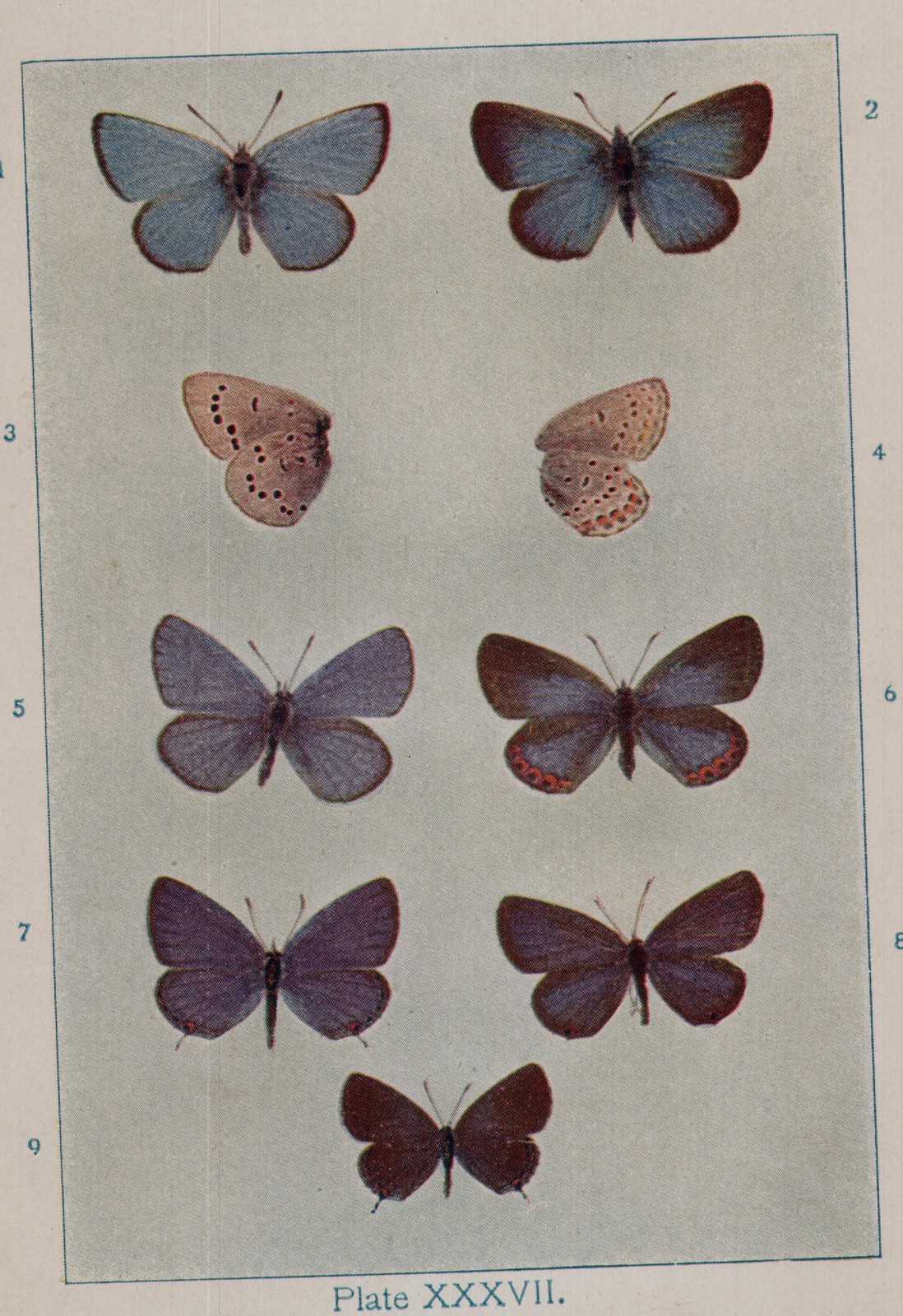
Rusticus scudderi (Rus'ti-cus scud'der-i) PLATE XXXVII, FIG. 4, 5, 6 The eyes are naked. In both sexes the costal edge of the fore wings is white. In the males the wings are of a uniform purplish violet above, narrowly margined with blackish brown; in the female the violet is confined to a small portion of the disk of the wing, the larger part of the wing being dark brown. In this sex there is a submarginal series of roundish dark brown spots in the cells of the hind wings; 3 5 7 9 १९ १९ Plate XXXVII. 4 6 8 these spots are more or less surmounted and embraced by orange lunules. Beneath in both sexes the wings are pale hoary slate gray. On the fore wings the medial cross-veins bear a black spot encircled with white; beyond this there is a series of six similar spots. Between this series and the outer margin there is a series of pale orange or whitish spots bordered within and without with black. The hind wings are marked in a similar manner; there are eight spots in the series next beyond the medial cross-veins, and on the base of the wing there is a transverse series of four or more less distinct black spots. The orange spots are more distinctly marked than on the fore wings, and the outer black border of these spots is more or less covered with pale metallic greenish scales. Expanse of wings one inch. This is a Canadian butterfly; but it occurs in certain parts of New York and probably in New England. The species is two-brooded.
CATERPILLAR.-Length, about one-half inch. Color peagreen with a yellowish tinge on the sides of the abdomen. Body is sparsely covered with short hairs and the body walls are rather transparent.
Food-plant. Wild lupine.
Far Surely it must be one of Mr. Scudder's compensations for a lifetime of infinitely patient and loving research in the habits of butterflies that this beautiful little creature bears his name. better to have a name preserved on glinting wings than on tablets of stone, for stone crumbles in the course of time; but every summer when the wild roses bloom through all the future centuries this butterfly will come and tell to a glad world that the life of a great and noble man was lived in closest touch with Nature.
There is a purple tinge to the sapphire iridescent wings of Scudder's blue; and the female has a row of orange spots with black centers bordering her hind wings and just a hint of a similar border on the front wings. The species is Canadian, though it occurs in New England and New York. It flies close to the ground, and loves to collect in large numbers about damp places looking from a distance like a still pool mirroring the sky.
The caterpillar is a flexible, extensible little creature and loves to poke its tiny head between the upper and lower surface of a leaf and suck the soft juices. No need of vivisection in order to study the internal anatomy of this caterpillar, for all its inner workings may be seen through the transparent body walls. It secretes honeydew and is in high favor with the ants. "See a little blue butterfly fluttering about on the dry brown leaves in a warm place by the swamp side, making a pleasant contrast."
THOREAU.