Home › Nectar Guides › Nectar Guides
Nectar Guides
THE bee is always in a hurry. She flies from flower to flower as fast as she can.
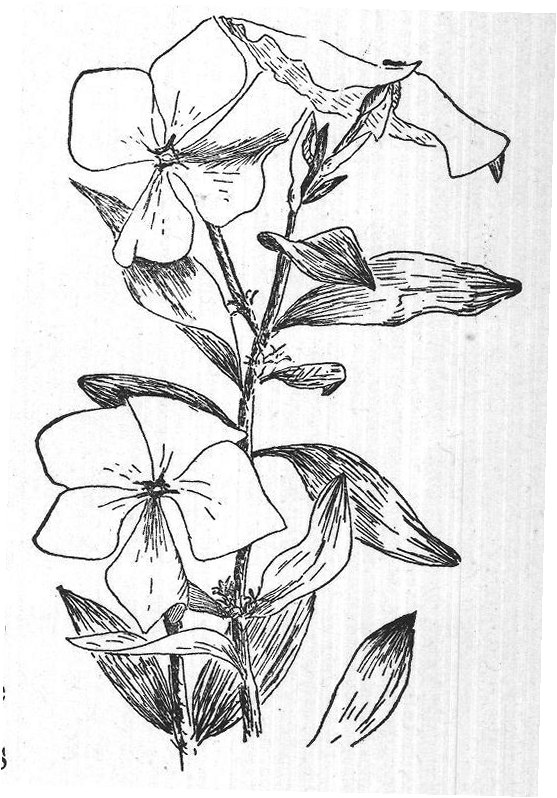
She sees the flowers far off and comes straight to them, choosing the brightest. She has learned that the bright flowers hold much honey and often have guides to the nectary, so that she does not have to hunt about, but, alighting on a flower, follows the bright guide. Sometimes it is a spot in front of the nectary and sometimes a line leading to it. It leads her at once by the shortest path to the nectar, and since she is in such haste, the nectar guides are her good friends, helping her to save time.
CELLS.
CELLS are a matter of importance.
To be sure there are cells and cells, and some are much more important than others.
For instance, there are prison cells, more 's the pity, and anther cells and honeycomb cells and ovary cells and many more like them. All these are small, hollow spaces with walls around them.
But there is another kind of cell, more important than all these others put together, and they are not hollow and do not always have a wall.
Perhaps you are not very much interested in cells, but you had better be in these we are going to talk about, for they have a great deal to do with football games and dancing and going to parties and picnics.
In fact, without them there could be no football and no dancing and no parties nor picnics.
All these things depend upon cells. So we may as well begin at once to find out what they are.
These cells that we are going to talk about are alive. They are made of protoplasm. You do not know what protoplasm is? I can tell you it is time you did then, for if it had not been for protoplasm you would not be in the land of the living. The protoplasm made you; so if you are not interested in it, I think you ought to have been a cabbage or a squash or a liriodendron or some other thoughtless vegetable not expected to be interested in protoplasm. Like a good many other interesting things, protoplasm cannot usually be seen by the naked eye; it is in such small quantities that it takes a microscope to find it. And when you have found it, so far as its looks are concerned, it would hardly seem to pay for the trouble, for to the eye it is nothing but a colorless, jelly-like substance. It looks more like the white of an egg than anything else. But remember it is not safe to judge protoplasm or people by looks alone.
Napoleon was small, and he was not handsome; yet if you had seen him, you would have seen the greatest man living in the world at that time.
In So when you look at protoplasm you see something very much more wonderful than it seems. fact, the great Napoleon himself owed his physical life to protoplasm, as did also Shakespeare and Plato, and every person who has ever lived, for protoplasm is the only living matter in the world.
You cannot understand that all in a minute, but you begin to see that protoplasm is rather important, and as well worth knowing about as the latest fashion in bicycles or sleeve patterns.
Sometimes a bit of protoplasm lives all by itself.
It is just a little speck of colorless, jelly-like substance. Yet it can do a number of things. One little creature, which is only a bit of protoplasm, has a name much larger than itself. We call it "Amœba."
Rather a pretty name, on the whole, and very uncommon. I doubt if you know a single person by that name.
It is a name, too, that everybody ought to know.
Well, as I told you before, and shall probably tell you a great many more times, for I do not want you to forget it, the amoeba is only a bit of protoplasm. Yet it can go about. You watch it some fine day under your microscope and see it travel. It runs out a little, thin bit of its body, so rest of the body sort of pulls and then the itself up to that. In this way, by putting out little finger-like projections and drawing the rest of the body up to them, it can move quite a distance if you give it time enough. You can imagine so changeable a creature as the amœba can scarcely be found twice of the same shape, and how its friends recognize it is more than I can tell. Suppose you were in the habit of changing your shape whenever you moved, being long and thin one minute, short and thick another, having fourteen arms one day and none the next?
How could you expect people to know you when they met you?
But perhaps the ameba has an unsocial nature and does not care whether it is recognized or not.
Because it changes its shape so often the amœba has received its pretty name. For "amœba," you must know, comes from a Greek word meaning "change."