Home › Nectar Guides › Nectar Guides: Proteus
Nectar Guides: Proteus
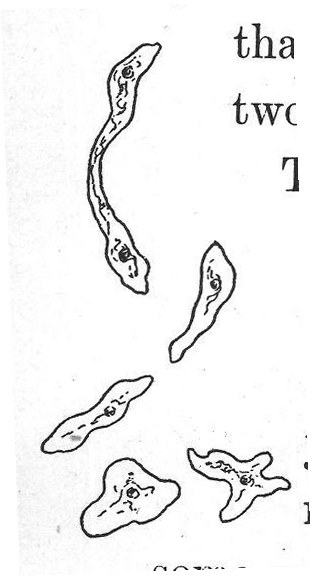
It is sometimes called "Proteus" for the same reason. Of course you know all about Proteus, the sea god who lived at the bottom of the ocean and paid homage to the great god Neptune, who was ruler of the seas. Proteus took care of the sea calves, and he had a queer way of changing his shape whenever he chose. He used to go to sleep on the rocks while the calves were sunning themselves, and because he was very wise and could help people who were in trouble, they used to go there and catch him. But he was not as friendly as he was wise, and would never tell anything unless forced to; and when he found himself a prisoner, he would at once change his form, and so try to escape by frightening his captors. He had a pleasant habit of all at once changing into an enormous serpent and opening a mouth full of frightful teeth; then, if that did not frighten badly enough, he would all at once turn into a bull or a raging fire or a fierce torrent. He has been known to change into a dozen dreadful things in as many minutes, so no wonder his name has come to mean "something that changes." And no wonder the amœba is called " proteus," not that it indulges in any such outrageous transformations as the sea god, for it never does anything worse than change the shape of its own little jelly-like body.
Although it can move along, I do not think it would amount to much in a race, as it only moves a few inches in the course of a day; still that is a good deal, considering its size.
A great deal depends upon size in this world.
You could go as far in ten seconds as a snail could in as many hours. The distance would not count for much as far as you are concerned, but it would be a good day's work for the snail. So when an amœba travels a few inches, that counts for as much in its life as a long day's walk of a good many miles would in yours, or as a few hundreds of miles on a railway train.
The amœba can do more than travel. If you touch one it will shrink together, showing that this little bit of protoplasm has a sort of feeling power. When it is hungry it eats. For an amoeba can get as hungry as anybody.
Hunger does not depend upon size. You can get as hungry as an elephant, although you cannot eat as much. You would starve to death, too, as soon as an elephant, perhaps sooner. An amœba no doubt gets as hungry as you do, and it certainly would starve to death if it did not have something to eat. How can it eat without a mouth? Just as easily as it can travel without feet. You do not know protoplasm if you think it cannot eat when it is hungry. Very likely the reason it travels about is because it wants to find something good to eat. It does not care for roast turkey and cranberry sauce, nor for apple pie and plum pudding.
That is not what it is looking for. It is looking for some tiny speck of food smaller than itself.
It lives in the water, of course. It would dry up if it were out in the air. You should think it would It lives in the water, of course. It would dry up melt in the water? than a jellyfish melts.
Well, it does not, any more When it comes to some little speck of dead plant or animal, or, for all I know, to some living speck small enough, it proceeds to eat it.
It glides over it in the way you know about, and wraps the food speck up in its body. Then it draws out all the good part of the food into its own substance and goes on, leaving behind the waste particles.
Do you not think that is a good deal for an amœba to be able to do? But it can do more than this; it can divide itself in two and make two amœbæ out of one.
The little amœba is called a "cell." After awhile you will see why. The whole amœba is just one cell.
As to whether it is a plant or an animal you will have to ask the amœba, for I cannot tell you. Some think it is a plant and some say it is an animal.
I do not think it makes much difference which you say it is.
A bit of protoplasm living by itself is called a "cell."
Many plants and animals have, like the amœba, only one cell. Very often the little one-celled being has a thick outside wall. The protoplasm changes part of the food into a hard substance, that is, it builds itself a wall.
Very often cells live together in colonies instead of living alone. In such cases, the first cell divides into two cells, but the two stay together instead of entirely separating. Then each of these two cells divides again, and the four cells stay together, and so it goes on until a large body is built up of many cells.
The truth is, plants are only collections of cells which have agreed to work together. Where there is but one cell, it has to do all sorts of work; but where there are many, some do one kind of work, some another, - just as Robinson Crusoe, living all alone on the island of Juan Fernandez, had to do all sorts of things for himself: make his own shoes and clothes, get his own food and cook it, build his own house, and gather his own wood. But in a town one set of men makes shoes, another chops wood, another raises vegetables and grain, another grinds the grain, and another bakes the bread; then they all exchange with each other, and everybody has enough - or ought to have.
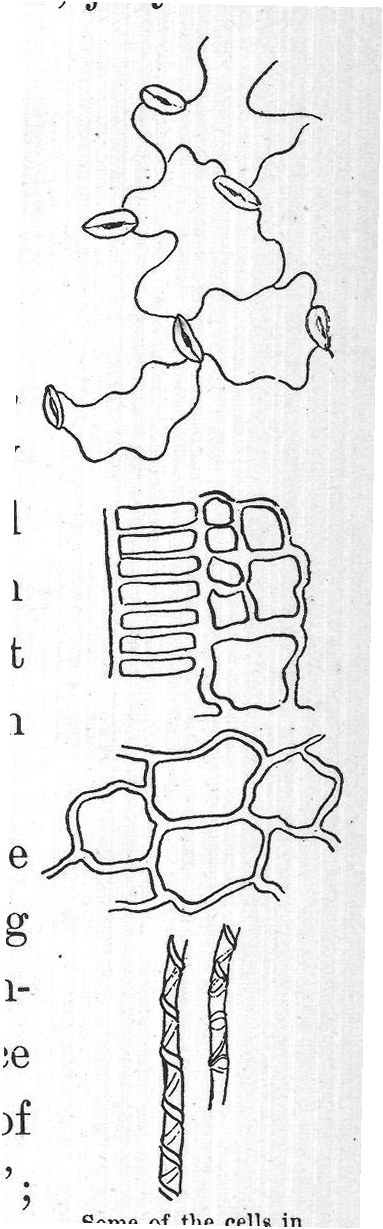
So in the plant made of many cells. One set of cells makes hard walls to protect the plant. Another set draws up water from the earth for all the cells in the plant, for living things require a great deal of water. Another set takes gas from the air and changes it into food. Another set makes tubes for the sap to flow through. Other sets do other things. Each set of cells does something for the whole plant. If you look at a leaf or a bit of skin from a stem under a microscope, you will see they are built up of cells, as a house is built of bricks. Only the cells are not placed regularly like the bricks in a house, and they are not solid like bricks. The walls of these cells are sometimes hard and sometimes soft, sometimes tough and sometimes tender; but the walls were all built by the protoplasm that lived in them. Sometimes the protoplasm leaves the little house it has built and goes somewhere else.
Then the empty, wall-surrounded space is left like a cell of honeycomb before the honey is put in, or an anther cell after the pollen has fallen out and left nothing in it.
Before microscopes were as perfect as they are now, these empty spaces with their surrounding walls were discovered. Even where the cells contained protoplasm the microscope was not strong enough to reveal it, so only the cell walls were seen.
It was soon known that plants were built up of these little compartments, and because they resembled cells in being small and shut in by walls, they were called "cells." After awhile it was discovered that the living part of the plant was the colorless, jellylike protoplasm which lived in the cells. Yet later, particles of wall-less protoplasm were found building up plants and animals.
What were these soft little protoplasmic atoms to be called?
The plant was really built up by them, and only part of them had walls, so they were called by the name the people had already given to the walled spaces which they supposed built up the plant, and so got the name of "cells," which is not at all an appropriate name.
There is nothing quite so easy as to be mistaken, you see, and the botanists, having seen that the plant was built of little compartments, and never suspecting the presence of the living protoplasm lurking in some of them, had called the compartments "cells"; later, when the protoplasm was discovered to be the real builder, the old name was kept. So " cell." you see how the ameba came to be called a There are a great many different kinds of cells in one plant.
Some of the cells in one plant.
But every living cell has very much the same powers as the amœba, though in many of them some one power is developed at the expense of all the rest. In this way different sets of cells are able to perform different kinds of work, and do it very well indeed. The amoeba is not the only single-celled creature.
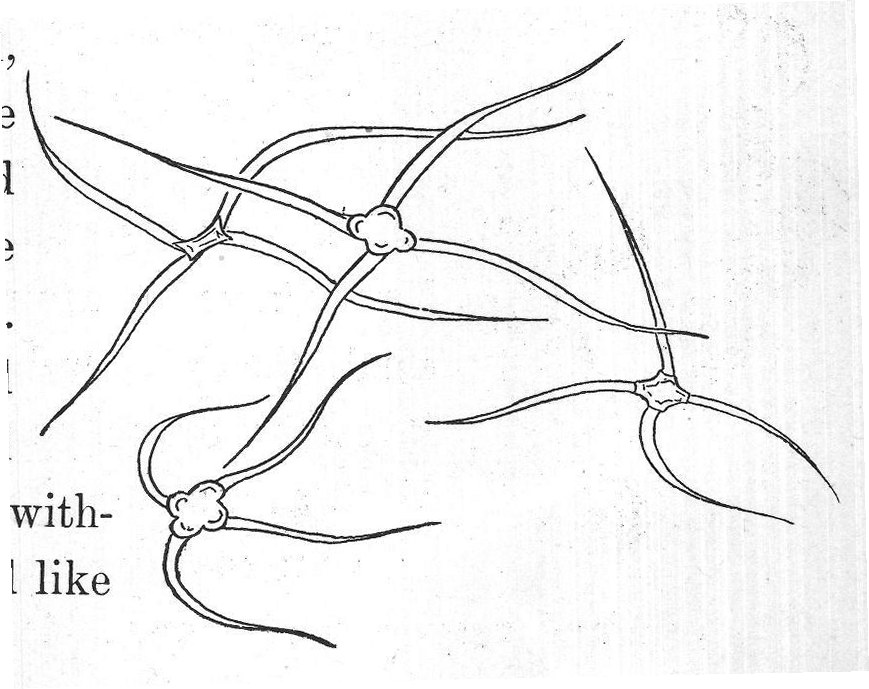
There are a great many different kinds of singlecelled plants or animals, and some of them take very curious and beautiful forms, with streamers floating about them.
Such are not protean, like the amœba; they do not change their shapes.
Plants are not the only things that have cells.
Animals, too, are built up of them. Animal cells are usually softer than plant cells, because they very often have no hard walls. Bone cells of course have hard walls, and there are others, but most of the animal cells are without walls.
So you see all living things are built of cells, and the living part of the cells is the protoplasm.
You yourself are built up of millions of cells, and without the help of protoplasm you would not be living, for protoplasm made your cells, and protoplasm is the only thing in you that is alive. Your muscles are made of muscle cells, and the protoplasm in them moves, and when the muscle cells all move together, that moves your arm or your leg or your head or some other part of your body.
Since your muscle cells devote themselves to moving, they do not try to do much else; so other cells digest the food which the blood carries to the muscle cells. Yet other cells build a good thick skin to protect the soft muscles, and yet another set of cells thinks for the muscles, and tells them where and when and how to move. Each set of cells has its own work. Your brain is made up of nerve cells, and the protoplasm in them in some way enables you to think and feel. Your bone cells are hard and resisting, your sinew cells strong and flexible. So each part of your body is made up of different kinds of cells. But what has all this to do with football and parties and picnics you would like to know?
Why, a great deal, to be sure. If it were not for cells and protoplasm there would be no people.
And how could you have football games and picnics without people, I should like to know?