Home › Contents › Hyacinth Stories (Not think however the bulbs)
Hyacinth Stories (Not think however the bulbs)
not think, however, the bulbs are called "tunicated" because they came from the lands where tunics are worn. I think it is merely a name the botanists gave them for convenience to tell that they were covered by coats or scales.
What do you suppose a hyacinth tunic is, anyway?
Merely a leaf scale! That is, instead of growing into a leaf it remained a scale, and some of the scales on a full-grown bulb are really the lower parts of the leaves. The upper part has fallen off and left the fleshy base to feed the plant.
Tulips have tunics too, and so have many other plants. And bulb tunics are a very convenient sort of garment to have, for they not only wrap up the plant, but feed it!
They answer the same purpose that tubers do on potato roots. You know what tubers are? They are just swollen portions of underground stems.
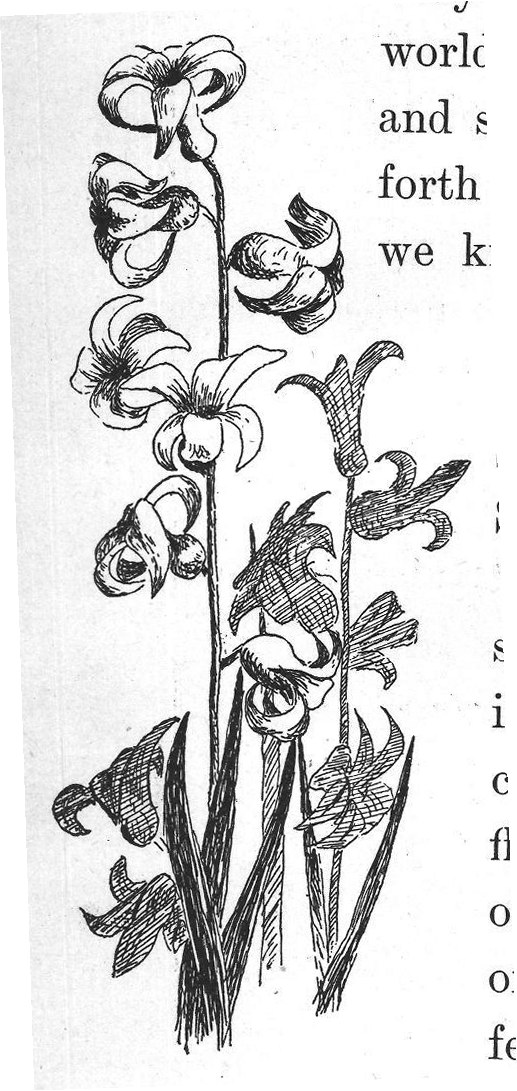
When you eat your next potato remember it is a tuber, and that a tuber is merely a short piece of stem very much thickened. If you cannot believe this, look a potato in the eyes. There you will see the truth, for the eyes are merely the joints of the stem, and at each is a little bud that in the spring will start to grow, just like the buds on the branches of a tree. The bud grows at the expense of the material in the tuber, and the hyacinth grows at the expense of the food stored in the bulb. Of course, after a while green leaves form and make more food, but the very first food comes from the thick underground scales. The hyacinth belongs to the royal Lily Family, and is a very great favorite with people all over the is a very great favorite with people all over the world. Sometimes its flowers are single and sometimes double, and they always give forth a delightful fragrance. Its home, as we know, is in the Levant, a country made up of the islands and the coast along the eastern part of the Mediterranean Sea, particularly of Asia Minor and Syria.
It grows so readily and comes up so early in the spring and is so lovely it is no wonder people everywhere cherish it. Its bulb is large and fleshy, and, as we know, is made up of thick scales. These scales are full of starch and other food materials to feed the young plant.
For the young plant is in the very center of the bulb, with the fleshy scales folded about it very much as the scales are folded about a tree bud. In fact, a. bulb is very much like a bud. The bottom of the bulb is a very short, broad stem. The scales grow on this stem as the leaves do on a branch. They are alternate in arrangement, but packed so closely together you have to look very carefully in order to discover that they are arranged like leaves on a stem. After all, as we know, these scales are only modified leaves. The bracts of the pelargonium are leaves modified to protect the young buds, and the scales of the hyacinth are leaves modified to protect and feed the plant within.
For what do you think? At the very center of the hyacinth bulb is a tiny flower cluster wrapped about by half a dozen tiny leaves! These are white and delicate and very, very small. But in the spring they grow and come out of the bulb in the form of green leaves and bright flowers.