Home › Rings in Ecclesiastical Usages › Rings in Ecclesiastical Usages: Religious
Rings in Ecclesiastical Usages: Religious
Religious ring.
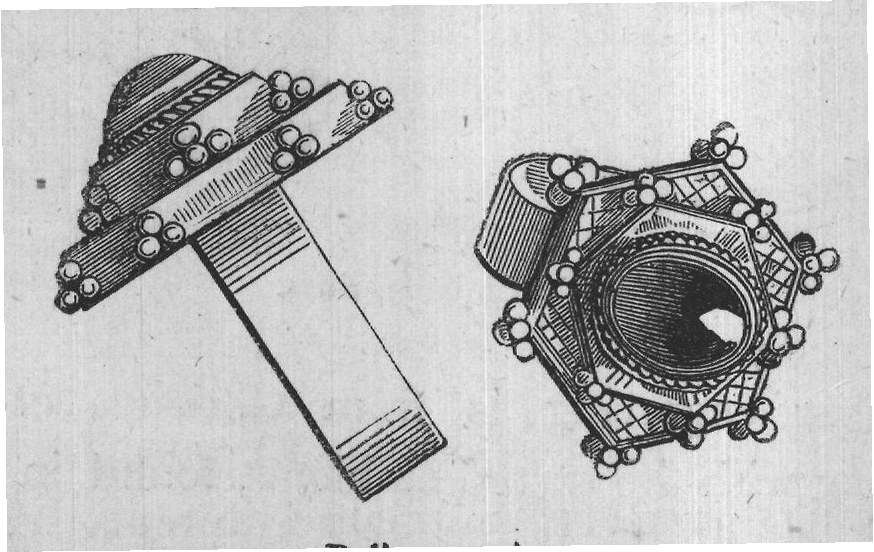
At Barnard Castle, in 1811, a gold ring was found of eight globules, in weight equal to three guineas and a half. On the second is s; on the fourth, us; on the sixth, JH; on the eighth, s, the abbreviation of Sanctus Jesus; on the first, is the Saviour on the cross in the arms of God; on the third, the Saviour triumphing over death; on the fifth, the Saviour scourged; on the seventh, Judas, the traitor. The accompanying illustration represents a 'religious' ring, found in the eighteenth century near Loughborough, Amen Time Religious ring. and described in the 'Gentleman's Magazine' for 1802. The figures are those of the Virgin Mary, Child, and St. Michael. A ring of a curious form is described in the 'Gentleman's Magazine' for 1811, as having been found in the parish of Stonham-Aspal, Suffolk. The gold seemed pure, but the workmanship was rude, and the gem which it enclosed was supposed to be a virgin sapphire.
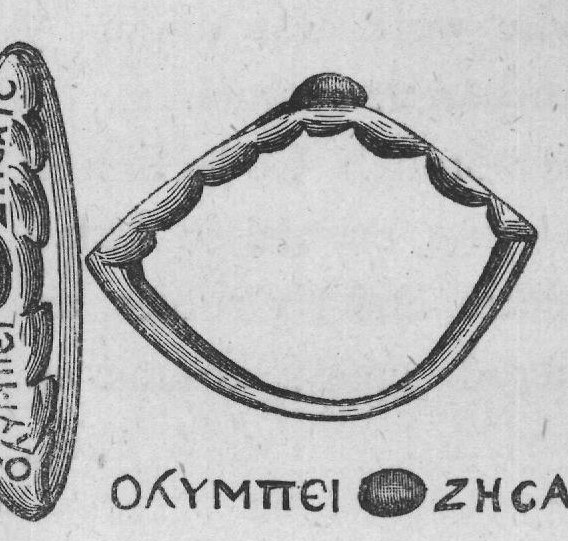
OΛYMΠEI ZHCAIC OΛYMΠEI ZHGAIC Religious ring.
The following represents a large and curious ring found about 1750 at the hermitage on the River Itchen, at Southampton, which is noticed in Sir Henry Englefield's 'Walk Round Southampton,' and is mentioned in the 'Gentleman's Magazine' for 1802. The bezel is little broader than the hoop.
Religious ring.
In the collection of Mr. Octavius Morgan, F.R.S., F.S.A., is a Jewish ring enamelled with figures in relief, representing the Creation, the Temptation, and the Fall of Adam and Eve; date, sixteenth century. 2 'Paradise' rings.
In the cathedral library at Chichester is an ancient gem having the Gnostic equivalent of the blessed name Jehovah. This was used by Seffrid, Bishop of Chichester (died 1159), as his episcopal signet.
Reliquary ring.
S In the Gérente Collection is a reliquary ring of silver-gilt elaborately ornamented.
The Bessborough Collection has a ring with a frog or toad cut in a magnificent almandine, of Roman work-a favourite device in the later Imperial times, the animal typifying a new birth by its total changes of form and habits, and hence adopted into the list of Christian symbols.
The Rev. C. W. King notices in his 'Antique Gems,' among some 'highly curious and undoubted Christian subjects engraved on gems, one of the most interesting-a red jasper set in an elegant antique gold ring, the shank formed of a corded pattern, in wire, of a novel and beautiful design. The stone bears, in neatly-formed letters : IHCOYC-ΘEOY- YIOC-THPE, "Jesus, Son of God, keep us." Another, of equal interest and of the earliest period of our religion, a fish cut on a fine emerald (quarter of an inch square), is set in an exquisitely-moulded six-sided ring, with fluted and knotted shank, imitating a bent reed, very similar to a bronze one figured in Caylus.
The first of the annexed illustrations represents an early Christian ring with the symbol of an anchor.
Early Christian rings.
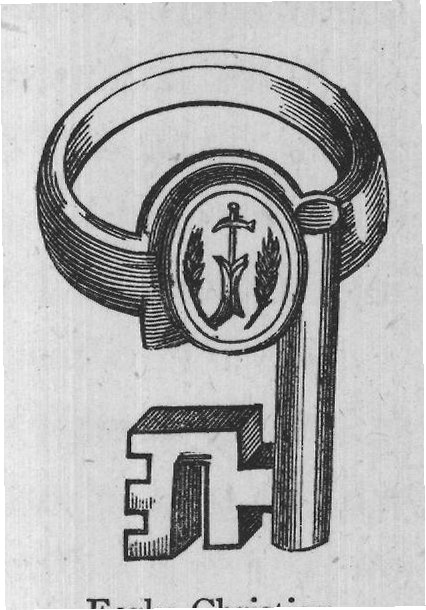
The other engraving is from Gorlæus, of an early Christian ring with the sacred emblems, found in the Catacombs at Rome. The following illustration represents a key-ring, with sacred monogram.
In the Waterton 'Dactyliotheca' is an early Christian ring having 'the Holy Church represented by a pillar, on which are figured twelve dots, which denote the twelve apostles. Three steps, thrice repeated, lead to the pillar, symbolising the lavacrum regenerationis, which was formerly received by three immersions, and three interrogations, and three replies given by those who were being baptised.' Early Christian.
In the treasuries of various continental churches are 'religious' rings, to which a high value is attached. In the church of St. Ursula, at Cologne, is one called the ring of that saint, and is, certainly, of very early date.
Mr. J. W. Singer informs me that he has seen in the treasury of the cathedral of Liége, a large shrine, far above the size of life, in silver-gilt, the bust of St. Lambert, the patron of the cathedral. One hand has a crosier, and the other holds a book. On the right hand are six rings, and on the left are three, of the seventeenth and eighteenth century style; the shrine being late fifteenth or early sixteenth century. The rings are on very different parts of the fingers, some being on the first joint.
These rings may have been votive offerings; one is a ruby ring having a stone weighing ten carats.
In a catalogue (kindly lent to me by Mr. Singer), 'Des Bijoux de la Très Sainte Vierge del Pilar de Saragosse' of offerings by the pious to the sacred treasury for many centuries, and which were sold in 1870 to defray the expenses S2 of repairs and embellishments to the Holy Chapel, numerous costly rings are included among other precious objects. With a few instances of 'religious' rings, including pilgrims' rings, &c., now in the possession of several eminent collectors, and exhibited at various meetings of the Archæological Society, I must conclude the present chapter. In the curious catalogue of Dr. Bargrave's Museum (Camden Society) is mentioned 'a small gold Salerno ring, written on the outside-not like a posey, in the inside, but on the out-Bene scripsisti de Me, Thoma. The story of it is, that Thomas Aquinas, being at Salerno, and in earnest in a church before a certain image there of the Blessed Virgin Mary, his devotion carried him so far as to ask her whether she liked all that he had writ of her, as being free from original sin, the Queen of Heaven, &c., and entreated her to give him some token of her acceptance of his endeavours in the writing of so much in her behalf; upon which the image opened its lipps and said, Bene scrippaz O.JEWITT Religious seal-ring. sisti de Me, Thoma. 'Salerno layeth a little beyond Naples on the Mediterranean Sea ; and the goldsmiths of that place, for their profit, make thousands of these rings, and then have them touch that image which spake. And no merchant or stranger that cometh thither but buyeth of these rings for presents and tokens.' A seal-ring, considered to belong to the fifteenth century, was discovered at Cuddesden in 1814, by some workmen, in front of the gate of the episcopal palace. It is of brass; the impress is an oblong octagon ; the device is the word pax, with a crown above, and a heart and palmbranches below. In the collection of the Hon. Richard Neville is a ring of silver-gilt (time, Henry VII.), with bevelled facets, engraved with figures of saints, found at the Borough Field, Chesterford; also a latten ring found in the Thames (1846), the impress being the Virgin and Child; and the ring of latten-ih-discovered in repairing Weston Church, Suffolk ; within is inscribed, in deo salug.
A gold ring in the possession of Mrs. Baker, of Stamford, stated to have been found in the tomb of an ecclesiastic, in a stone coffin, near Winchester, bears a representation of St. Christopher.
A ring found at Loughborough, in 1802, represents the Virgin and St. Michael, with motto.
Amore Jeruer Religious ring.
A silver ring found at Carlisle, in 1788, bears an inscription below, which has been suggested for ' Mary, Jesus.' The bezel of this ring is a rude representation of joined hands, surmounted by a crown, and a portion of the hoop is decorated with lozenge-shaped spaces, filled with a row of quatrefoils. A correspondent to the 'Gentleman's Magazine' for 1788, in allusion to this ring, mentions that the hands joined together exactly resemble one found at Shaf Abbey, with the motto 'iheu. Or, he suggests, 'it may be a wedding-ring, and to be read, Marith (marrieth) us.' A similar ring, with the hands joined, and inscribed Jesus Nazarenus, is represented in the 'Gentleman's Magazine' (vol. liv. p. 734, and vol. lv. p. 333).