Home › Rings from the Earliest Period › Rings from the Earliest Period (With a zigzag punched ornament)
Rings from the Earliest Period (With a zigzag punched ornament)
with a zigzag punched ornament round it. This ring was found in the neighbourhood of Bristol.
It was in the Middle Ages, however, after a period of comparative mediocrity, that the greatest degree of perfection in goldsmiths' work, and especially in rings, began to display itself. In the reign of Edward III. (1363), so great was the extravagance in dress and decoration that an Act was passed to repress the evil. All persons under the rank of Knighthood, or of less property than two hundred pounds in land and tenements, were forbidden to wear rings, and other articles of jewellery.
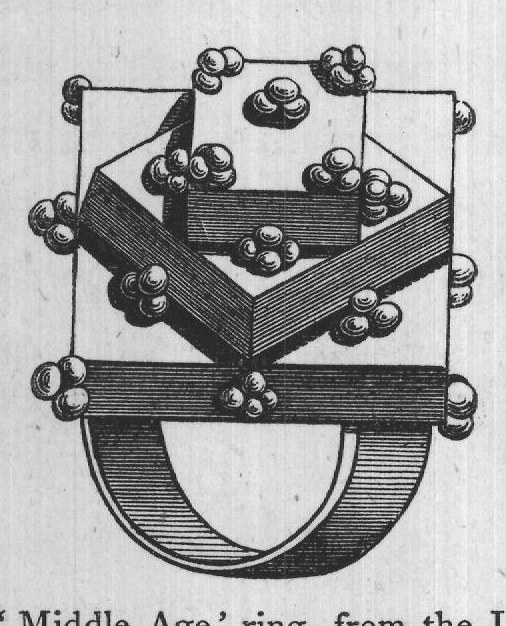
Gold Middle Age' ring, from the Louvre.
In the 'Vision of Pierce Ploughman,' written, it is supposed, about this date, the poet speaks of a richly-adorned lady, whose fingers were all embellished with rings of gold, set with diamonds, rubies, and sapphires.
In a parchment roll of Prayers to the Virgin in the Library of Jesus College, Oxford, which formerly belonged to Margaret of Anjou, there is a portrait of that queen who is represented wearing two rings on each finger except the least, placed on the middle as well as the third joint of the fingers-a fashion probably introduced by her, and shown in the curious portrait of this queen on the tapestry at Coventry.
In later ages we find the same practice of ornamenting the fingers with several rings. In the description of a Scottish woman of the middle of the sixteenth century, attributed to Dunbar, we find :- On ilkune fyngar scho weirit ringis tuo Scho was als proud an ony papingo.
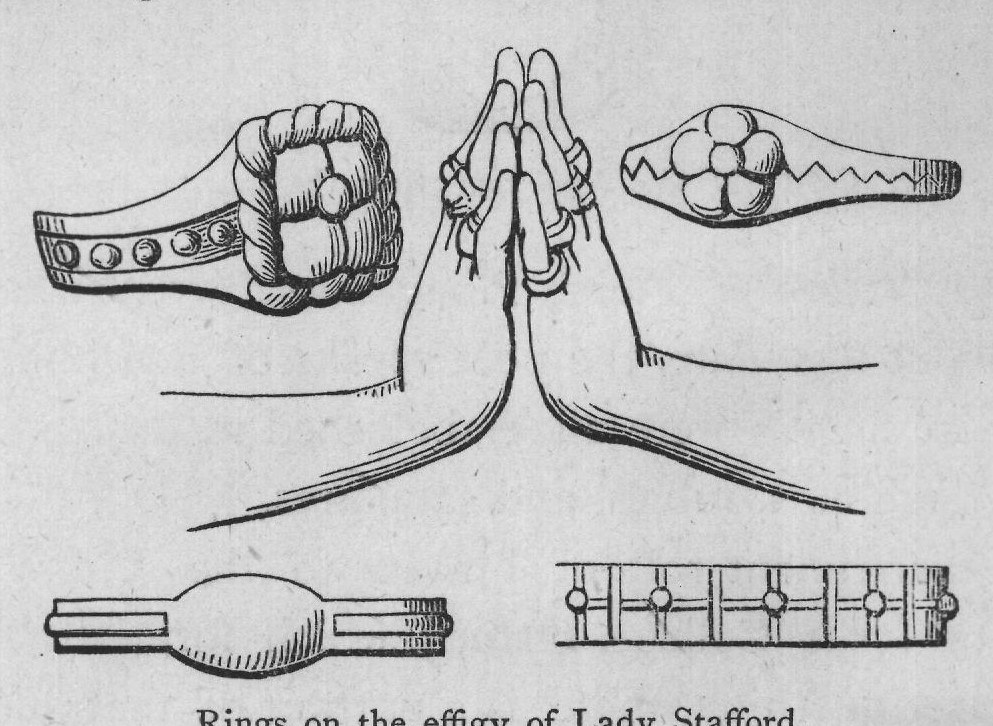
For Queen Elizabeth had an immoderate love for jewellery ; and the description given of her dresses covered with gems of the greatest rarity and beauty reads like a romance. finger-rings she had a remarkable fondness. Paul Hentzner, in his 'Journey into England,' 1598, relates that a Bohemian baron having letters to present to her at the palace of Greenwich, the queen, after pulling off her glove, 'gave him her right hand to kiss, sparkling with rings and jewels-a mark of particular favour.' In Bromsgrove Church, Staffordshire, are the fine monu- Rings on the effigy of Lady Stafford. mental effigies of Sir Humphrey Stafford and his lady (1450)-remarkable alike for the rich armour of the knight and the courtly costume of the lady. She wears a profusion of rings; every finger, except the little finger of the right hand, being furnished with one. They exhibit great variety of design. The two hands are lifted in prayer. 'In the Duke of Newcastle's comedy,' observes Mr.
Fairholt, the "Country Captain" (1649), a lady of title is told that when she resides in the country a great show of finger rings will not be necessary : "Show your white hand, with but one diamond, when you carve, and be not ashamed to wear your own ringe with the old posie." That many rings were worn by persons of both sexes is clear from another passage in the same play, where a fop is described, 'who makes his fingers like jewellers' cards to set rings upon.' The same custom prevailed in France. Mercier, in his 'Tableau de France,' mentions that at the close of the eighteenth century enormous rings were worn. The hand of a woman presented a collection of rings, 'et si ces bagues étaient des antiques, elles offriraient un échantillon d'un cabinet des pierres gravées.' He adds that 'the nuptial ring is now unnoticed on the fingers of women; wide and profane rings altogether conceal this warrant of their faith.' So important a business was the making of rings that it was separated from the ordinary work of the goldsmith, and became a distinct trade.
In the sixteenth century, among the various articles carried by the pedlar rings were reckoned. In Heywood's 'Four PP (A Newe and a very mery Enterlude of a Palmer, a Pardoner, a Potycary, and a Pedler),' the Potycary addresses the Pedler :- What the devyll hast thou there at thy backe?to which he replies :- What dost thou not knowe that every pedler In all kinde of trifles must be a medler?
Gloves, pinnes, combes, glasses unspotty'd, Pomanders, hookes, and lases knottyed; Broches, rynges, and all maner of bedes.
The instances in which brooches and rings are mentioned together are numerous. In Scott's edition of Sir Tristrem (pages 23, 28) we find :- Who gaf broche and beighe (ring)?
Who but Douk Morgan?
A loud thai sett that sleigh With all his winning yare With broche and riche beighe.
In the Chester Mystery Plays the shepherds do not know what to present to the Babe of Bethlehem, and Secundus Pastor says :- Goe we nere anon, with such as we have broughte, Ringe, broche, ner precious stoune, Let us see yf we have oughte to proffer.
And the 'first boye' adds :- Nowe Lorde for to geve thee have I no thinge, Neither goulde, silver, broche, ner ringe.
In the old ballad of Redisdale and Wise William the lady is enticed with rich presents :- Come down, come down, my lady fair, A sight of you i'll see, And bonny jewels, broaches, rings, I will give unto thee. to which she replies :- If you have bonny broaches, rings, Oh, mine are bonny tee, Go from my yettes, now, Reedisdale, For me ye shall not see.