Home › Rings from the Earliest Period › Rings from the Earliest Period: Alexander
Rings from the Earliest Period: Alexander
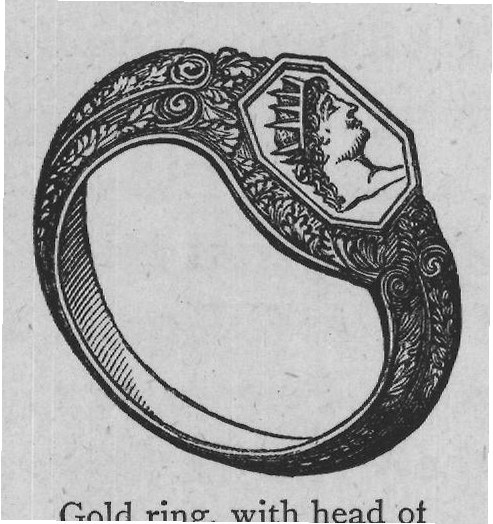
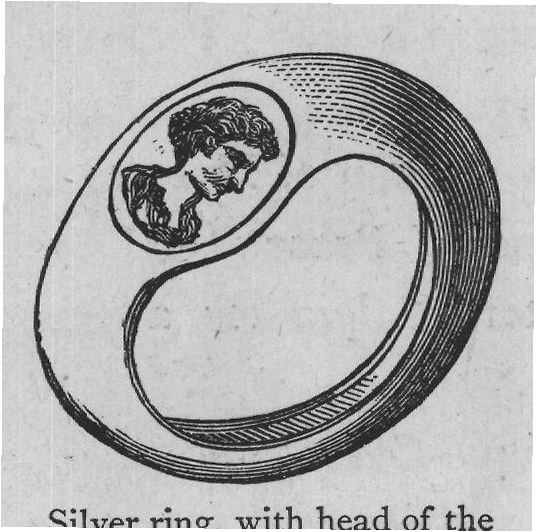
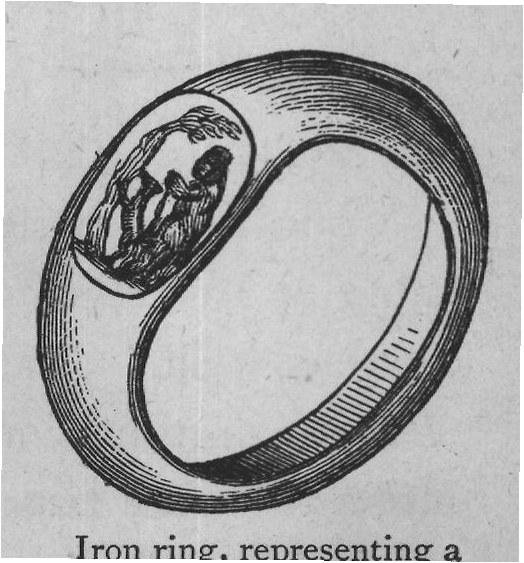
On the ring of Julius Cæsar was a representation of an armed Venus, as he claimed to be a descendant of the goddess. This device was adopted by his partisans; on that of Augustus, first a sphinx; afterwards the image of Alexander the Great, and at last, his own portrait, which succeeding emperors continued to use. Among the ancients the figures engraved on rings were not hereditary, and each assumed that which pleased him. Numa had made a law prohibiting representations of the 1 'As soon as the despotic power of the Cæsars was established,' remarks the Rev. C. W. King ('Handbook of Engraved Gems'), 'it became a mark of loyalty to adorn either one's house, or one's hand, with the visible presence of the sovereign. Capitolinus notices that the individual was looked upon as an impious wretch, who, having the means, did not set up at home a statue of M. Aurelius ; and, a century later, the Senate obliged by an edict every householder to keep a picture of the restorer of the Empire, Aurelian. That official swore such portraits in their rings as an indispensable mark of distinction may be deduced from the negotiations of Claudius (preserved by Pliny ) confining the entrée at court to such as had received from him a gold ring having the imperial bust carved on it.' gods, but custom abrogated the ordinance, and the Romans had engraved in their rings not only figures of their own deities, but those of other countries, especially of the Egyptians. The physician Asclepiades had a ring with Urania represented upon it. Scipio the African had a sphinx; Cornelius Scipio Africanus, younger son of the great Africanus, wore the portrait of his father, but as his conduct was unworthy of the character of his illustrious sire the people expressed their disgust by depriving him of the ring. Sylla had a Jugurtha; the Epicureans, a head of Epicurus ; Commodus, an Amazon, the portrait of his mistress Martia ; Aristomenes, an Agathocles, King of Sicily; Callicrates, a Ulysses; the Greeks, Helen; the Trojans, Pergamus; the inhabitants of Heraclia, a Hercules; the Athenians, Solon ; the Lacedæmonians, Lycurgus; the Alexandrians, an Alexander; the Seleucians, Seleucus; Mæcenas, a frog; Pompey, a dog on the prow of a ship; the Kings of Sparta, an eagle holding a serpent in its claws; Darius, the son of Hystaspes, a horse; the infamous Sperus, the rape of Proserpine; the Locrians, Hesperus, or the evening star; Polycrates, a lyre; Seleucus, an anchor.
The Rev. C. W. King, in 'Antique Gems,' informs us that 'the earliest mention of a ring-stone in relief occurs in Seneca, who, in a curious anecdote which he tells ("De Beneficiis," iii. 26) concerning the informer Maro and a certain Paulus, speaks of the latter as having had on his finger on that occasion a portrait of Tiberius in relief upon a projecting gem, "Tiberii Cæsaris imaginem ectypam atque eminente gemma." This periphrasis would seem to prove that such a representation was not very common at the time, or else a technical term would have been used to express that particular kind of gem-engraving.' D2 Among the discoveries made during some excavations at Canterbury in 1868 was a Roman ring of exceedingly pure gold, the stone being a very fine and highly-polished onyx, engraved with a Ganymede.