Home › Ring Superstitions › Ring Superstitions: Morgan
Ring Superstitions: Morgan
At the meeting of the 'Society of Antiquaries' (June 12, 1873) a very interesting collection of so-called Tau (T) rings were exhibited by Octavius Morgan, Esq., F.R.S., F.S.A. These, bearing the mystical emblem of the T (tau), are by no means of frequent occurrence, and it is not likely that so many were ever brought together before. The tau was early esteemed a sacred symbol, and was considered to be the mark placed on the forehead, as mentioned in the 66 Bible. 'I have,' remarks Mr. Morgan, 'in my collection a champlevé enamel of the thirteenth century, where the man in the linen garment," as mentioned in Ezekiel ix., is represented marking the T on the forehead of the faithful children of Israel. A mystical virtue was attached to this T, and, in company with the word ANANIZAPTAwhich, being faithfully translated from the Chaldee, according to the Rev. C. W. King, means, "Have mercy on us, OJudge" -was thought a most powerful prophylactic against epilepsy.' A description of these curious rings will be found in the 'Proceedings of the Society' (vol. vi. No. 1, pp. 51, 53). A toadstone ring (the fossil palatal tooth of a species of Ray) was supposed to protect new-born children and their mothers from the power of the fairies; and this continued a late-day superstition, for Joanna Baillie, in a letter to Sir Walter Scott, mentions one having been repeatedly borrowed from her mother for that purpose. It was believed also to be a specific in cases of diseased kidney, when immersed in water which was drunk by the patient.
In the inventory of the Duke de Berry is mentioned 'une crapaudine assize en un annel d'or;' also, in the inventory of the Duke of Burgundy, we find' deux crapaudines, l'une en ung anneau d'or, l'autre en ung anneau d'argent.' These were highly esteemed for their magical properties, as I have remarked, and were probably also worn to prevent the administration of poison, being supposed to indicate its presence by perspiring and changing colour. Fenton, who wrote in 1569, says, 'Being used in rings they give forewarning of venom.' In Ben Jonson's 'Fox' (ii. 5) it is thus alluded to :- Were you enamoured on his copper rings, His saffron jewel, with the toadstone in't?
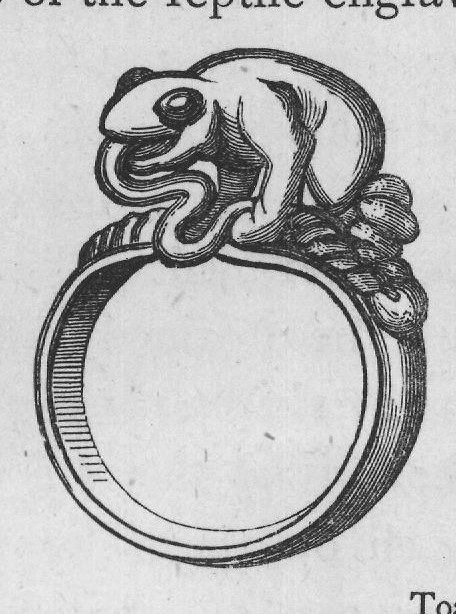
Lupton, in his 'Thousand Notable Things,' says that the stone (which, according to Fenton, was most commonly found in the head of a he-toad) was not easily attained, for the toad 'envieth so much that man should have that stone. To know whether the stone called crapaudina be the right or perfect stone or not, hold the stone before a toad so that he Silver toadstone ring (fifteenth century). may see it, and, if it be a right and true stone, the toad will leap towards it, and make as though he would snatch it from you.' An ingenious method of obtaining the stone is given by the same writer: 'Put a great or overgrown toad (first bruised in divers places) into an earthen pot; put the same into an ant's hillock, and cover the same with earth, which toad at length the ants will eat, so that the bones of the toad and stone will be left in the pot.' A mediæval author, however, states that the stone should be obtained while the toad is living, and this may be done by simply placing upon him a piece of scarlet cloth, 'wherewithal they are much delighted, so that, while they stretch out themselves as it were in sport upon that cloth, they cast out the stone of their head, but instantly they sup it up again, unless it be taken from them through some secret hole in the same cloth.' The scarlet, however did not always perform this miracle, for Boethius relates how he watched a whole night an old toad he had laid on a red cloth to see him cast forth the stone, but the toad was stubborn, and left him nothing to 'gratify the great pangs of his whole night's restlessness.' The Londesborough Collection contains two remarkable specimens of rings connected with toad superstition, thus described by Mr. Fairholt: 'The first is of mixed metal, gilt, having upon it the figure of a toad swallowing a serpent. There is a mediæval story of a necromancer introducing himself to another professor of magic by showing him a serpent-ring, upon which the latter, who did not desire anyone to interfere with his practice, produced his toadstone ring, observing that the toad might swallow the serpent, thereby intimating his power to overcome him. The second ring is curious, not only as containing the true toad-stone, but the stone is embossed with the figure of a toad, according to the description of Albertus Magnus, who describes the most valuable variety of this coveted gem as having the figure of the reptile engraved on it.' Toadstone rings.
Prætorius mentions that a member of the German house of Alveschleben received a ring from a 'Nixe' to which the future fortunes of his line were to be attached. The turquoise ring of Shylock, which he would not have given for a 'wilderness of monkeys' ('Merchant of Venice,' scene i.), was probably more esteemed for its secret virtues than from any commercial value, the turquoise, turkise, or turkey-stone having, from remote periods, been supposed to possess talismanic properties. Fenton, in his 'Secret Wonders of Nature' (1569), thus describes the stone: 'The turkeys doth move when there is any peril prepared to him that weareth it.' Dr. Donne alludes to A compassionate turquoise, that doth tell, By looking pale, the wearer is not well.
Among the virtues of the turquoise is one which would spare us the shame of a divorce-court, as it was believed to take away all enmity, and to reconcile man and wife. Holinshed, speaking of the death of King John, says: 'And when the king suspected them (the pears) to be poisoned indeed, by reason of such precious stones as he had about him cast forth a certain sweat, as it were bewraeing the poison, &c.' The turquoise was a supposed monitor of poison from this circumstance. 'With the Germans the turquoise is still the gem appropriated to the ring, the " gage d'amour," presented by the lover on the acceptance of his suit, the permanence of its colour being believed to depend upon the constancy of his affection. Inasmuch as this stone is almost as liable to change, and as capriciously as the heart itself, the omen it gives is verified with sufficient frequency to maintain its reputation for infallibility' (The Rev. C. W. King, on 'Precious Stones,' &c.). Camillus Leonardus, in the 'Mirror of Stones,' describes the carbuncle as 'brandishing its fiery rays on every side, and in the dark appearing like a fiery coal. It is esteemed the first among burning gems.' The ancients supposed this stone to give out a native light without reflection, and they ranked it fifth in order, after diamonds, emeralds, opals, and pearls. The virtue of the carbuncle was to drive away poisonous air, repress luxury, and preserve the health of the body. The wonderful light emitted from the stone is one of the most prolific resources of romance among old writers. Shakspeare alludes to the superstition in 'Titus Andronicus' (Act ii. sc. 4). Martius.
Quintus.
Martius.
Lord Bassianus lies embruèd here All on a heap, like to a slaughtered lamb, In this detested, dark, blood-drinking pit.
If it be dark, how dost thou know 'tis he?
Upon his bloody finger he doth wear A precious ring that lightens all the hole, Which, like a taper in some monument, Doth shine upon the dead man's earthy cheeks, And shows the rugged entrails of the pit.