Home › Ring Superstitions › Ring Superstitions: Abraxas-stones
Ring Superstitions: Abraxas-stones
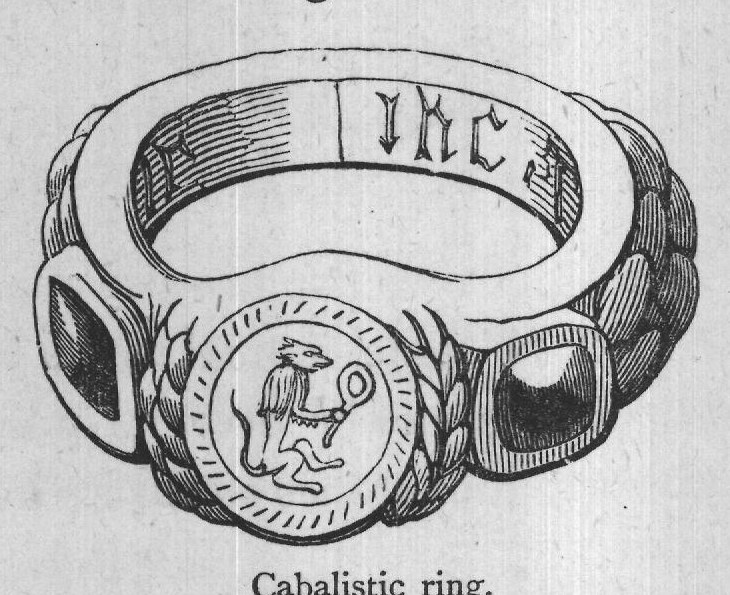
A thumb-ring was discovered a few years since in the coffin of an ecclesiastic, in Chichester Cathedral, set with an Abraxas gem,¹ an agate; the deceased churchman, it may be well believed, had worn it guiltless of all knowledge of Alexandrine pantheism. The ring was of gold, and was found on the right-hand thumb-bone of a skeleton, the supposed remains of Seffrid, Bishop of Chichester, A.D. 1125. A very large ring, bearing great resemblance to the episcopal ring, was occasionally worn as a thumb-ring by the laity. In the Londesborough Collection is a fine specimen. The Cabalistic ring.
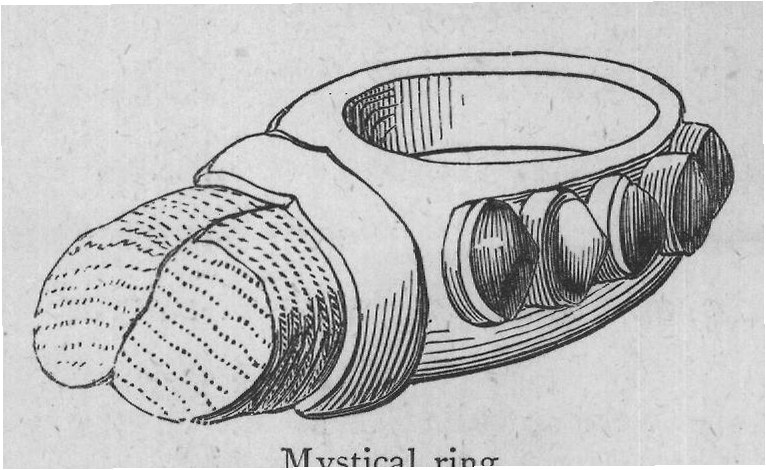
It is somewhat roughly formed of mixed metal, and has upon the circular face a conventional representation of a monkey looking at himself in a hand-mirror. This is sur- 1 Abraxas-stones were so called from having the word Abraxas or Abrasax engraved on them. They are cut in various forms, and bear a variety of capricious symbols, mostly composed of human limbs, a fowl's head and serpent's body. These gems are represented as coming from Syria, Egypt, and Spain. It is certain that the use of the name Abraxas was at first peculiar to the Gnostic sect of the Basilideans. There is little doubt that the greater part of the Abraxas-stones were made in the Middle Ages as talismans. rounded by a cable-moulding, and on each side is set two large stones. The outer edge of this ring is also decorated with a heavy cable-moulding; inside, next the figure, is the cross and sacred monogram, placed on each side of the mystic word anamzapta, showing it to be a charm-ring. Another mystical ring in the same collection is inscribed, on an oval boss, hETH; the workmanship, probably English, of about the fifteenth century. This ring was bought at Ely. Heth was the sacred name of Jehovah. Dr. Dee and similar Gnostics composed several mystical arrangements founded on these four letters.