Home › Ring Superstitions › Ring Superstitions (Supposed that this ring)
Ring Superstitions (Supposed that this ring)
supposed that this ring and the other remains alluded to indicate the spot where a Spanish or Portuguese vessel was wrecked about two hundred years ago.
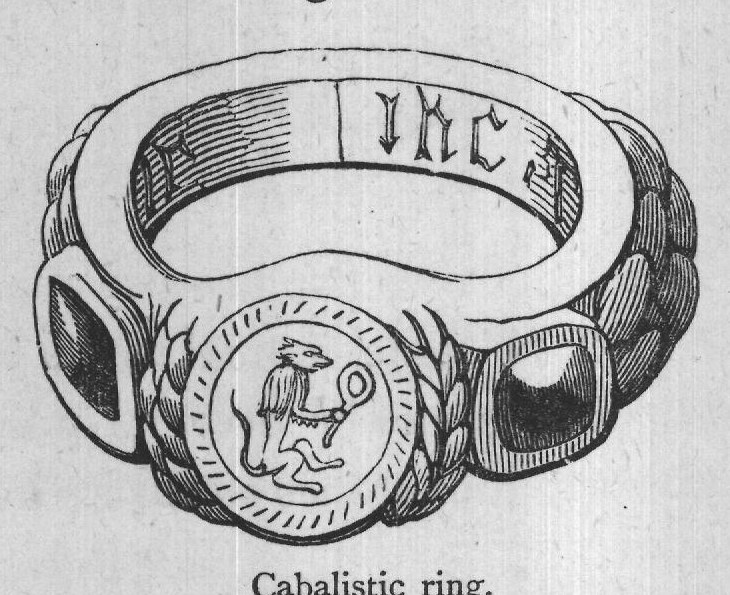
The following engraving, from the 'Archæological Journal' (vol. iii. p. 267), represents another cabalistic ring, found in Worcestershire, and the property of Mr. Jabez Allies. It is of base metal, plated with gold, and is, apparently, of the fourteenth century. +THEBAIGUTHGUTHANI A ANHTHE Talismanic ring.
In the 'Archæological Journal' (vol. v. p. 159) is an engraving and description of a curious talismanic ring, with an inscription showing stronger evidence of oriental origin than any heretofore noticed, the Greek letters theta and gamma occurring twice in the legend. The discovery of this relic, which is of gold, weighing 56 grains, was singular. It was found in digging up the roots of an old oak-tree which had been blown down by a violent wind in 1846, on a farm called the 'Rookery,' in the parish of Calne, Wiltshire, belonging to Mr. Thomas Poynder, who thinks that the spot where the ring was found was in the track of the fugitive Royalists, after the battle at Rounday Hill, near Devizes, on their retreat towards Oxford, where the King's head-quarters were stated to be at that time. This curious ring is divided into eight compartments, with a row of three little rounded points, or studs, between each. The hoop is bent irregularly, so that the inner circle presents seven HBALTVOLVANI AWAY del O-JEWITISO Talismanic ring. straight sides, but the angles thus formed do not correspond precisely with the external divisions.
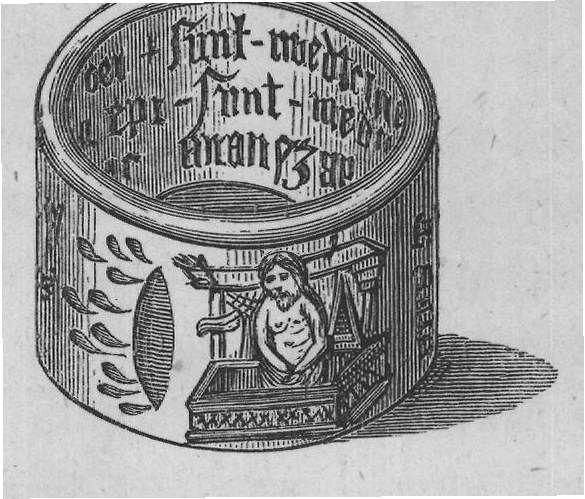
A talismanic ring of gold found in Coventry Park in 1802, represents in the centre device Christ rising from the sepulchre, der+Funt-medte cpp-nnt-my M Aman the well of emer Toling Lyffe therwell the well of the well of Talismanic ring. of ronfort he well of gracy and in the background are shown the hammer, sponge, and other emblems of the Passion. On the left is figured the wound at the side, with an inscription 'the well of ewerlastingh lyffe.' In the next compartment, two smaller wounds, with 'the well of confort,' 'the well of gracy,' and afterwards two other wounds inscribed 'the well of pitty,' 'the well of merci.' From some small remains it is evident that the figure of our Saviour, with all the inscriptions, had been filled with black enamel, whilst the wounds and drops of blood issuing from them were appropriately distinguished by red. On the inside of the ring is the following inscription: 'Wulnera quinq' dei sunt medecina mei, pia crux et passio xpi sunt medecina michi, Jaspar, Melchior, Baltasar, ananyzapta tetragrammaton.' In the 'Archæologia' (vol. xviii.) it is stated that Sir Edward Shaw, goldsmith and alderman of London, by his will (circa 1487), directed to be made sixteen rings of 'fyne gold, to be graven with the well of pitie, the well of mercie, and the well of everlasting life.' It is, perhaps, impossible now to explain the import of the legends which occur on certain mediæval rings, and devices which are probably, in many cases, anagrammatic, and the original orthography of the legend corrupted and changed in others; but they, no doubt, had a talismanic meaning. A gold ring found in Rockingham Forest in 1841 has inscribed on the outer side, guttv: gutta: madros: adros; and in the inner side, vdros: udros: thebal. A thin gold ring discovered in a garden at Newark in 1741 was inscribed with the words Agla: Thalcut: Calcut: Cattama.
The mystic word, or anagram, Agla is engraved on the inner side of a silver ring (of the fourteenth century) found in 1846 on the site of the cemetery of St. Owen's, which stood on the west site of Gloucester, a little without the south gate, and was destroyed during the siege of 1643. On the outside of the ring is engraved + AVE MARIA, and within appear the letters AGLA, with the symbol of the cross between each letter. The weight of the ring is 20 grs. The term Agla designated in the East a wand of dignity or office, and may possibly have been used in connection with magical or alchemical operations.
There is a notice of a curious magical ring against leprosy in the 'Archæologia' (vol. xxi. p. 25, 120). In the Londesborough Collection is a 'religious,' or 'superstitious' ring of silver, the workmanship of which dates it at the end of the fifteenth century, and which is supposed to have been worn as a charm against St. Vitus's dance. To a circular plate are attached three large bosses, and, between each, two smaller bosses, all the nine of which are hollow, and were filled, apparently, by some resinous substance. On the three larger bosses are engraved the letters S. M. V. (Sancta Maria Virgo) in relief.
In the same collection is a gold ring of the same century, the face engraved with St. Christopher bearing the infant Saviour, worn as a charm against sudden death, more particularly by drowning.
It is very delicately engraved. The circle is formed by ten lozenges, each of which bears a letter of the inscription, 'de boen cuer.' Amulet rings.
Sir John Woodford is in possession of a gold ring found on the field of Azincourt, which bears the inscription BURO. BERTO. BERIORA. These mystic words occur likewise in the charm against tooth-ache given in the Stockholm MS. ('Archæological Journal, vol. iv. p. 78).