Home › Ring Superstitions › Ring Superstitions: Astrological
Ring Superstitions: Astrological
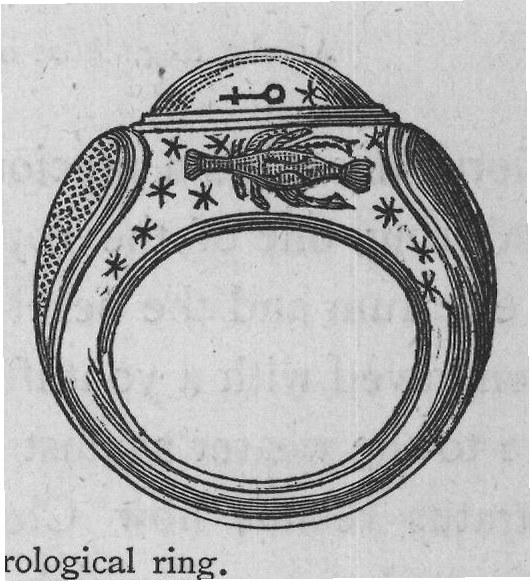
Astrological rings in connexion with mythological representations were worn by the ancients. The accompanying engraving from Gorlæus represents the sun and stars. According to the Gnostic theories, the properties of the sun on the destinies of men were numerous and important. The mystical virtues of the most precious stones were under the solar influence. ** Astrological ring.
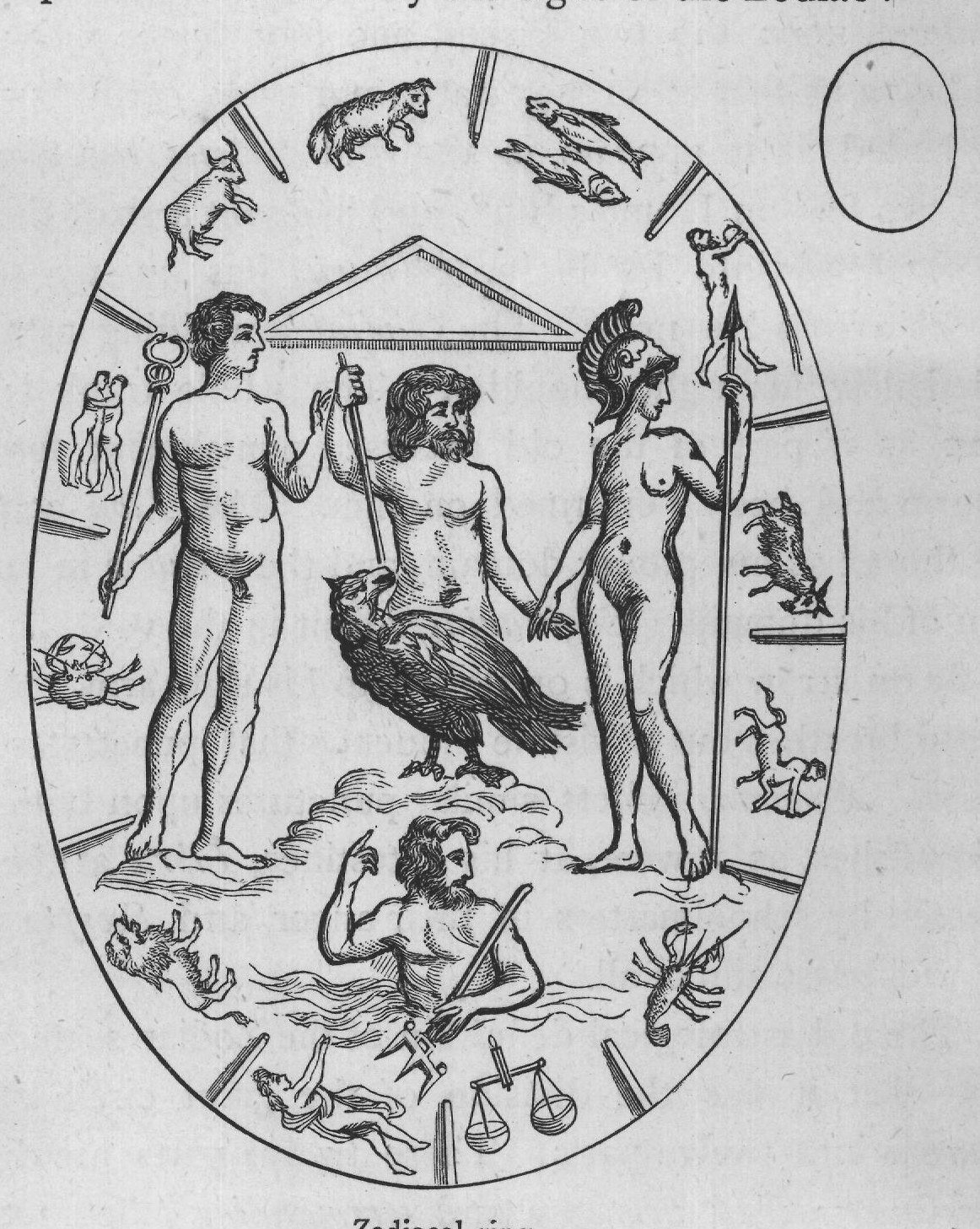
Planetary rings were formed of the gems assigned to the several planets, each set in its appropriate metal: thus, the Sun, diamond or sapphire in a ring of gold; the Moon, crystal in silver; Mercury, magnet, in quicksilver; Venus, amethyst in copper; Mars, emerald in iron; Jupiter, cornelian in tin; Saturn, turquoise in lead. From the remotest antiquity every planet in the heavens was believed to possess a virtue peculiar to itself. Each presided over some kingdom, nation, or city; then, extending its influence to individuals, it decided their personal appearance, temperament, disposition, character, health, and fortune, and even influenced the several members and parts of the body. After this, it ruled plants, herbs, animals, stones, and all the various productions of nature. Southey, in the 'Doctor' (vol. iii. p. 112), commenting on the exhibition of the Zodiacal signs in the 'Margarita Philosophica,' a work of the sixteenth century, observes: 'There Homo stands naked, but not ashamed, upon the two Pisces, one foot upon each; the fish being neither in air nor water, nor upon earth, but selfsuspended, as it appears, in the void. Aries has alighted with two feet on Homo's head, and has sent a shaft through the forehead into his brain. Taurus has quietly seated himself across his neck. The Gemini are riding astride a little below his right shoulder. The whole trunk is laid open, as if part of the old accursed punishment for high treason had been performed on him. The Lion occupies the thorax as his proper domain, and the Crab is in possession of his domain. Sagittarius, volant in the void, has just let fly an arrow which is on its way to his right arm. Capricornus breathes out a visible influence that penetrates both knees. Aquarius inflicts similar punctures upon both legs. Virgo fishes, as it were, at his intestines, Libra at the part affected by schoolmasters in their anger, and Scorpio takes the wickedest aim of all.' The old astrological definition of the Zodiac seems to be this that it was the division of the great circle of the heavens into twelve parts. These twelve parts are divided into those called northern and commanding (the first six), and those called southern and obeying (the remaining six). The other constellations of the two hemispheres are not unconsidered in astrology, but those of the zodiac are more important, because they form the pathway of the sun, the moon, and the planets, and are supposed to receive from these bodies, as they roll through their spaces, extraordinary energy.1 1 Montfaucon, in his 'L'Antiquité Expliquée,' has a singular theory in regard to the signs of the Zodiac. He mentions a fine gem on which IIO The following illustration from Liceti, 'Antiqua Schemata Gemmarum Annularium,' represents Jupiter, Mercury, Pallas, and Neptune surrounded by the signs of the Zodiac :- Zodiacal ring. were represented the figures of Mercury, Jupiter, and Venus, included in a large circle which contained the twelve signs of the Zodiac. These he conjectured to signify the days of the week, Wednesday, Thursday, and Friday. But, why,' he observes, 'do the three gods in this image indicate so many days of the week? Some ancient and particular custom is referred to and expressed, without doubt. Ausonius, in his "Eclogues," inserts a verse current in his time preceded by this question :--' Quid quoque die demi de corpore oporteat?" On what days is it most proper to cut the beard, nails, or hair? "Ungues Mercurio, barbam Jove, Cypride crines." That is, on Wednesday pare your nails, Among the various modes of enquiring by magical means as to who should succeed to the Roman emperorship during the reigns of Valentinian and Valens, we are told that the letters of the alphabet were artificially disposed in a circle, and a magic ring, being suspended over the centre, was believed to point to the initial letters of the name of him who should be the future emperor. Theodorus, a man of most eminent qualifications and high popularity, was put to death by the jealousy of Valens on the vague evidence that this kind of trial had indicated the first letters of his name.
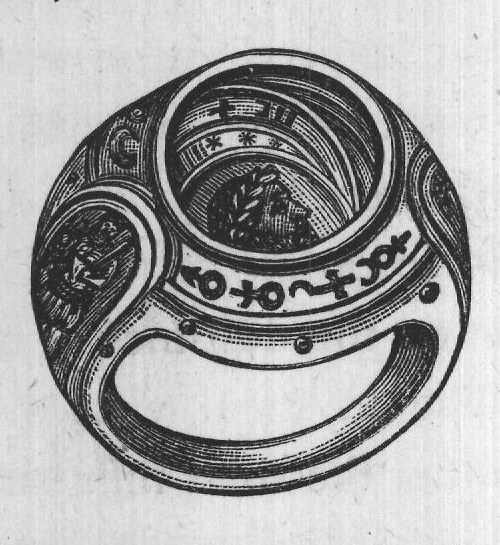
Gibbon remarks on this point that the name of Theodosius, who actually succeeded, begins with the same letters which were indicated in this magic trial.
This ring mystery, the Dactylomancia (from two Greek words signifying ring and divination), was a favourite operation of the ancients. It was preceded by certain ceremonies, and the ring was subjected to a form of conjuration. The person who held it was arrayed in linen, a circlet of hair was left by an artistic barber on his head, and in his hand shave your beard on Thursday, and on Friday cut your hair." This usage Ausonius rallies in eight pleasant verses. "Mercury," says he, "a pilferer by trade, loves his nails too well to let them be pared. Jupiter, venerable by his beard, Venus adorned by her hair, are by no means willing to part with what is so dear to them." . . . I think it certain that these deities are represented as presiding over Wednesday, Thursday, and Friday, without being able to assign the certain reason why they are pictured upon this gem.' A very extraordinary form of oath, by which the astronomer Vettius Valens bound his disciples to secresy, is quoted by Selden. 'I adjure thee, most honoured brother and your fellow-students, by the starry vault of heaven, by the circle of the zodiac, the sun, the moon, and the five wandering stars (by which universal life is governed), by Providence itself, and Holy Necessity, that you will keep these things secret, nor divulge them except to those who are worthy and are able to make a just compensation to me, Valens.' he held a branch of vervain. An invocation to the gods preceded the ceremony. 6 The 'suspended ring,' another mode of divination practised at a later period, is thus described by Peucer among various modes of hydromancy: 'A bowl was filled with water, and a ring suspended from the finger was librated in the water, and so, according as the question was propounded, a declaration, or confirmation of its truth, or otherwise, was obtained. If what was proposed was true, the ring, of its own accord, without any impulse, struck the sides of the goblet a certain number of times. They say that Numa Pompilius used to practise this method, and that he evoked the gods, and consulted them in water this way.' The ring suspended over a monarch was supposed to indicate certain persons among those sitting round the table, and if a hair was used, taken from one of the company, it would swing towards that individual only. An ancient method of divining by the ring is similar in principle to the modern table-rapping. The edge of a round table was marked with the characters of the alphabet, and the ring stopped over certain letters, which, being joined together, composed the answer.