Home › The Great Fish-Lizards › The Great Fish-Lizards: Lias
The Great Fish-Lizards: Lias
Mr. Hawkins tells us that his youthful attention was directed to the Lias quarries, near Edgarly, in Somersetshire, in consequence of some strange reports. It was said that the bones of giants and infants had, at distant intervals, been found in them. These quarries he visited, and, by offers of generous payment, induced FISH LIZARDS. LIAS PERIOD, PLATE IV.
Ichthyosaurus communis.
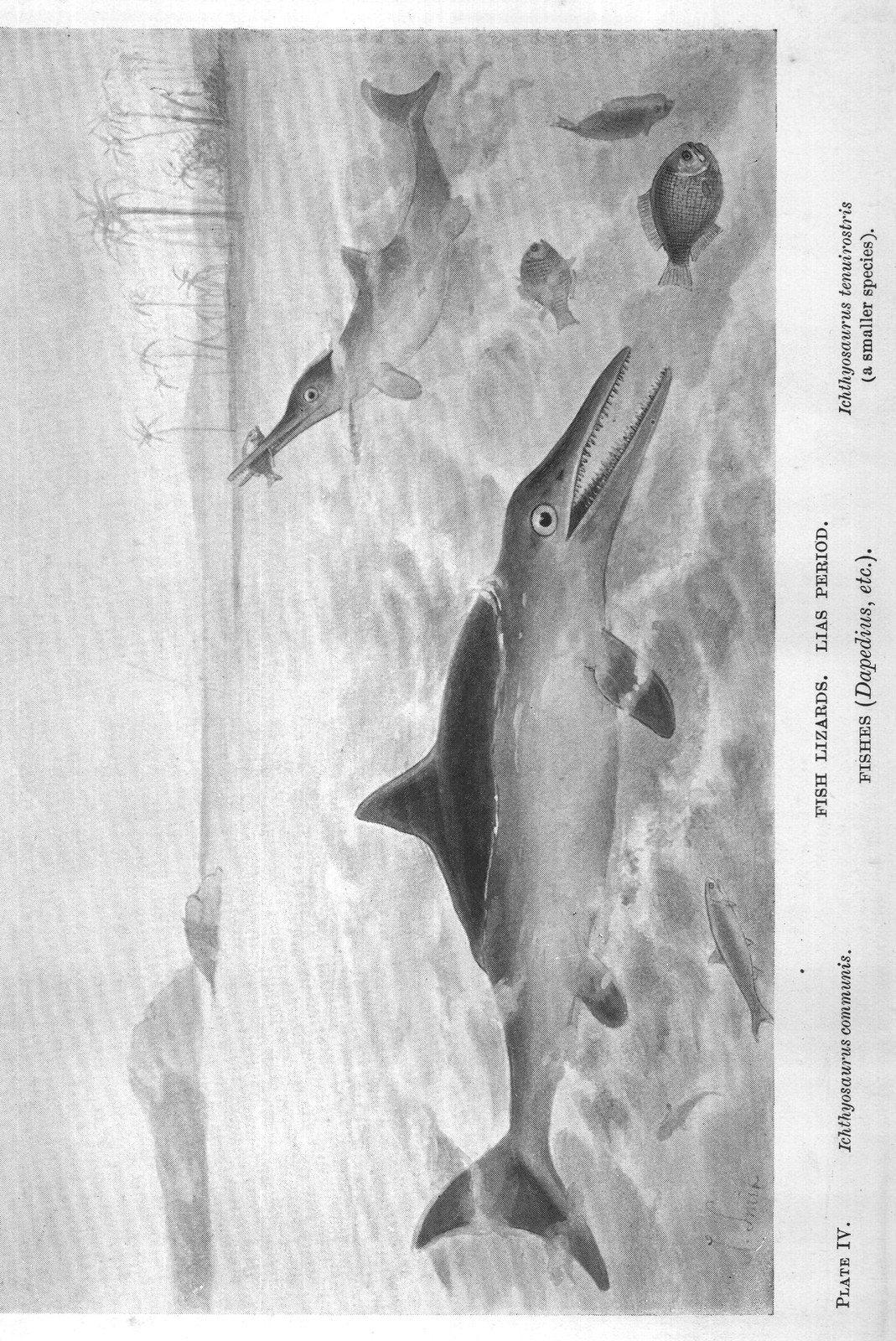
FISHES (Dapedius, etc.).
Ichthyosaurus tenuirostris (a smaller species). the workmen to keep for him all the remains they might find. In this way he finally obtained the co-operation of all the quarrymen in the county. When, however, he complains of the Philistine dulness and stupidity of quarrymen, who often, in their ignorance, break up finds of almost priceless value, we can fully sympathise. In general contour the body of the fish-lizard was long and tapering, like that of a whale (see Plate IV.). It probably showed no distinct neck. The long tail was its chief organ of propulsion. We notice two pairs of fins, or paddles; one on the fore part of the body, the other on the hinder part, like the pectoral and abdominal fins of a fish. The skin was scaleless and smooth, or slightly wrinkled, like that of a whale. No traces of scales have ever been found; and if such had existed, they would certainly have been preserved, since those of fishes and crocodiles of the Jurassic period have been found in considerable number and variety. It is therefore safe to conclude that such were absent in this case. In the Lias strata, at least, the specimens are often preserved with most wonderful completeness (see p. 70). The long and pointed jaws are a striking feature of these animals. The eyes were very large and powerful, and specially adapted, as we shall see presently, to the conditions of their life. It might, perhaps, be asked whether the fish-lizards breathed, like fishes, by means of gills. That question can easily be answered; for if they had possessed gills for taking in water and breathing the air dissolved therein, they would reveal the fact by showing a bony framework for the support of gills, such as are to be found in all fishes. These structures, known as “branchial arches," are absent; therefore the fish-lizards possessed lungs, and breathed air like reptiles of the present day. Their skulls show where the nostrils were situated; namely, near the eyes, and not F at the end of the upper jaw-bone. There are also passages in the skull leading from the nostrils to the palate, along which currents of air passed on their way to the lungs. Being air-breathers, they would be compelled occasionally to seek the surface of the sea, in order to obtain a fresh supply of the life-giving element-oxygen; but, being cold-blooded and with a small brain, needing a much less supply of oxygen for its work, the fish-lizards had, like fishes, A B C FIG. 9.-(A) Lateral and (B) profile views of a tooth of Ichthyosaurus platyodon (Conybeare), Lower Lias, Lyme Regis, Dorsetshire. (c) Tooth of Ichthyosaurus communis (Conybeare), Lower Lias, Lyme Regis, Dorset. this advantage over whales, which are warm-blooded that their stern-propeller, or tail-fin, could take the form best adapted for a swift, straightforward course through the water.
In the whale tribe the tail-fin is horizontal; and this is so on account of their need, as large-brained, warm-blooded air-breathers, of speedy access to the atmospheric air. Were it otherwise, they would not have the means of rising with sufficient rapidity to the surface of the sea; for they have only one pair of fins. But the fish-lizards had two pairs of these appendages, and the hinder or pelvic pair no doubt were of great service in helping the creatures to come up to the surface when necessary.
These great marine predaceous reptiles literally swarmed in the seas of the Lias period, and no doubt devoured immense shoals of the fishes of those times, whose numbers were thus to some extent kept down. There is the clear proof of this in the fossilised droppings-known as "coprolites," - which show on examination the broken and comminuted remains of the little bony plates of ganoid fishes that we know were contemporaries of these reptiles. Probably young ones were sometimes devoured too (see p. 72). FIG. 10. Skull of Ichthyosaurus latifrons.