Home › Veery or Wilson Thrush › Veery or Wilson Thrush: Veeries
Veery or Wilson Thrush: Veeries
Veeries are perfectly garbed for the life they lead, on or near the ground, their backs being almost a perfect match in color to dead leaves.
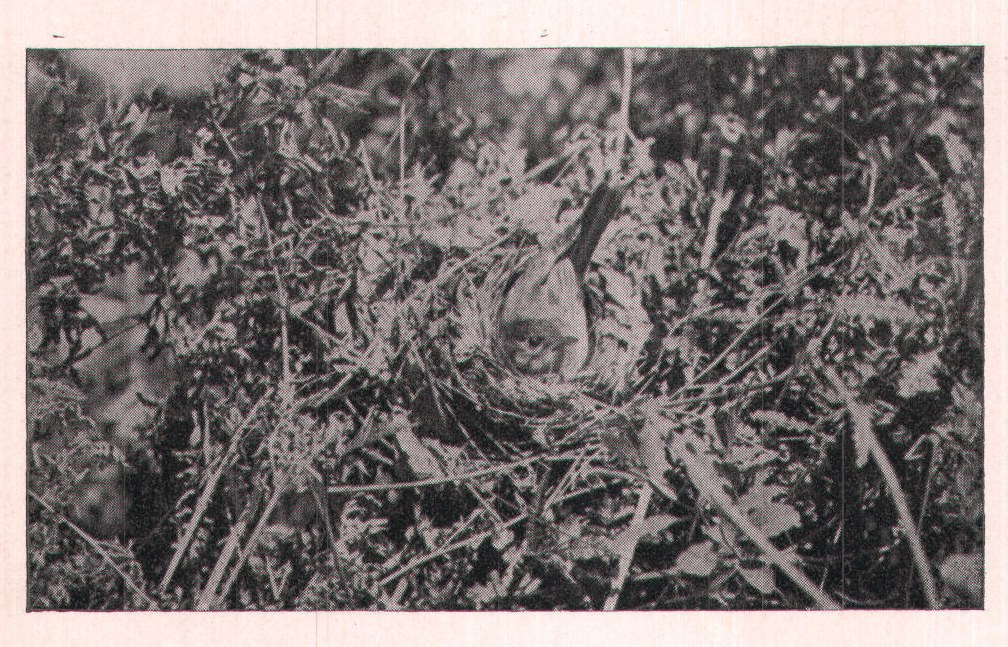
Veeries build their nests of strips of bark and fine grasses, placing them on the ground or very near it; often it is set down in the middle of a patch of dead leaves, sometimes in the midst of a clump of ferns and often against the sides or in the middle of old stumps. The four greenish-blue eggs loom up prominently in the deeply-cupped nest; probably for that reason the bird does not leave the nest unless she is seen, for to do so would expose the brightly colored eggs to view and result in discovery while she can usually escape notice.
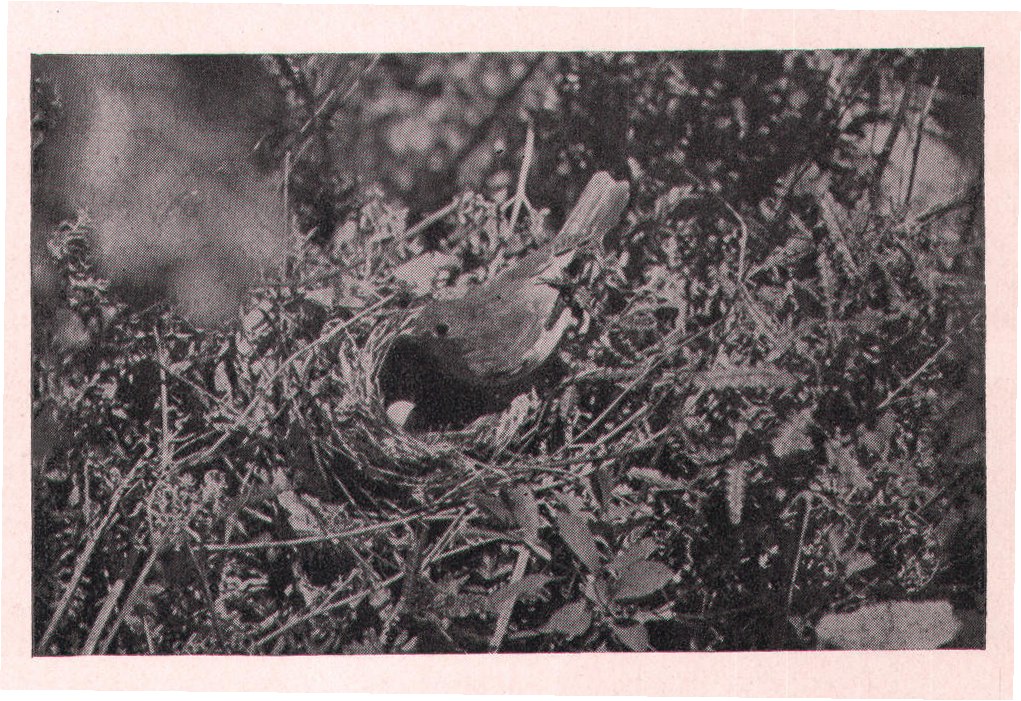
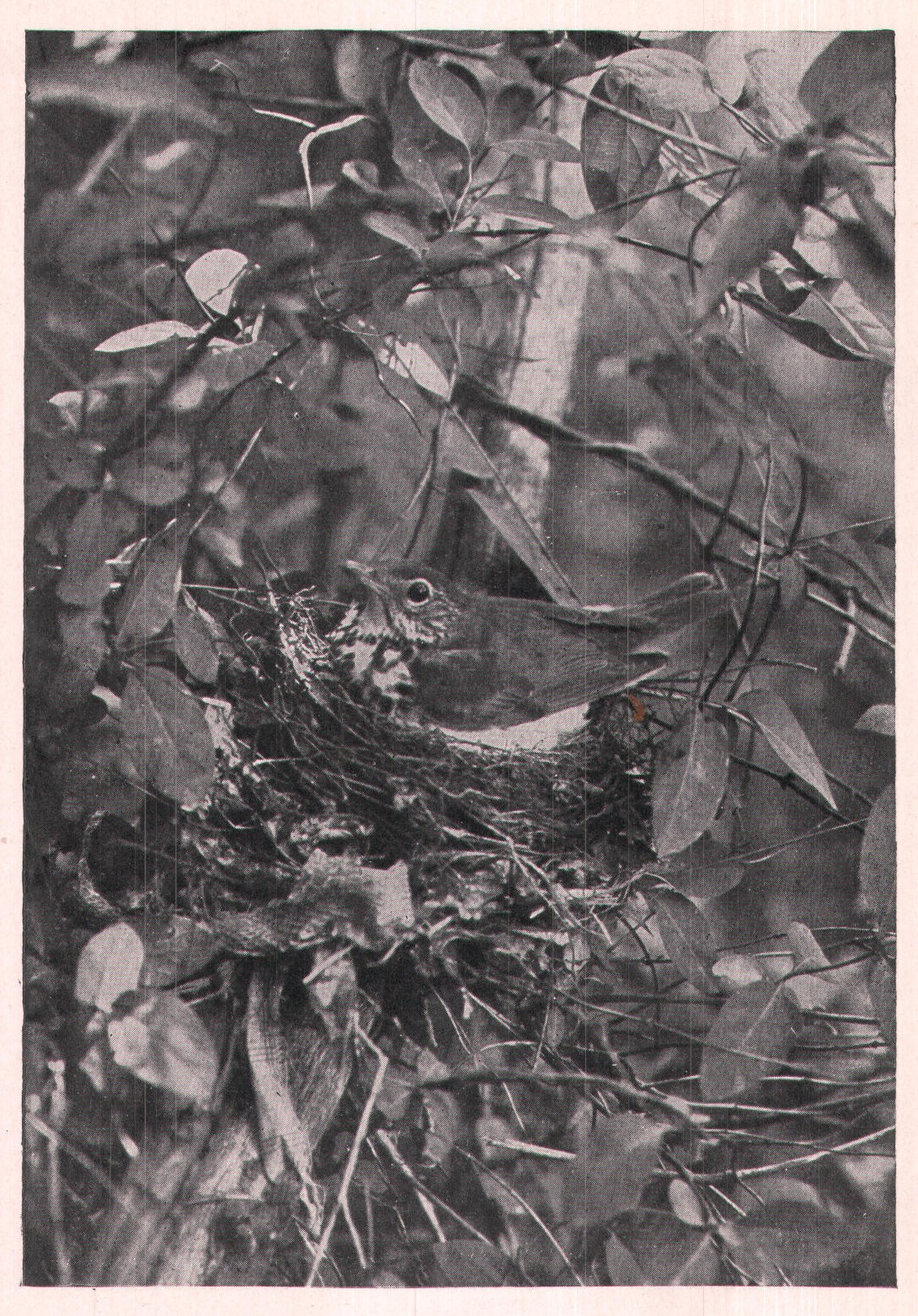
Although I have taken many pictures of Wilson Thrushes in many different locations, the one chosen for this sketch illustrates one of my very first attempts at bird photography. This nest was situated at the base of a clump of blackberry vines, and contained four eggs. The bird proved to be more shy than usual and in two weeks time I was able to secure but two satisfactory pictures of her.
The day following its discovery an attempt was made to picture the Thrush returning to the nest. The camera was set with the lens but two feet distant from the eggs and I was concealed in a heap of brush twenty feet away. The camera was covered with a green cloth and plentifully sprinkled with leaves so as to attract as little attention as possible, but undoubtedly it looked to the Veeries bigger than a house would to us.
Both birds were away while I was getting in readiness. Upon their return they were greatly astonished to see a strange affair standing so near their home. They talked to each other about it, in low tones, for several minutes and then flew away. In about ten minutes they returned, talk- ed some more and went off again. Evidently they thought the camera was something that would remove its unwelcome presence after awhile and they were going to wait for it to go.
Just twice during the three days that I was present while the nest contained eggs, did the owner visit it, that is to actually alight upon the nest. Upon developing the first exposure, the nest and eggs appeared beautifully but there was not a trace of the Veery although she was standing on the edge of the nest when I pressed the bulb. The second Fig. 104. You can sometimes approach and take a "time" picture of a Wood Thrush without alarming her. exposure was the one shown here, of the Veery entering the nest.
The next morning the eggs had hatched. I waited until the little birds were ten days old before attempting to again photograph the parent. She was still very shy but remained in sight of the nest all the time, usually with her beak filled with food for her babies. Her mate perched on a branch hard by and, after scolding for awhile, tried to induce her to be brave by singing to her. Sometimes his "veery" song would ring out exceedingly loud and clear, and again it would be just a faint murmur as though the singer were a great ways off, although he sat on the same twig about thirty feet distant.
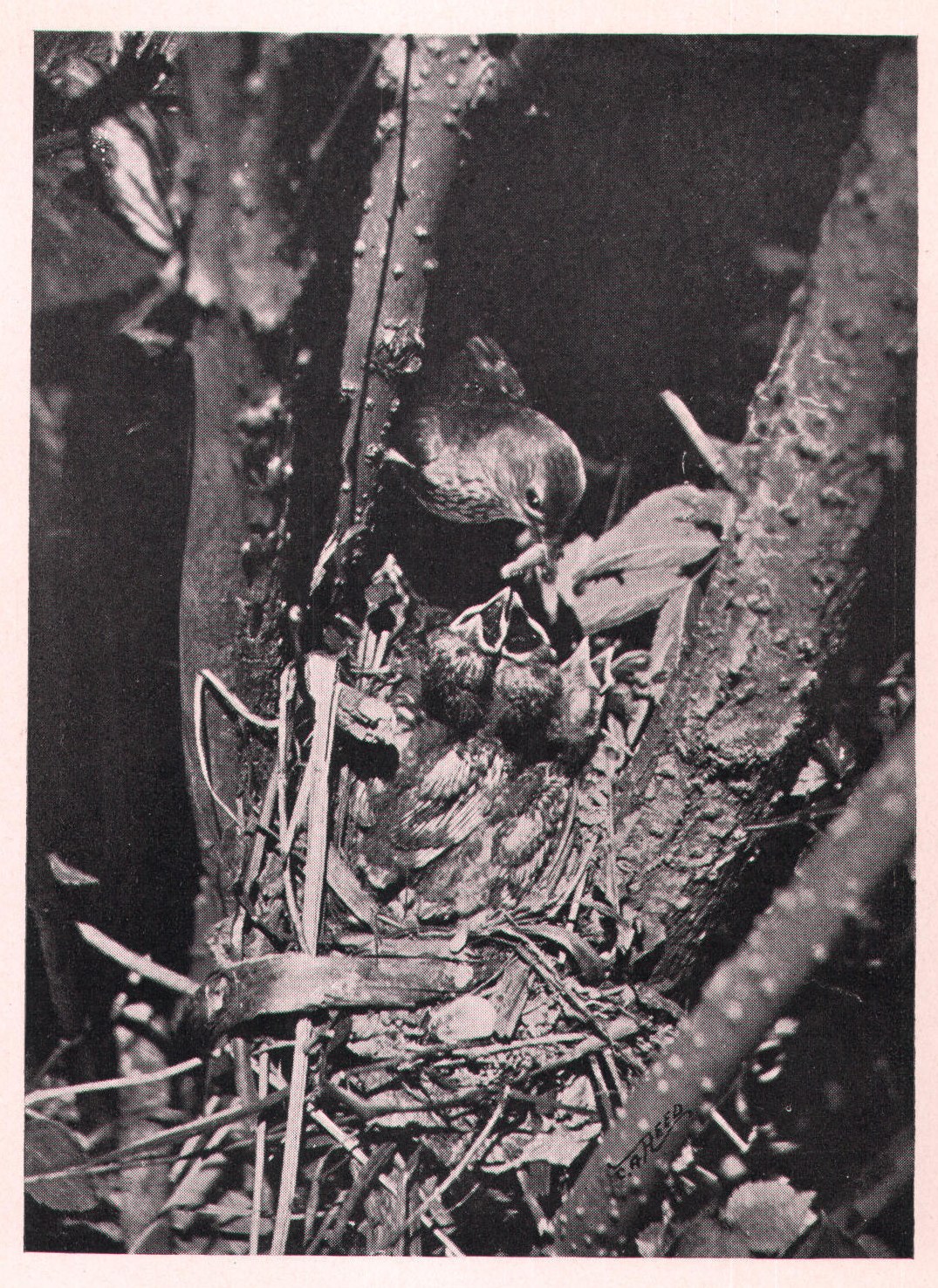
Finally Mrs. Veery descended to the ground and commenced walking in a circle about the nest, each circuit bringing her a little nearer the goal. Every time she came to the slender tube running from the camera to my place of concealment she would pause and look at it critically, then jump over it and turn quickly about to look it over again. With her head cocked to one side so comically, I could imagine her saying to herself: "It looks like a worm, but it can't be, for I never heard of one as long as that is." At last she hopped to the nest, all the little heads were expectantly raised, mouths wide open like little yellow caverns, and my long awaited opportunity had come.
Several times we went through this operation, but with the exception of the picture shown here, the results were not satisfactory to me. Several incidents happened to relieve the monotony of waiting, incidents that tended to still further alarm and delay the return of an already shy mother bird. The thrush was just on the point of approaching the nest when a fusilade of shots was heard from the edge of the woods. Soon a twenty-five year old, overgrown boy appeared armed with a small repeating rifle. He passed by about twenty yards distant and showed his sporting proclivities by firing at every animate object; when his supply of these ran short he would even shoot at the surrounding trees, just for excitement. I kept close watch to see that he did not notice the camera for he certainly would have tried to hit it, although his enthusiasm far exceeded his skill for he missed everything that he fired at while in my sight.
The next diversion was occasioned by one of the several cows that were feeding in the swamp. She ambled over to the camera and persisted in eating the leaves off the branches with which I had covered it, and seemed to take it unkindly when I was forced to drive her away to protect the camera.