Home › Contents › A Family of Redstarts
A Family of Redstarts
The morning of one June day found me threading my way along a narrow footpath that wound its way in and out through one of the most delightful pieces of woodland that ever echoed a bird song. As I walked slowly along, I was separating, by their voices, the many varieties of birds whose babble filled the woodland with melody.
A gleam of orange and black among the foliage, proclaims the presence of a Redstart, that alert member of the warbler family whose habits are so like those of some of the flycatchers. He was in the act of tearing fragments from a caterpillar nest; this material he carried across the path to a small maple about twenty feet from me and wound it about the framework of a nest that he and his mate had just commenced. While he was so engaged, his partner appeared with a load of plant fibres which she carefully and skilfully weaved into the growing home.
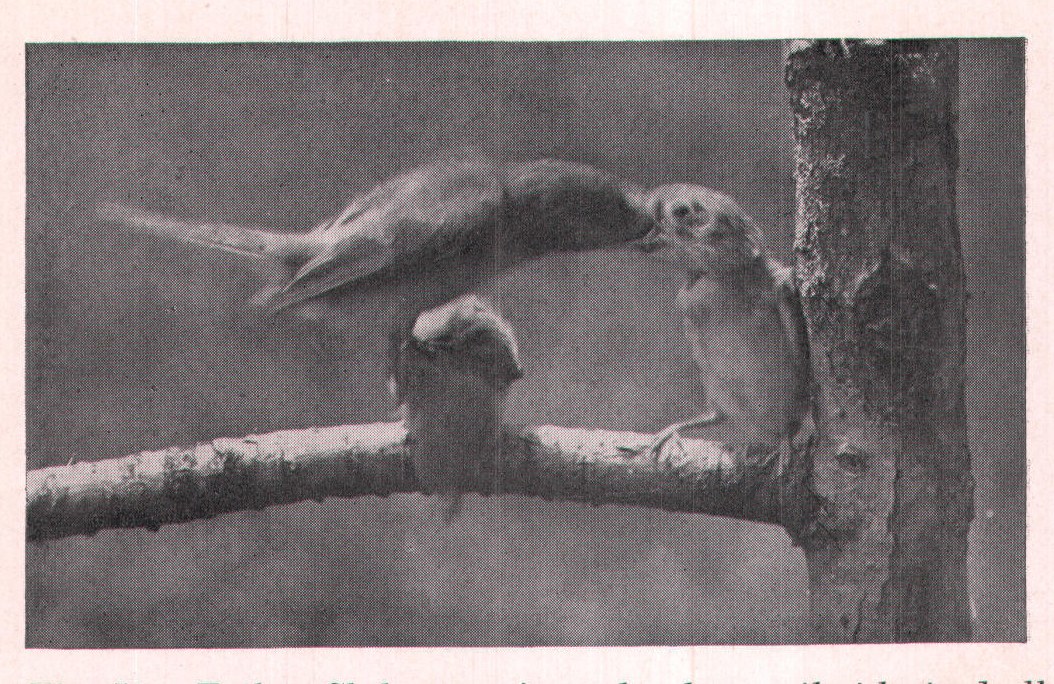
He was perfectly fearless and came as regularly as though we were not present.
Seating myself under the shade of a bush not more than ten feet away I enjoyed a two hour lesson in the art of nest-building. The male was an unusually bright-colored bird; he was very proud and conceited too. His mate was also very beautiful, even though less gaily clad than he. Undoubtedly she knew more about correct house building than Mr. Redstart, but he did not think so, and whenever she objected to his manner of doing the work, he promptly drove her away with playful snappings of his bill. In the end, she had her way as is usual in such differences, for when he went off for more material she would do his work over to suit herself.
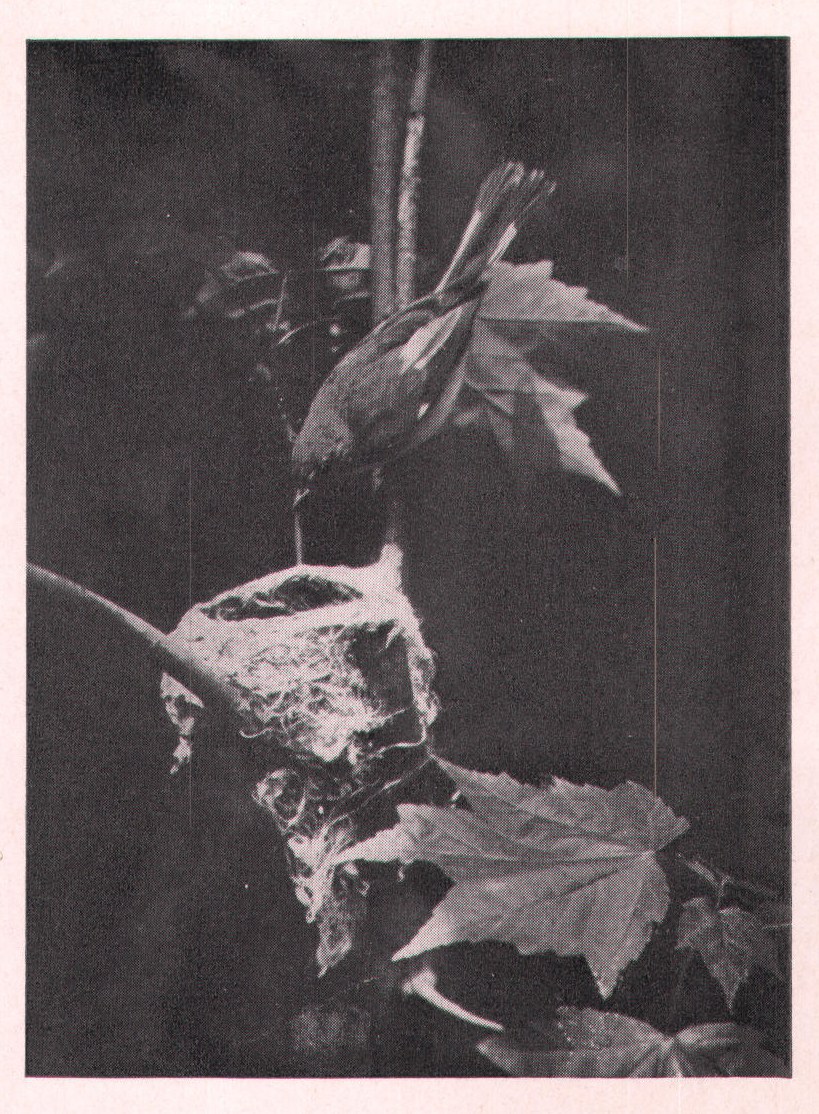
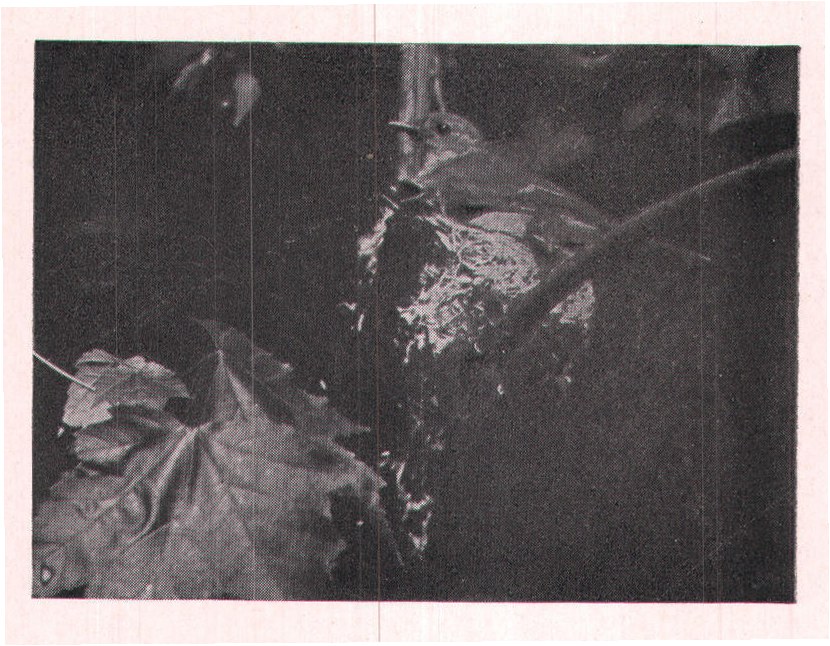
They were exceedingly active in all their movements, their actions as they chased one another about being bewildering. Naturally, with so much play, the nest grew but slowly, and it was over a week from the time the foundation was laid before the trim little structure was completed. A week later, four possibilities of future Redstarts occupied the nest. As there were many squirrels about and the woods were often frequented by boys, I concluded it well to at least get one photographic record of the nest in case anything should happen to it. It was located only about four feet above ground and I had not the least difficulty in getting a good likeness of the female as she descended to the eggs.
The male bird, at this time, was literally "out of a job," for I never saw him assist her in the duties of incubation and only once while I was present did he bring her anything to eat. He spent his time in the tops of the trees, singing, dashing after insects and driving away birds that came too near him. With the advent of the young, came an end to his period of loafing and he did his duty manfully and with much enthusiasm.
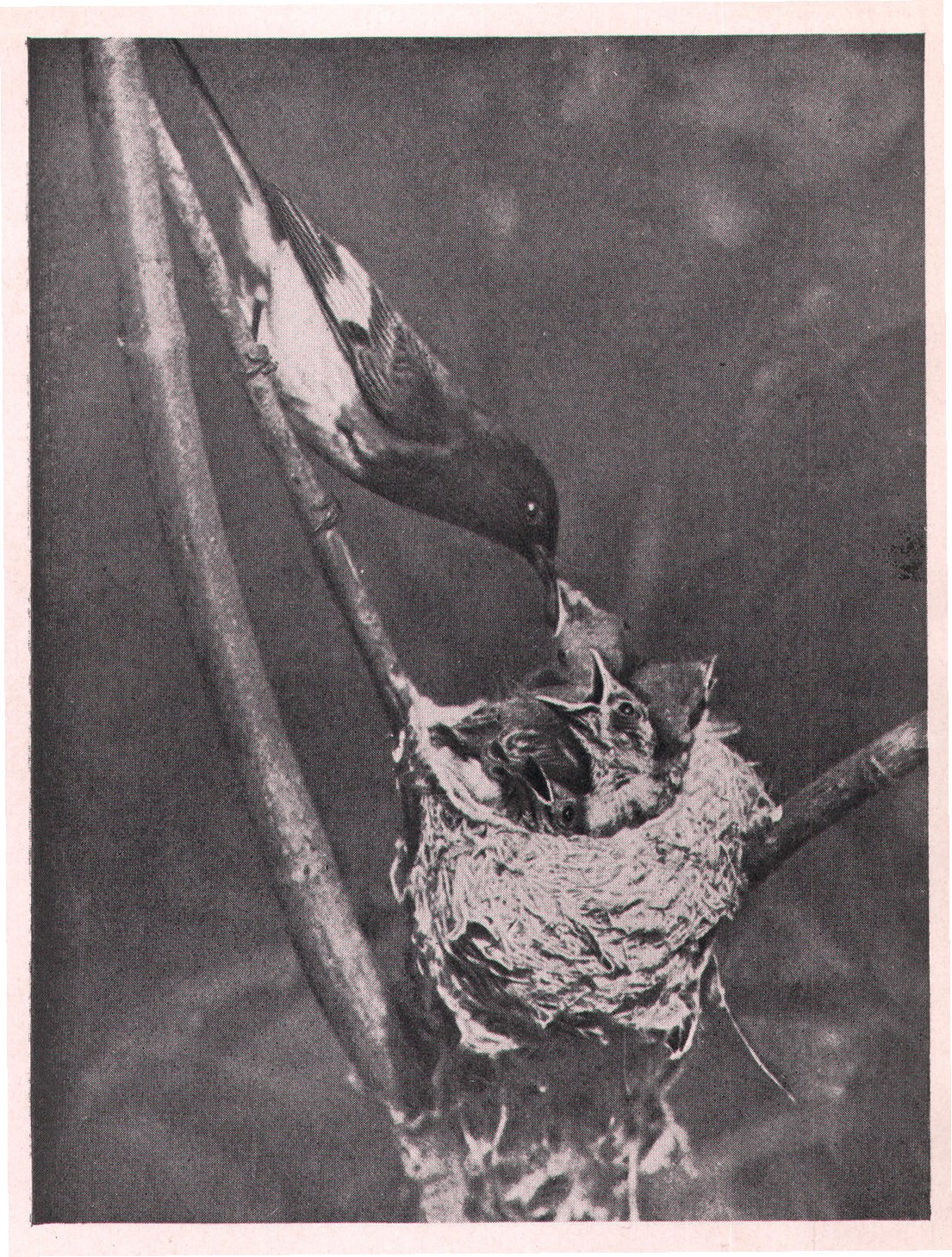
The actions of the two birds, in the presence of the camera, were quite different. The male showed a disdain for it that was amusing. I had arrived during his absence and had my head under the cloth focussing on the nest when I felt a little rush of air, a streak of orange flashed across the ground glass screen and the male was bending over his children. How I longed to reproduce the picture that showed on the screen as he fed each of his little ones in turn, his wings quivering in his enthusiasm and his tail opening and closing like a fan. The pictures were not made from the tent, I being concealed in a bush about ten feet away and making exposures by means of a long tube to release the shutter. Several times he lit upon the camera and once he swung upon the long rubber tube for several seconds. I made quite a number of pictures of him but many were failures because of the rapidity of his movements. His mate was much more cautious in her manner of approach, in fact she seemed to fear the camera more than she had when I made her picture before, but after she became acquainted with me she was very tame. The quartet of youngsters were very bright. When they were a week old, their curiosity was fully developed. They had just the faintest suspicion of feathers on them, their almost bald heads looking very comical as they hung them over the edge of the nest and watched their parents foraging. They were naughty too, at times, as is shown by the picture of the mother trying to brood them. She turned and twisted and poked at them in her endeavors to keep them under her, but they would insist on sticking their heads out to see what was going on. The one on the right really looks as though he were laughing at her vain attempts to control him.
The nest, which was plenty large enough for the eggs and for the little birds in their first stages, is shown by the pictures of the male feeding them, to be entirely too small to accomodate them as they get larger. We cannot but pity the poor little fellow that is vainly trying to push his way up, but we may rest assured that when it comes his turn to be fed, he will not be forgotten. At no time, while I was watching them, did they feed the little birds upon large insects such as many of the smaller birds frequently do. All food brought seemed to be small winged insects or little caterpillars that they picked up from the ground.
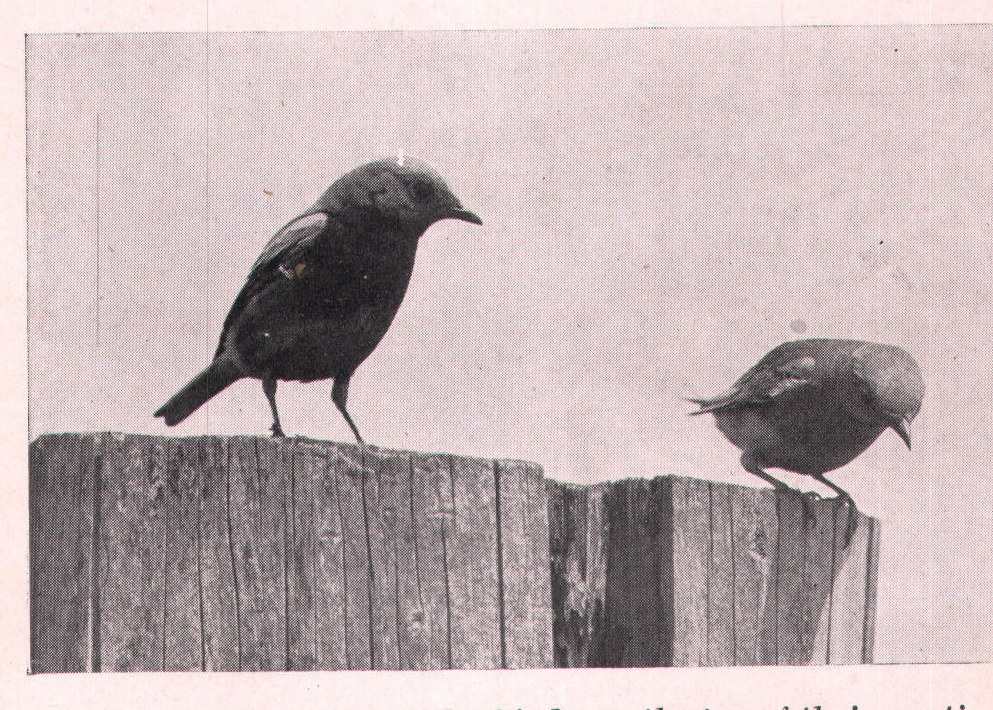
Fig. 62. A pair of Bluebirds on the top of their nesting post.