Home › Contents › The Ovenbird
The Ovenbird
In early morning, during spring and summer, the woodland resounds with the loud, vibrant songs of Ovenbirds,- "teacher-teacher-teacher- - - - - - - " repeated many times and giving the species the local name of "Teacher-bird". It is also very commonly known as the Golden-crowned Thrush because it has a dull, orange-yellow stripe on the crown and because the rest of the coloration is thrush-like. The reason for the name of Ovenbird is rather obscure to the beginner in bird study until he or she has discovered one of their nests.
One morning, as we approached a pretty bit of woodland, above the sweet voices of numerous other songsters, we heard the loud chanting of an Ovenbird. Ere the last notes of his ditty had been uttered, the song was taken up and continued by other Ovenbirds in distant parts of the woods. Usually nests of these birds are found by flushing the sitting bird, the present instance being the only one in which I ever discovered the nest of an Ovenbird before seeing the owner. We had barely entered the woods before I noticed a slight elevation of the leaves ahead of us. Inleaves ahead of us. stinctively the thought came to mind that it was a nest; apmind that it was a nest ; approaching carefully, we stooped and looked under the arching top. Greatly disturbed by this undesired curiosity the owner, an Ovenbird of course, dashed out and from a branch close at hand scolded us roundly.
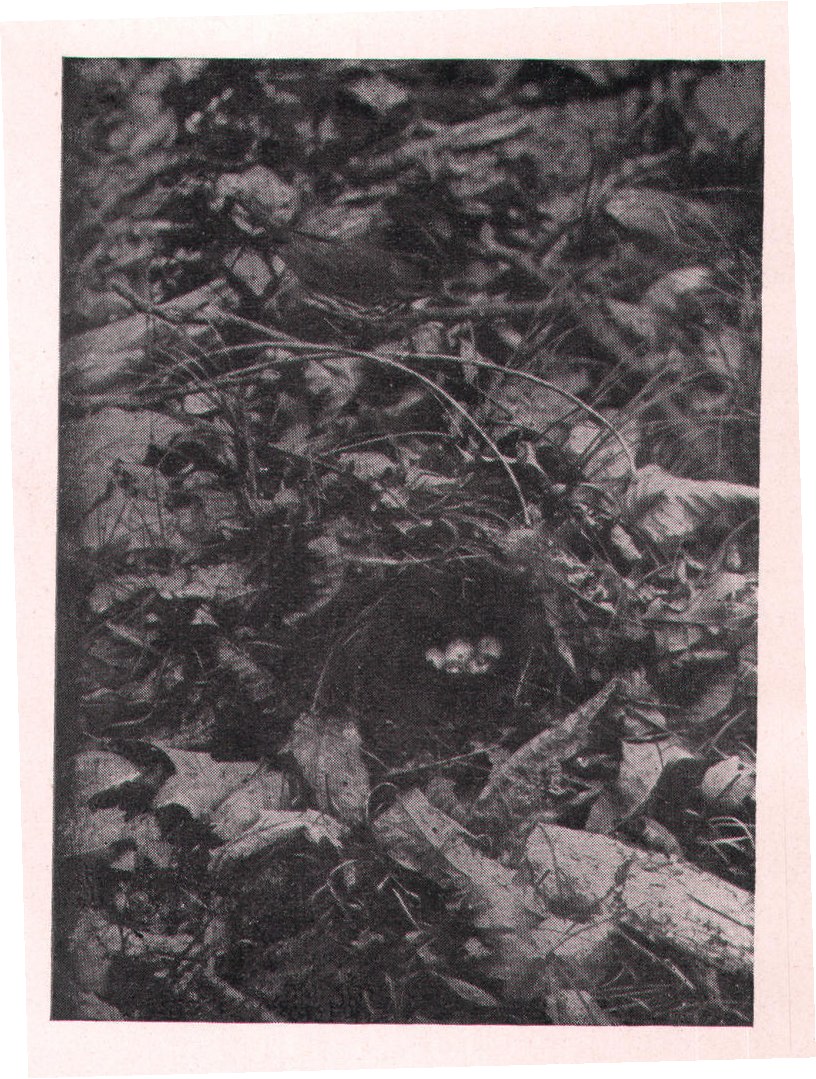
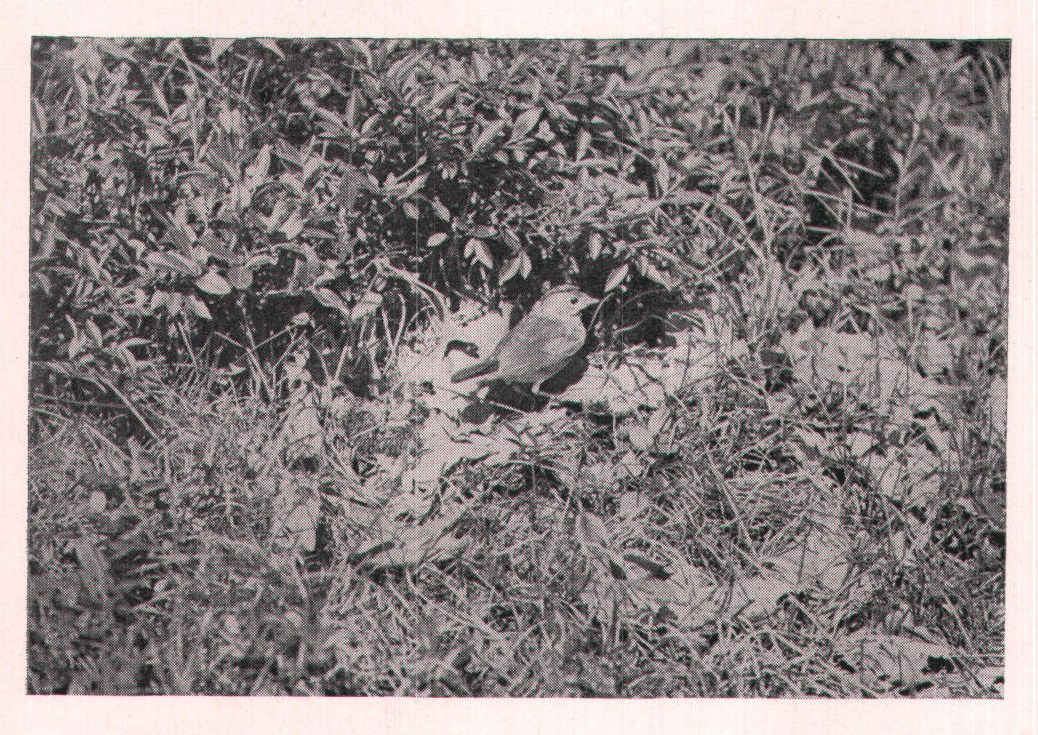
In- It was a fine type of the nest of this species; the top was strongly arched over, so much so that the eggs could barely be seen. Concluding that, as we had discovered the little oven so easily, others might do the same, we made a picture of the nest and eggs and then set the camera so as to get a picture of the returning bird, although the light in the shady woods was very poor for quick exposures. As soon as we were concealed within the tent the Ovenbird ceased her anxious chirping, hopped down on the ground and apparently commenced to walk aimlessly about picking up a bit of food here and there.
The Ovenbird walks, not hops, very daintily; Mr. Ernest Seton Thompson has very aptly termed the bird "A Pretty Thompson has very aptly termed the bird "A Pretty Pedestrian". Every circuit brought her closer to her little oven-like home, until at last she hopped on a twig just over the arch, and within the scope of the lens. A sharp click and one more bird had been photographically shot.
We were fortunate to have taken these pictures as we did, for two days later a slight hollow in the ground was the only sign of where the nest had been. Whether its disappearance was due to a two or a four-footed animal could not be surmised as red squirrels were abundant in the woods and people were constantly crossing.
The finding of another nest, a few days later, yielded one more picture of an Ovenbird just entering her "oven". This nest too was destroyed, presumably by chipmunks, before the eggs had hatched.