Home › Contents › Ruby-Throated Hummingbird
Ruby-Throated Hummingbird
Hummingbirds are creatures of the New World. About five hundred species are found in North and South America. They range from Alaska to Patagonia, being most numerous in northern South America and in Central America. Only sixteen species out of this great number are known to have occurred in the United States and but a single species, the Ruby-throated Hummingbird, is found east of the Mississippi River. I have always been greatly interested in these "gems." In fact, when I was but eight years of age, my interest in them led me to capture one in a butterfly net as it flew about the flowers in the garden. I thought I had a most wonderful prize, but I am glad to say that my parents quickly induced me to release it. As usual with all ornithologists at that time, my early investigations were made chiefly from a covetous standpoint. Much was learned, but knowledge so gained does not compare in value with that obtained when the possessive instinct is ignored.
There is a very prevalent idea that Hummingbirds subsist entirely upon the honey or nectar of flowers; such a diet would soon ruin the digestive organs of any kind of bird or beast. As a matter of fact, nectar forms a very small percentage of hummingbird food. Instead of sipping the honey from the flowers they visit, they usually are engaged in the very useful occupation of eating the many tiny insects that gather in such places. It is well known that most flowers that secrete nectar are partially or wholly dependent upon certain insects to carry pollen from one blossom to the stigma of another and so effect cross-fertilization; these useful insects are usually large, long-tongued ones like bees, moths and butterflies. So in destroying the tiny insects, hummingbirds perform a service to the plants by removing pilfering insects that do no good, and to mankind also. Hummingbird I have always believed that nests of this hummingbird contain a greater amount of labor, are better made and are very much more beautiful than nests of any other kinds of birds. I have had many excellent opportunities to watch them during their home-building.
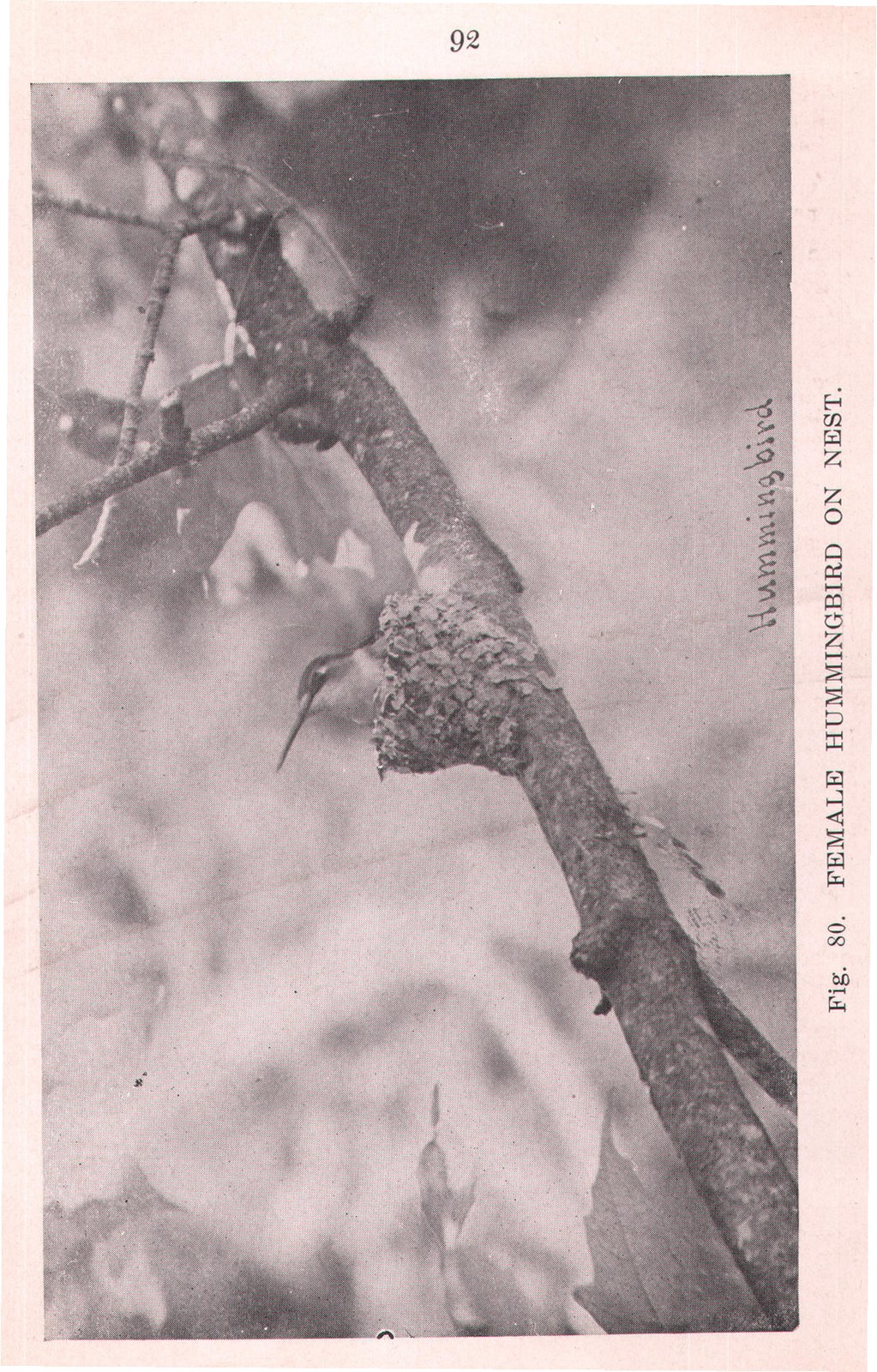
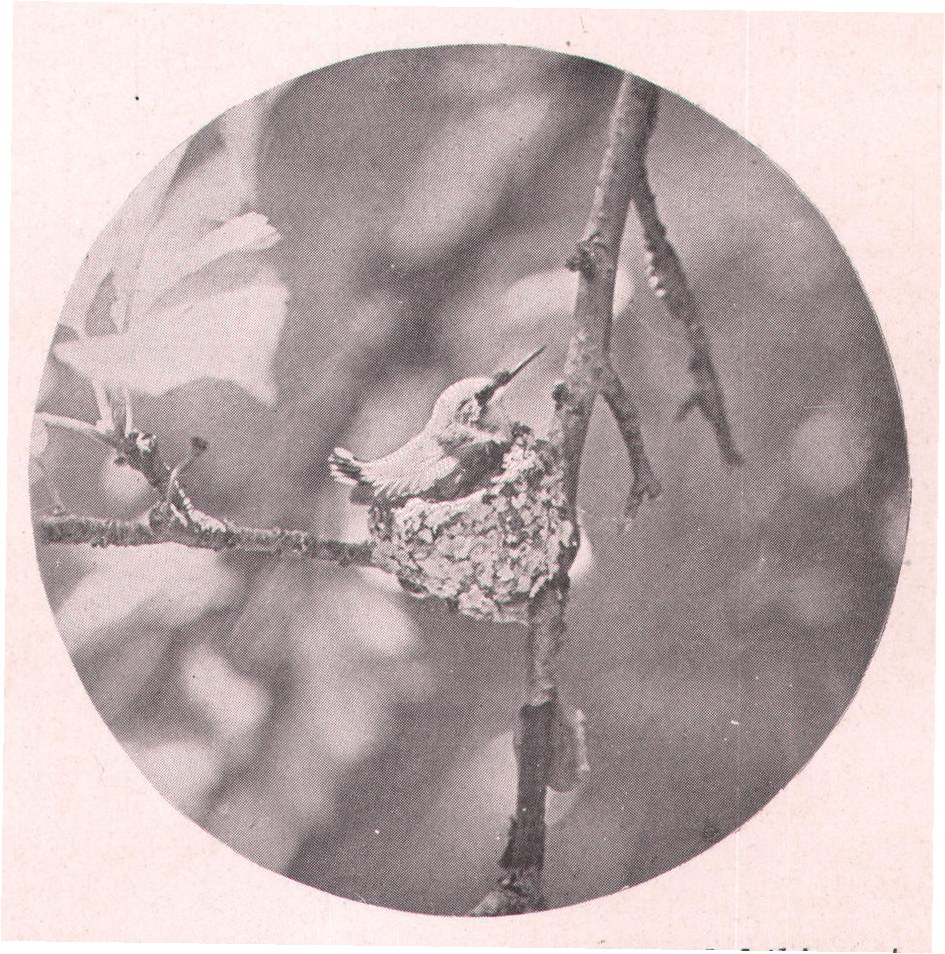
One day I saw a "hummer" buzzing about under some ferns, within a few inches of the ground; she was gathering the soft, downy wool that sheathes the young fronds and is often left hanging to the stems of older ferns. When she had a tiny load of this in her slender bill, she whizzed away with it; fortunately I was able to keep track of her rapid flight and saw her land on a limb about twenty feet above ground. She had just commenced her work, barely enough of the future nest showing to be seen with the field glasses. She was quite industrious but she only gathered tiny loads at a time and it took her quite a long while to find the material, so that building was a very slow operation. At the end of three days, the walls of the nest had just commenced to assume a recognizable form. Sometimes she brought little masses of whiter, finer material even than the "wool," probably cobwebs; this evidently held the balance of the material more closely together. I never saw her mate anywhere near the nest during its construction, but he did appear and help defend the home after the little "hummers" appeared.
The decorating of the outside of the nest was the most interesting part of the work. She seemed to be exceedingly particular about the appearance of each piece of lichen that was glued in place. Often she would buzz up and down and around the trunks of several trees before she could find a piece to her liking.
When finished, she had a bit of bird architecture of which she was justly proud. Greens predominated in the lichens that grew on this tree, and all the pieces that were on her nest were of the same shade. Without seeing her going to it, nobody would have suspected that the little tuft of moss was other than a natural growth on the limb.
It was just ten days from the time the structure was commenced, when it was finished. In four days more, there were two little white eggs, just the size and shape of small pea-beans, laying in the soft little cup. In sixteen days Fig. 81. You can imagine how crowded this nest was before the first of the two young left. more, there emerged from these eggs, two tiny, naked mites, looked anything except like the little feathered jewels into which they were to develop. The little birds remained in the nest three weeks. At the end of the first week, tiny little pin feathers had commenced to appear; in two weeks they looked like little cushions stuck full of pins. From this time until they left, their feathers blossomed out very rapidly and they were transformed from the little helpless mites into lusty little birds bigger than the nest could comfortably hold. For two weeks they were fed entirely by regurgitation,on food pre-digested by the parents. This feeding process food pre-digested by the parents. This feeding process is one of the most peculiar sights in bird-dom. The parent stands on the edge of the nest, erect and neck stretched to the slender bill into the mouth of the little one. The head is worked vigorously and the food process that looks a great deal more like a surgical operation than like a dinner party.
Hummingbirds, tiny as they are, have violent and easily aroused tempers; no bird is more courageous nor as quick to attack man, bird or beast that threatens its home. With ," they will often dash right at your face like little winged bullets, so that you invariably dodge.
They stop when a few inches away, but there is always the uncertainty so that one does not dare keep still to see if they would strike.
Hummers are quite cleanly in their habits. I never saw them bathe in pools of water, but I have seen them bathe in pools of water, but I have seen them moistened as though with dew from the leaves, and then seen them taking "dust baths" to dry themselves. It is believed that our Hummingbird has a preference for bright red colors and that they like particularly well to feast from flower, trumpet creeper and other gaudy, long-tubed blossoms of that hue. However, we find them very commonly about many of the garden and wild flowers of other colors and about apple, pear and cherry trees when they are in bloom.