Home › Contents › Grasshopper Sparrow
Grasshopper Sparrow
This is one of the most inconspicuous of all sparrows. The bird itself is of a rather shy n ture and seldom allows one to approach sufficiently near to study it in detail without the aid of a good field glass. Its song is just a weak insect-like chirping or rather buzzing, a sound that would escape the notice of probably ninety-five out of a hundred per-- sons. They make their homes on the ground in fields and pastures. When singing you can usually locate them on a stone wall, fence post or some little elevation in the middle of the field. The continued presence of a pair of "Grasshoppers" in a field that I often crossed, finally tempted me to try and find their nest. A large stone in the middle of the field furnished a lookout perch for the male bird. He commenced chirping as soon as I climbed the wall and in a few moments his mate appeared on the rock too; it was impossible to tell from which direction she came as she. was wholly concealed by the tall grass when she ran from the nest. Attempts on several days, to start her from the nest, failed because of the vigilance of the guard, until I almost despaired of finding it. One morning I crept carefully up to the wall and watched, without being seen, for over an hour. At last I was rewarded by seeing a sparrow-like bird fly from the grass, across the fields. Another wait of a half hour and she returned, first alighting on the rock beside the male and then, as she had no idea anyone was watching, she flew about fifty yards away and dropped into the grass at the same point she had risen from.
I got quickly over the wall and rushed to the spot; as the watchman had no time to warn her, she flushed from the nest within ten feet of me. It contained five pretty, white, spotted eggs in a little grass cup well arched over on the southern side so as to always be shaded within.
Daily visits were now paid, and the habits of the female gradually underwent a change as the eggs advanced in incubation, until she would allow me to reach a point where I could look in and see her. The next time, I took the camera already set on a short tripod. In order not to startle her too suddenly, I walked slowly by the nest several times, as though I did not see her, pausing a little longer each time when in front of the nest. But as soon as I brought the camera in view she was off like a flash and the trials were over for that day.
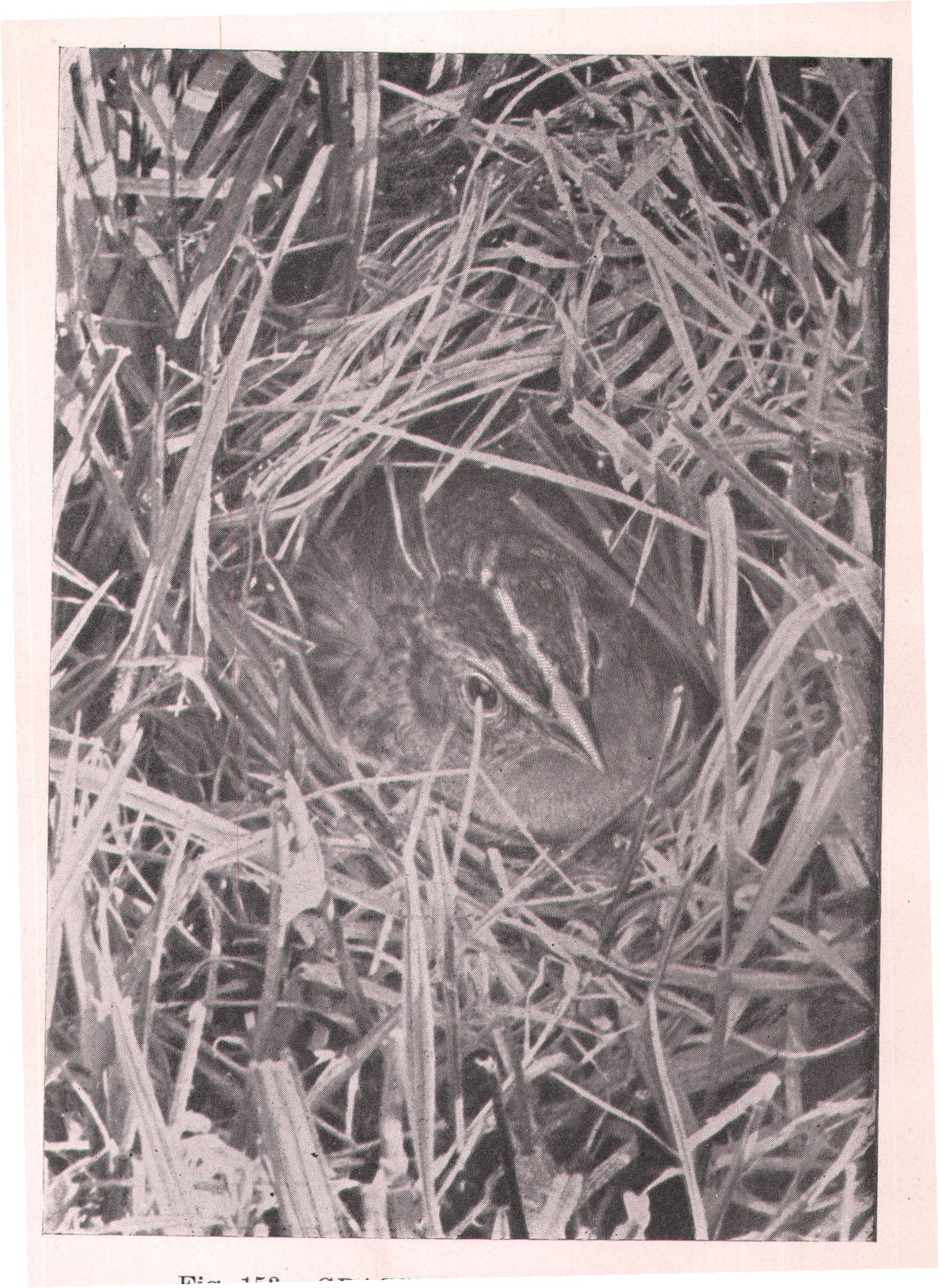
Several more trials on succeeding days got her a little used to the machine and one day I was able to get focussed, draw the slide from the holder and give an exposure of two seconds, the result of which is shown in the picture of her sitting on the nest. Her brown eyes twinkled with excite. ment and anxiety but she kept her place and I quietly removed the camera and left her. The eggs hatched the next day but I troubled her no more as I could not spare more time for pictures of her, and I doubt if it would have been possible to have gotten them.