Home › The Mammoth › The Mammoth
The Mammoth
"His legs were as thick as the bole of the beech, His tusks as the buttonwood white, While his lithe trunk wound like a sapling around An oak in the whirlwind's might."
In the October number of McClure's Magazine for 1899 was published a short story, "The Killing of the Mammoth," by "H. Tukeman," which, to the amazement of the editors, was taken by many readers not as fiction, but as a contribution to natural history. Immediately after the appearance of that number of the magazine, the authorities of the Smithsonian Institution, in which the author had located the remains of the beast of his fancy, were beset with visitors to see the stuffed mammoth, and the daily mail of the Magazine, as well as that of the Smithsonian Institution, was filled with inquiries for more information and for requests to settle wagers as to whether it was a true story or not. The contribution in question was printed purely as fiction, with no idea of misleading the public, and was entitled a story in the table of contents. We doubt if any writer of realistic fiction ever had a more general and convincing proof of success.
About three centuries ago, in 1696, a Russian, one Ludloff by name, described some bones belonging to what the Tartars called "Mamantu"; later on, Blumenbach pressed the common name into scientific use as "Mammut," and Cuvier gallicized this into "Mammouth," whence by an easy transition we get our familiar mammoth. We are so accustomed to use the word to describe anything of remarkable size that it would be only natural to suppose that the name Mammoth was given to the extinct elephant because of its extraordinary bulk. Exactly the reverse of this is true, however, for the word came to have its present meaning because the original possessor of the name was a huge animal. The Siberian peasants called the creature "Mamantu," or "ground-dweller," because they believed it to be a gigantic mole, passing its life beneath the ground and perishing when by any accident it saw the light. The reasoning that led to this belief was very simple and the logic very good; no one had ever seen a live Mamantu, but there were plenty of its bones lying at or near the surface; consequently if the animal did not live above the ground, it must dwell below.
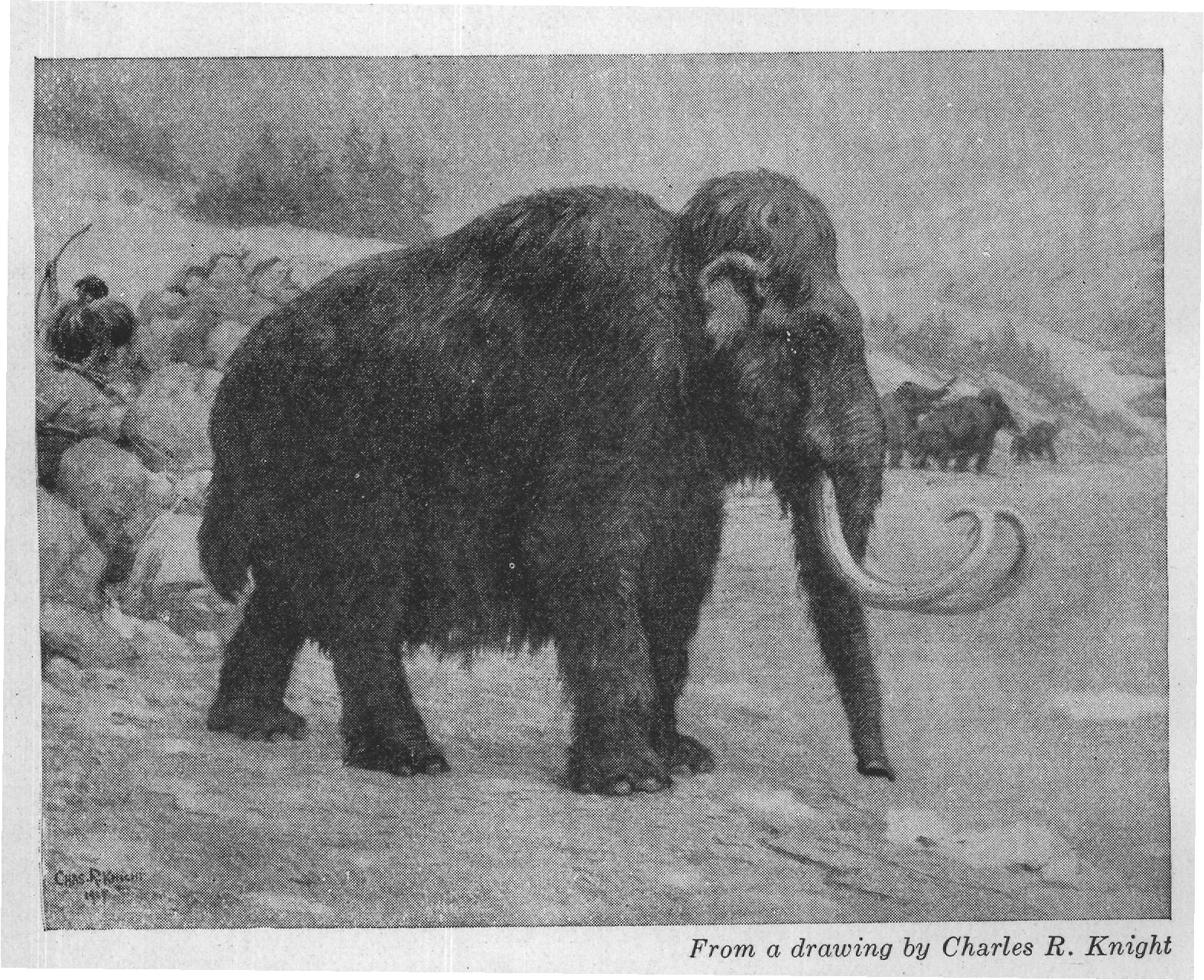
CHAS-RKHANT From a drawing by Charles R. Knight
To-day, nearly every one knows that the mammoth was a sort of big, hairy elephant, now extinct, and nearly every one has a general idea that it lived in the North. There is some uncertainty as to whether the mammoth was a mastodon, or the mastodon a mammoth, and there is a great deal of misconception as to the size and abundance of this big beast. It may be said in passing that the mastodon is only a second or third cousin of the mammoth, but that the existing elephant of Asia is a very near relative, certainly as near as a first cousin, possibly a very great grandson. Popularly, the mammoth is supposed to have been a colossus somewhere from twelve to twenty feet in height, beside whom modern elephants would seem insignificant; but as "trout lose much in dressing," so mammoths shrink in measuring, and while there were doubtless Jumbos among them in the way of individuals of exceptional magnitude, the majority were decidedly under Jumbo's size, averaging no larger in fact than a good-sized Indian Elephant, or from nine to ten feet high. Our own mammoth from Indiana stands as mounted, ten feet six inches at the shoulders, but the restored leg bones are admittedly too long. This applies to the mammoth par excellence, the species known scientifically as Elephas primigenius, whose remains are found in many parts of the Northern Hemisphere and occur abundantly in Siberia and Alaska. There were other elephants than the mammoth, and some that exceeded him in size, notably Elephas antiquus of southern Europe, and Elephas imperator of our Southern and Western States, but even the largest cannot positively be asserted to have exceeded a height of thirteen feet. Tusks offer convenient terms of comparison, and those of an average fully grown mammoth are from eight to ten feet in length; those of the famous St. Petersburg specimen measuring nine feet three inches. So far as the writer is aware, the largest tusks actually measured are two from Alaska, one twelve feet ten inches long, weighing 190 pounds, reported by Mr. Jay Beach; and another eleven feet long, weighing 200 pounds, noted by Mr.
T. L. Brevig. Compared with these we have the big tusk that used to stand on Fulton Street, New York, just an inch under nine feet long, and weighing 184 pounds, or the largest shown at Chicago in 1893, which was seven feet six inches long, and weighed 176 pounds. The largest, most beautiful tusks, probably, ever seen in this country were a pair brought from Zanzibar and displayed by Messrs. Tiffany & Company in 1900. The measurements and weights of these were as follows: length along outer curve, ten feet and three-fourths of an inch, circumference one foot, eleven inches, weight, 224 pounds; length along outer curve, ten feet, three and one-half inches, circumference two feet and onefourth of an inch, weight, 239 pounds. As regards size of tusks it is to be borne in mind that in the good old days animals lived out their alloted lives and that in the case of the mammoth his tusks had a chance to reach their full growth, while now-a-days few elephants with large tusks are allowed to reach their maximum growth.
For our knowledge of the external appearance of the mammoth we are indebted to the more or less entire examples which have been found at various times in Siberia, but mainly to the noted specimen found in 1799 near the Lena, embedded in the ice, where it had been reposing, so geologists tell us, anywhere from 10,000 to 50,000 years. How the creature gradually thawed out of its icy tomb, and the tusks were taken by the discoverer and sold for ivory; how the dogs fed upon the flesh in summer, while bears and wolves feasted upon it in winter; how the animal was within an ace of being utterly lost to science when, at the last moment, the mutilated remains were rescued by Mr. Adams, is an old story, often told and retold. Suffice it to say that, besides the bones, enough of the beast was preserved to tell us exactly what was the covering of this ancient elephant, and to show that it was a creature adapted to withstand the northern cold and fitted for living on the branches of the birch and hemlock.
The exact birthplace of the mammoth is as uncertain as that of many other great characters; but his earliest known resting-place is in the Cromer Forest Beds of England, a country inhabited by him at a time when the German Ocean was dry land and Great Britain part of a peninsula. Here his remains are found today, while from the depths of the North Sea the hardy trawlers have dredged hundreds, aye thousands, of mammoth teeth in company with soles and turbot. If, then, the mammoth originated in western Europe, and not in that great graveyard of fossil elephants, northern India, eastward he went spreading over all Europe north of the Pyrenees and Alps, save only Scandinavia, whose glaciers offered no attractions, scattering his bones abundantly by the wayside to serve as marvels for future ages. Strange indeed have been some of the tales to which these and other elephantine remains have given rise when they came to light in the good old days when knowledge of anatomy was small and credulity was great. The least absurd theory concerning them was that they were the bones of the elephants which Hannibal brought from Africa. Occasionally they were brought forward as irrefutable evidences of the deluge; but usually they figured as the bones of giants, the most famous of them being known as Teutobochus, King of the Cimbri, a lusty warrior said to have had a height of nineteen feet. Somewhat smaller, but still of respectable height, fourteen feet, was "Littell Johne" of Scotland, whereof Hector Boece wrote, concluding, in a moralizing tone, "Be quilk (which) it appears how extravegant and squaire pepill grew in oure regioun afore they were effeminat with lust and intemperance of mouth." More than this, these bones have been venerated in Greece and Rome as the remains of pagan heroes, and later on worshipped as relics of Christian saints. Did not the church of Valencia possess an elephant tooth which did duty as that of St. Christopher, and, so late as 1789, was not a thigh-bone, figuring as the arm-bone of a saint, carried in procession through the streets in order to bring rain?
Out of Europe eastward into Asia the mammoth took his way, and having peopled that vast region, took advantage of a land connection then existing between Asia and North America and walked over into Alaska, in company with the forerunners of the bison and the ancestors of the mountain sheep and Alaskan brown bear. Still eastward and southward he went, until he came to the Atlantic coast, the latitude of southern New York roughly marking the southern boundary of the broad domain over which the mammoth roamed undisturbed.¹ Not that of necessity all this vast area was occupied at one time; but this was the range of the mammoth during Pleistocene time, for over all this region his bones and teeth are found in greater or less abundance and in varying conditions of preservation. In regions like parts of Siberia and Alaska, where the bones are entombed in a wet and cold, often icy, soil, the bones and tusks are almost as perfectly preserved as though they had been deposited but a score of years ago, while remains so situated that they have been subjected to varying conditions of dryness and moisture are always in a fragmentary state. Many bones of the mammoth and some fine skulls have been unearthed during the extensive mining operations of the past twenty-five years, but owing to cost of transportation, lack of communications and distances to be traversed
This must be taken as a very general statement, as the distinction between and habitats of Elephas primigenius and Elephas columbi, the southern mammoth, are not satisfactorily determined; moreover, the two species overlap through a wide area of the West and Northwest. it has not been possible for any scientific institution to avail itself of any of these discoveries so much valuable material has been lost to science. As previously noted, several more or less entire carcasses of the mammoth have been discovered in Siberia, only to be lost; and, while no entire animal has so far been found in Alaska, some day one may yet come to light. That there is some possibility of this is shown by the discovery, recorded by Mr. Dall, of the partial skeleton of a mammoth in the bank of the Yukon with some of the fat still present, and although this had been partially converted into adipocere, it was fresh enough to be used by the natives for greasing, not their boots, but their boats. Quite recently Judge Worcester reports the finding of a specimen on which much of the flesh was present and large quantities of the hair and wool. And up to the present time this is the nearest approach to finding a live mammoth in Alaska.
As to why the mammoth became extinct, we know absolutely nothing, although various theories, some much more ingenious than plausible, have been advanced to account for their extermination-they perished of starvation; they were overtaken by floods on their supposed migrations and drowned in detachments; they fell through the ice, equally in detachments, and were swept out to sea. But all we can safely say is that long ages ago the last one perished off the face of the earth. Strange it is, too, that these mighty beasts, whose bulk was ample to protect them against fourfooted foes, and whose woolly coat was proof against the cold, should have utterly vanished.
A most ingenious and rather plausible theory has recently been advanced by M. Neuville that this was due to the lack of oil glands which were absent in the mammoth as well as in existing elephants: thus there was no oily secretion to repel water and when exposed to rain or melting snow the wool became water-soaked, ofttimes frozen, so that after all the mammoth perished from cold. This sounds well, but fails to account for the disappearance of such southern species as the Imperial and Columbian mammoths which went the way of their northern relative.
Mammoths ranged from England eastward to New York, almost around the world; from the Alps to the Arctic Ocean; and in such numbers that to-day their tusks are articles of commerce, and fossil ivory has its price current as well as wheat. Mr. Boyd Dawkins thinks that the mammoth was actually exterminated by early man, but, even granting that this might be true for southern and western Europe, it could not be true of the herds that inhabited the wastes of Siberia, or of the thousands that flourished in Alaska and the western United States. So far as man is concerned, the mammoth might still be living in these localities, where, before the discovery of gold drew thousands of miners to Alaska, there were great stretches of wilderness wholly untrodden by the foot of man.
Neither could this theory account for the disappearance of the mastodon from North America, where that animal covered so vast a stretch of territory that man, unaided by nature, could have made little impression on its numbers. That many were swept out to sea by the flooded rivers of Siberia is certain, for some of the low islands off the coast are said to be formed of sand, ice, and bones of the mammoth, and thence, for hundreds of years, have come the tusks which are sold in the market beside those of the African and Indian elephants.
That man was contemporary with the mammoth in southern Europe is fairly certain, for not only are the remains of the mammoth and man's flint weapons found together, but in few instances some primeval Landseer graved on slate, ivory, or reindeer antler a sketchy outline of the beast, somewhat impressionistic perhaps, but still, like the work of a true artist, preserving the salient features. We see the curved tusks, the snaky trunk, and the shaggy coat that we know belonged to the mammoth, and we may feel assured that if early man did not conquer the clumsy creature with fire and flint, he yet gazed upon him from the safe vantage point of some lofty tree or inaccessible rock, and then went home to tell his wife and neighbors how the animal escaped because his bow missed fire. Later the artists of the Cro- Magnon race depicted him time and again, singly and in herds, on the walls of the caves of southern France and Spain so that we have a pretty clear idea of the animal, how he resembled and how he differed from his nearest relative, the Asiatic Elephant, and with this knowledge, plus the skill of the trained modern artist, Mr. Knight has portrayed him on the walls of the Hall of the Age of Man. That man and mammoth lived together in North America is uncertain; so far there is no evidence to show that they did, although the absence of such evidence is no proof that they did not. That any live mammoth has for centuries been seen on the Alaskan tundras is utterly improbable, and on Mr. C. H. Townsend seems to rest the responsibility of having, though quite unintentionally, introduced the Alaskan Live Mammoth into the columns of the daily press. It befell in this wise: Among the varied duties of our revenue marine is that of patrolling and exploring the shores of arctic Alaska and the waters of the adjoining sea, and it is not so many years ago that the cutter Corwin, if memory serves aright, held the record of farthest north on the Pacific side. On one of these northern trips, to the Kotzebue Sound region, famous for the abundance of its deposits of mammoth bones,¹ the Corwin carried Mr. Townsend, then naturalist to the United States Fish Commission. At Cape Prince of Wales some natives came on board bringing a few bones and tusks of the mammoth, and upon being questioned as to whether or not any of the animals to which they pertained were living, promptly replied that all were dead, inquiring in turn if the white men had ever seen any, and if they knew how these animals, so vastly larger than a reindeer, looked.
Fortunately, or unfortunately, there was on board a text-book of geology containing the well-known cut of the St. Petersburg mammoth, and this was brought forth, greatly to the edification of the natives, who were delighted at recognizing the curved tusks and the bones they knew so well. Next the natives wished to know what the outside of the creature looked like, and as Mr. Townsend had been at Ward's establishment in Rochester when the first copy of the Stuttgart restoration was made, he rose to the emergency, and made a sketch.
This was taken ashore, together with a copy of the cut of the skeleton that was laboriously made by an Innuit sprawled out at full length on the deck. Now the Innuits, as Mr. Townsend tells us, are great gadabouts, making long sledge journeys in winter and equally long trips by boat in summer, while each season they hold a regular fair on Kotzebue Sound, where a thousand or two natives gather to barter and gossip. On these journeys and at these gatherings the sketches were no doubt passed about, copied, and recopied, until a large number of Innuits had become well acquainted with the appearance of the mammoth, a knowledge that Elephant Point, at the mouth of the Buckland River, is so named from the numbers of mammoth bones which have accumulated there. naturally they were well pleased to display to any white visitors. Also, like the Celt, the Alaskan native delights to give a "soft answer," and is always ready to furnish the kind of information desired. Thus in due time the newspaper man learned that the Alaskans could make pictures of the mammoth, and that they had some knowledge of its size and habits; so with inference and logic quite as good as that of the Tungusian peasant, the reporter came to the conclusion that somewhere in the frozen wilderness the last survivor of the mammoths must still be at large. And so, starting on the Pacific coast, the Live Mammoth story wandered from paper to paper, until it had spread throughout the length and breadth of the United States, when it was captured by Mr. Tukeman, who with much artistic color and some realistic touches, transferred it to McClure's Magazine, and-unfortunately for the officials thereof to the Smithsonian Institution.
And now, once for all, it may be said that there is no mounted mammoth to awe the visitor to the national collections, and with the exception of the largely restored specimen in St. Petersburg there is none elsewhere. And yet there seems no good and conclusive reason why there should not be: true, there are no live mammoths to be had at any price; neither are their carcasses to be had on demand; still there is good reason to believe that a much smaller sum than that said to have been paid by Mr. Conradi for the mammoth which is not in the Smithsonian Institution, would place one there. It probably could not be done in one year; it might not be possible in five years; but should any man of means wish to secure enduring fame by showing the world the mammoth as it stood in life, a hundred centuries ago, before the dawn of even tradition, he could probably accomplish the result by the expenditure of a far less sum than it would cost to participate in an international yacht race.
In the first edition of this book, just after the above lines were written it was noted that another well preserved example of the animal had been discovered in Siberia and that an expedition was on the way to secure it. It is painful to record that this expedition was only partially successful. It naturally took time for the report of the discovery to travel from Siberia to St. Petersburg and for the dispatch of the party to secure it, so that while the body was discovered in 1900, the work of exhumation did not begin until September, 1901.
Then too the official who was to have seen that the body was covered during the winter in order to preserve it from the attacks of wolves, was taken ill, so that the carcass was left exposed. The result was that much of the animal that might otherwise have been saved was lost by decay and the attacks of wild animals, though enough was left to add materially to our knowledge of the animal and to permit of its restoration.
This find threw much light on the problem of how the Mammoths came to be imbedded in ice or frozen soil, since the theory that this was due to some cataclysm that caused an almost instantaneous change in climate was long ago abandoned. Briefly, it is supposed to have been brought about by the giving away of the earth, precipitating the mammoth into a big crevasse formed by the sliding away of the bank, undercut by the river in flood. Some of the bones were broken, as if by a fall, and the attitude of the animal indicated that it had made desperate efforts to extricate itself from the trap into which it had fallen and in this attitude the restored animal has been mounted in the museum in St. Petersburg. 1 full account of this find is given in the Report of the Smithsonian REFERENCES.
The mounted skeleton of the mammoth in the American Museum of Natural History is the only one on exhibition in the United States, although almost every museum has teeth or odd bones of the animal. Remains of the mammoth are common enough but, save in Alaska, they are usually in a poor state of preservation or consist of isolated bones or teeth. A great many more or less complete skeletons of mammoth and some fine skulls have been found by gold miners in Alaska, and with proper care some of these could undoubtedly have been secured. Naturally, however, the miners do not feel like taking the time and trouble to exhume bones whose value is uncertain, while the cost of transportation precludes the bringing out of many specimens.
Some reports of mammoths have been based on the bones of whales, including a skull that was figured in the daily papers.
The tusk obtained by Mr. Beach and mentioned in the text still holds the record for mammoth tusks. The greatest development of tusks occurred in Elephas ganesa, a species found in Pliocene deposits of the Siwalik Hills, India. This species appears not to have exceeded the existing elephant in bulk, but the tusks are twelve feet nine inches long, and two feet two inches in circumference. How the animal ever carried them is a mystery, both on account of their size and their enormous leverage. The persistence of error is well shown by the many restorations of Mammoth and Mastodon in which the tusks are represented as curving outwards. This probably came about through the transposition of the tusks in the St. Petersburg specimen and this in turn was not unlikely due to the fact that the mounter thought that they ought to be different from those of existing elephants. The error was perpetuated in the restorations in the first edition of "Animals of the Past," though shortly after the publication of the book Mr. Knight's suspicions were aroused and these soon became certainties that the tusks were transposed. As for teeth, an upper grinder of Elephas columbi in the United States National Museum is ten and one-half inches high, nine inches wide, the grinding face being eight by five inches. This tooth, which is unusually perfect, retaining the outer covering of cement, came from Afton, Indian Territory, and weighs a little over fifteen pounds. The lower tooth, shown in Fig. 38, is twelve inches long, and the grinding face is nine by three and one-half inches; this is also from Elephas columbi. Grinders of the Northern Mammoth are smaller, and the plates of enamel thinner, and closer to one another. Mr. F. E. Andrews, of Gunsight, Texas, reports having found a femur, or thigh-bone five feet four inches long, and a humerus measuring four feet three inches, probably from the Imperial Mammoth, these being the largest bones on record indicating an animal fourteen feet high.
There is a vast amount of literature relating to the mammoth, some of it very untrustworthy. A list of all discoveries of specimens in the flesh is given by Nordenskiold in "The Voyage of the Vega," and "The Mammoth and the Flood," by Sir Henry Howorth, is a mine of information. Mr. Townsend's "Alaska Live-Mammoth Story" may be found in "Forest and Stream" for August 14, 1897.
THE MAMMOTH AS ENGRAVED BY A PRIMITIVE ARTIST on a Piece of Mammoth Tusk. ،،