Home › Volumes › Fishes › The Pampanos
Permit; Great Pompano
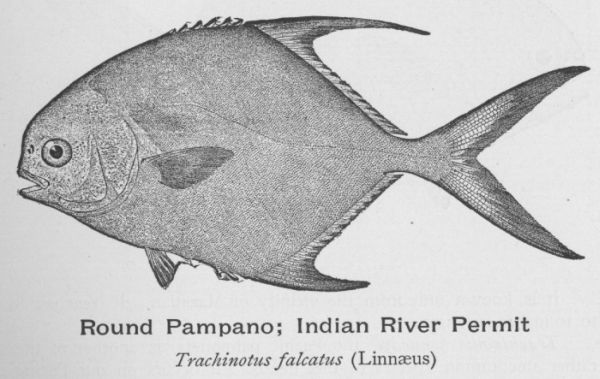
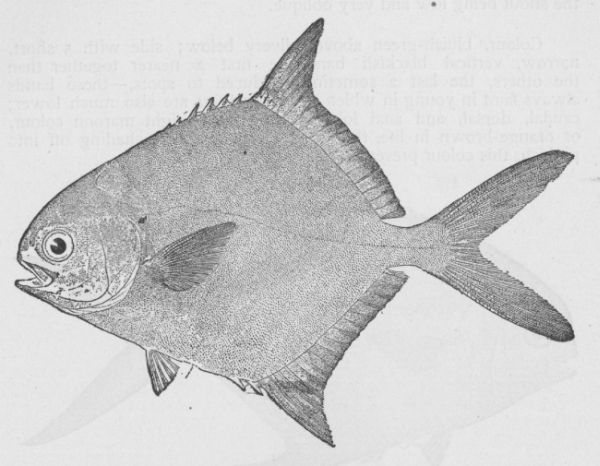
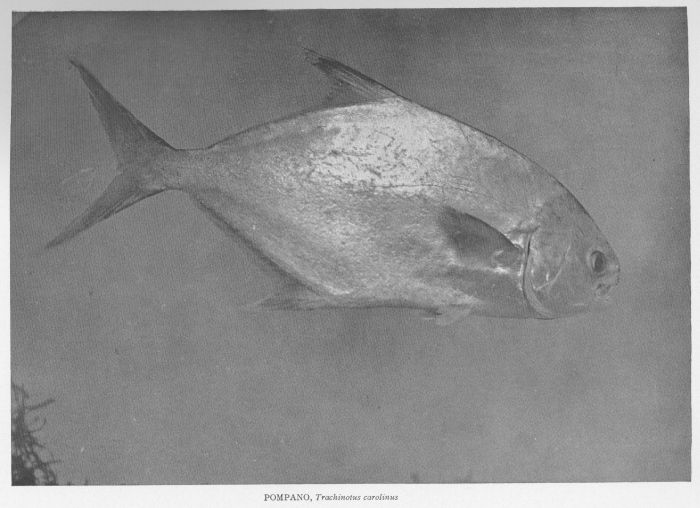
The permit is the largest of all pompanos. It reaches a length of 3 feet and a weight of 27 pounds or more. It occurs in the West Indies and north to Florida. It occurs about Key West and is occasionally taken in Indian River. It should be remarked, however, that to the Indian River fishermen this species is not distinguished from the common pompano, and that the fish known to them as the "permit" is the round pompano (T.falcatus). The permit is an excellent food-fish, not as good as the common pompano, but usually sold as that species and bringing as good a price.
Head 3; depth 2 3/5; D. VI-I, 19; A. II-I, 17; maxillary 2 3/5; ventrals 2. Body oblong, elliptical, moderately compressed; profile nearly straight from procumbent spine to nostril, where it descends nearly vertically, forming an angle, the vertical portion from angle to snout nearly equalling eye; maxillary reaching slightly behind middle of eye; jaws with bands of villiform teeth, disappearing with age; ventrals reaching 4/5 distance to vent; dorsal and anal fins falcate, the anterior rays less elevated than in the round pompano, but extending beyond middle of fin when depressed; caudal forked, the lobes 3 in body; lateral line nearly straight, slightly curved upward above the pectoral. Colour, bluish-silvery above, silvery below; dorsal, caudal, and anal lobes black; no crossbars.
Trachinotus argenteus, the silvery pompano, is a very rare species, known only from the West Indies south to Brazil. The type specimen was recorded from New York, but probably really came from Brazil. The species is allied to T. carolinus, but probably has the body deeper, the depth being half the length in examples 6 inches long, or 2 1/10 in length in the type, a specimen a foot in length.