Home › Volumes › American Animals › The Cattle
Mountain Sheep
Also called: Bighorn.
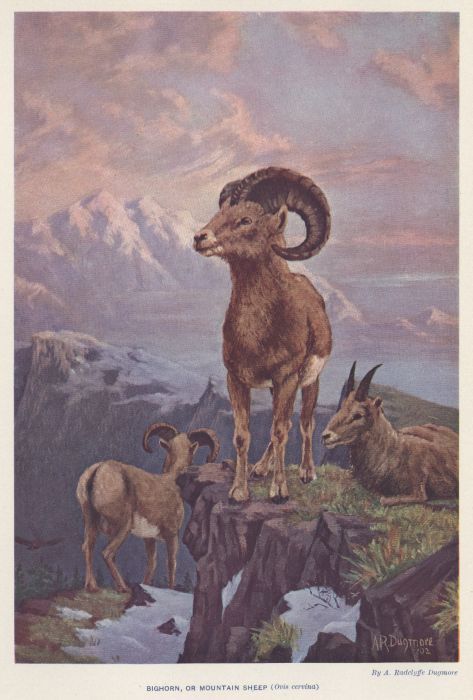
Length.—4 feet 6 inches. Height at shoulder, 3 feet 4 inches. Length of horn around curve, 50 inches. Circumference at base, 14 inches.
Description.—Body heavy, legs rather slender, hair everywhere closely appressed, no mane or beard. Horns in female short, in male very massive, curving backward and outward and in old rams making a complete spiral circle. Colour grayish brown, darkest on the back, under parts, inner side of legs, upper throat and patch on rump and around the base of the tail whitish; lighter and grayer in winter.
Range.—Higher mountains from British Columbia to Arizona. Nearly related varieties inhabit mountains to the North, South and West.
Range.—"Bad Lands." Western South Dakota and Eastern Wyoming.
Range.—Grapevine Mountains, between California and Nevada.
Range.—Northwestern Mexico and (?) southern New Mexico.
Range.—Headwaters of Pease River, Rocky Mountains, and Cassiar Mountains to Stikeen Mountains, Alaska.
Range.—Alaskan Mountains, north of 60degree to the Arctic coast.
Range.—Rocky Mountains, about 75 miles east of Dawson, Northwestern Territory.
The bighorn might be called the chamois of our Western mountains, scaling the rugged cliffs and plunging over precipices with the same agility and confidence that mark the famous inhabitant of the Alps.
The elastic spring of the animal when started and the easy poise of the splendid head as it settles back on the shoulders are exceedingly graceful, and the animal seems built and proportioned to the finest detail for the life that it leads.
From the edges of the Alaskan glaciers to the dry, waterless crags of the Mexican Sierras we find one variety or other of the mountain sheep.
During the breeding season an old ram presides over the flock of ewes and lambs, driving the younger rams off by themselves, as is usual among polygamous animals. The flocks are exceedingly watchful and at the slightest alarm are off instantly, selecting a course that few animals or men care to follow. In early spring the sheep venture farther down into the mountain valleys in search of food, but soon return to their rocky fastnesses among the higher slopes.
In the "Bad Lands," the easternmost part of their range, Audubon made the acquaintance of these noble animals in 1843. He says: "The parts of the country usually chosen by the sheep for their pastures are the most extraordinary broken and precipitous clay hills or stony eminences that exist in the wild regions belonging to the Rocky Mountain chain. Perhaps some idea of the country they inhabit--which is called by the French Canadians and hunters 'mauvaise terres'--may be formed by imagining some hundreds of loaves of sugar of different sizes, irregularly broken and truncated at top, placed somewhat apart and magnifying them into hills of considerable size. Over these hills and ravines the Rocky Mountain sheep bound up and down and you may estimate the difficulty of approaching them and conceive the great activity and sure-footedness of this species. They form paths around these irregular clay cones that are at times six to eight hundred feet high, and in some situations are even fifteen hundred feet or more above the adjacent prairies; and along these they run at full speed, while to the eye of the spectator below, these tracks do not appear to be more than a few inches wide although they are generally from a foot to eighteen inches in breadth. In many places columns or piles of clay or hardened earth, are to be seen eight or ten feet above the adjacent surface, covered or coped with a slaty, flat rock, thus resembling gigantic toadstools, and upon these singular places the bighorns are frequently seen, gazing at the hunter who is winding about far below, looking like so many statues on their elevated pedestals. One cannot imagine how these animals reach these curious places, especially on these inaccessible points, beyond the reach of their greatest enemies, the wolves, which prey upon them whenever they stray into the plains below."
Like all other big game the bighorn has been relentlessly pursued by hunters and in many parts of its original range it has been exterminated. In a number of localities, however, it holds its own with remarkable persistency, thanks no doubt to its agility, wariness and the inaccessibility of its favourite ranges. The sheep furnishes not only good sport in the chase but excellent meat as well, and has the misfortune to possess a pair of horns that are prized perhaps more than those of any of our other big game. Hornaday truly says, "The head of the male bighorn is a trophy which appeals to all sorts and conditions of hunters, except Indians. In the grandest head the noble red-man sees nothing more than a pair of horn spoons for his soup-kettle. Thousands of Ovis cervina have been hunted down and killed for their heads alone and thousands more have met their death before the rifles of sportsmen because they are grand game."