Home › The Ancestry of the Horse › The Ancestry of the Horse
The Ancestry of the Horse
"Said the little Eohippus I am going to be a horse And on my middle finger-nails To run my earthly course."
The American whose ancestors came over in the "Mayflower" has a proper pride in the length of the line of his descent. The Englishman whose genealogical tree sprang up at the time of William the Conqueror has, in its eight centuries of growth, still larger occasion for pluming himself on the antiquity of his family. But the pedigree of even the latter is a thing of yesterday when compared with that of the horse, whose family records, according to Professor Osborn, reach backward for something like 2,000,000 years. And if, as we have been told, "it is a good thing to have ancestors, but sometimes a little hard on the ancestor," in this instance at least the founders of the family have every reason to regard their descendants with undisguised pride. For the horse family started in life in a small way, and the first of the line, the Eohippus, was "a little animal no bigger than a fox, and on five toes he scampered over Tertiary rocks," in the age called Eocene, because it was the morning of life for the great group of mammals whose culminating point was man. At that time, western North America was a country of many lakes, for the most part comparatively shallow, around the reedy margins of which moved a host of animals, quite unlike
This is a minimum estimate, made twenty years ago and the time is now regarded as vastly longer, even so great as 25,000,000 years.
Four, to be exact; but we prefer to sacrifice the foot of Eohippus rather than to take liberties with one of the feet of Mrs. Stetson's poem. those of to-day, and yet foreshadowing them, the forerunners of the rhinoceros, tapir, and the horse.
The early horse-we may call him so by courtesy, although he was then very far from being a true horsewas an insignificant little creature, apparently far less likely to succeed in life's race than his bulky competitors, and yet, by making the most of their opportunities,
Skeleton of the Modern Horse and of His Eocene Ancestor. his descendants have survived, while most of theirs have dropped by the wayside; and finally, by the aid of man, the horse has become spread over the length and breadth of the habitable globe.
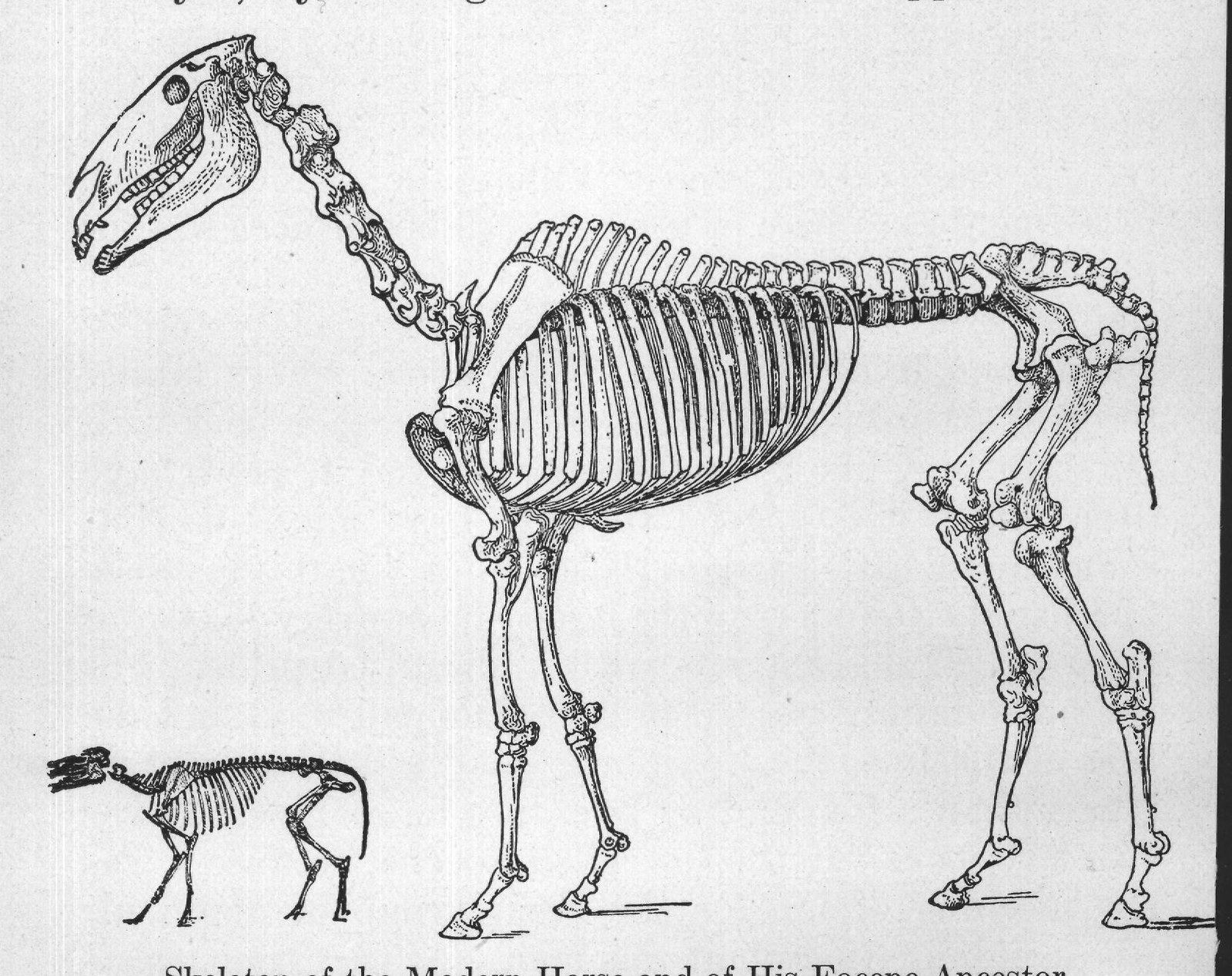
Now right here it may be asked, How do we know that the little Eohippus was the progenitor of the horse, and how can it be shown that there is any bond of kinship between him and, for example, the great French Percheron? There is only one way in which we can obtain this knowledge, and but one method by which the relationship can be shown, and that is by collecting the fossil remains of animals long extinct and comparing them with the bones of the recent horse, a branch of science known as Palæontology. It has taken a very long time to gather the necessary evidence, and it has taken a vast amount of hard work in our western Territories, for "the country that is as hot as Hades, watered by stagnant alkali pools, is almost invariably the richest in fossils." Likewise it has called for the expenditure of much time and more patience to put together some of this petrified evidence, fragmentary in every sense of the word, and get it into such shape that it could be handled by the anatomist. Still, the work has been done, and, link by link, the chain has been constructed that unites the horse of to-day with the horse of very many yesterdays.1
Many years ago in 1876, in his address on the "Demonstrative Evidence of Evolution," Huxley said: " the general principles of the hypothesis of evolution lead to the conclusion that the horse must have been derived from some quadruped which possessed five complete digits on each foot; which had the bones of the forearm and of the leg complete and separate; and which possessed forty-four teeth, among which the crowns of the incisors and grinders had a simple structure; while the latter gradually increased in size from before backwards, at any rate in the anterior part of the series, and had short crowns.
And if the horse has been thus evolved, and the remains of the different stages of its evolution have been preserved, they ought to present us with a series of forms in which the number of the digits becomes reduced; the bones of the forearm and leg gradually take on the equine condition; and the form and arrangement of the teeth successively approximate to those which obtain in existing horses. Let us turn to the facts and see how far they fulfil these requirements of the doctrine of evolution."