Home › Birds of Old › Birds of Old: Hesperornis
Birds of Old: Hesperornis
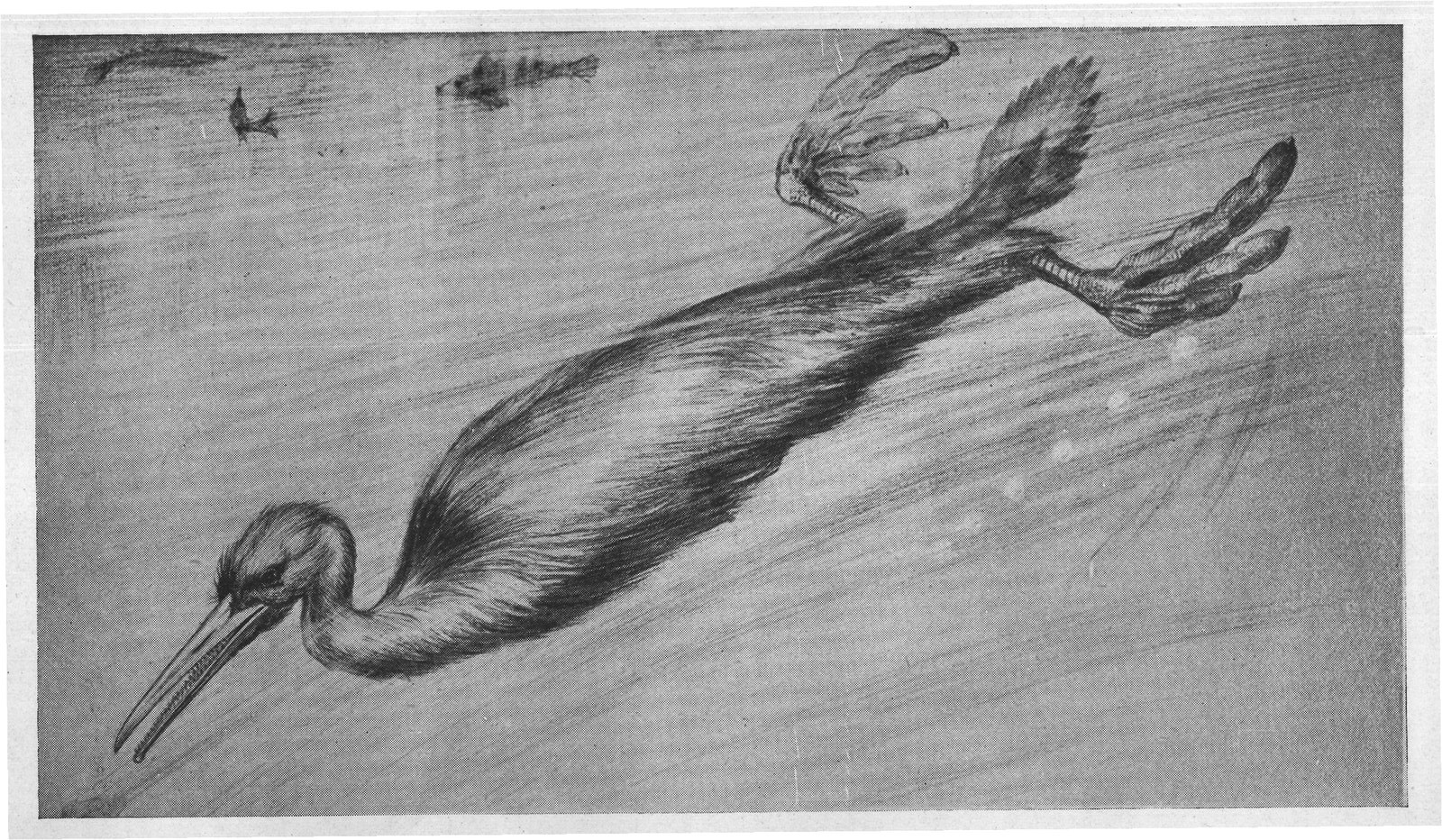
The penguins, as everyone knows, swim with their front limbs-we can't call them wings-which, though containing all the bones of a wing, have become transformed into powerful paddles; Hesperornis, on the other hand, swam altogether with its legs-swam so well with them, indeed, that through disuse the wings dwindled away and vanished, save one bone. This, however, is not stating the theory quite correctly; of course the matter cannot be actually proved. Hesperornis was a large bird, upwards of five feet in length, and if its ancestors were equally bulky their wings were quite too large to be used in swimming under water, as are those of such short-winged forms as the Auks which fly under the water quite as much as they fly over it. Hence the wings were closely folded upon the body so as to offer the least possible resistance, and being disused, they and their muscles dwindled, while the bones and muscles of the legs increased by constant use. By the time the wings were small enough to be used in so dense a medium as water the muscles had become too feeble to move them, and so degeneration proceeded until but one bone remained, a mere vestige of the wing that had been. The penguins retain their great breast muscles, and so did the Great Auk, because their wings are used in swimming, since it requires even more strength to move a small wing in water than it does to move a large wing in the thinner air. As for our domesticated fowls-the turkeys, chickens, and ducks --there has not been sufficient lapse of time for their THE GREAT, TOOTHED DIVER, HESPERORNIS Drawn by J. M. Gleeson 58 muscles to dwindle, and besides artificial selection, the breeding of fowls for food has kept up the mere size of the muscles, although these lack the strength to be found in those of wild birds.
As a swimming bird, one that swims with its legs and not with its wings, Hesperornis has probably never been equalled, for the size and appearance of the bones indicate great power, while the bones of the foot were so joined to those of the leg as to turn edgewise as the foot was brought forward and thus to offer the least possible resistance to the water. It is a remarkable fact that the leg bones of Hesperornis are hollow, remarkable because as a rule the bones of aquatic animals are more or less solid, their weight being supported by the water; but those of the great diver were almost as light as if it had dwelt upon the dry land. That it did not dwell there is conclusively shown by its build, and above all by its feet, for the foot of a running bird is modified in quite another way.
The bird was probably covered with smooth, soft feathers, something like those of an Apteryx; this we know because Professor Williston found a specimen showing the impression of the skin of the lower part of the leg as well as of the feathers that covered the "thigh" and head. While such a covering seems rather inadequate for a bird of such exclusively aquatic habits as Hesperornis must have been, there seems no getting away from the facts in the case in the shape of Professor Williston's specimen, and we have in the Snake Bird, one of the most aquatic of recent birds, an instance of similarly poor covering. As all know who have seen this bird at home, its feathers shed the water very imperfectly, and after long-continued submersion become saturated, a fact which partly accounts for the habit the bird has of hanging itself out to dry.
The restoration which Mr. Gleeson has drawn differs radically from any yet made, and is the result of a careful study of the specimen belonging to the United States National Museum. No one can appreciate the peculiarities of Hesperornis and its remarkable departures from other swimming birds who has not seen the skeleton mounted in a swimming attitude. The great length of the legs, their position at the middle of the body, the narrowness of the body back of the hip joint, and the disproportionate length of the outer toe are all brought out in a manner which a picture of the bird squatting upon its haunches fails utterly to show. As for the tail, it is evident from the size and breadth of the bones that something of the kind was present; it is also evident that it was not like that of an ordinary bird, and so it has been drawn with just a suggestion of Archæopteryx about it.
The most extraordinary thing about Hesperornis, however, is the position of the legs relative to the body, and this is something that was not even suspected until the skeleton was mounted in a swimming attitude. As anyone knows who has watched a duck swim, the usual place for the feet and legs is beneath and in a line with the body. But in our great extinct diver the articulations of the leg bones are such that this is impossible, and the feet and lower joint of the legs (called the tarsus) must have stood out nearly at right angles to the body, like a pair of oars. This is so peculiar and anomalous an attitude for a bird's legs that, although apparently indicated by the shape of the bones, it was at first thought to be due to the crushing and consequent distortion to which the bones had been subjected, and an endeavor was made to place the legs in the ordinary position, even though this was done at the expense of some little dislocation of the joints. But when the mounting of the skeleton had advanced further it became more evident that Hesperornis was not an ordinary bird, and that he could not have swum in the usual manner, since this would have brought his great knee-caps up into his body, which would have been uncomfortable. And so, at the cost of some little time and trouble,¹ the mountings were so changed that the legs stood out at the sides of the body, as shown in the picture, a position that was verified later on by the discovery of the specimen now in the American Museum of Natural History in which the limbs lay in just the position given them by Mr. Gleeson.
A final word remains to be said about toothed birds, which is, that the visitor who looks upon one for the first time will probably be disappointed. The teeth are so loosely implanted in the jaw that most of them fall out shortly after death, while the few that remain are so small as not to attract observation.
By the time the Eocene Period was reached, even before that, birds had become pretty much what we now see them, and very little change has taken place in them since that time; they seem to have become so exactly adapted to the conditions of existence that no further modification has taken place. This may be expressed in another way, by saying that while the Mammals of the Eocene have no near relatives among those now living, entire large groups having passed completely The mounting of fossil bones is quite a different matter from the wiring of an ordinary skeleton, since the bones are not only so hard that they cannot be bored and wired like those of a recent animal, but they are so brittle and heavy that often they will not sustain their own weight. Hence such bones must be supported from the outside, and to do this so that the mountings will be strong enough to support their weight, allow the bones to be removed for study, and yet be inconspicuous, is a difficult task. out of existence, the few birds that we know might, so far as their appearance and affinities go, have been killed yesterday.
Were we to judge of the former abundance of birds by the number we find in a fossil state, we should conclude that in the early days of the world they were remarkably scarce, for bird bones are among the rarest of fossils. But from the high degree of development evidenced by the few examples that have come to light, and the fact that these represent various and quite distinct species,¹ we are led to conclude that birds were abundant enough, but that we simply do not find them. Several eggs, too-or, rather, casts of eggs-have lately been found in the Cretaceous and Miocene strata of the West; and, as eggs and birds are usually associated, we are liable at any time to come upon the bones of the birds that laid them.
To the writer's mind no thoroughly satisfactory explanation has been given for the scarcity of bird remains; but the reason commonly advanced is that, owing to their lightness, dead birds float for a much longer time than other animals, and hence are more exposed to the ravages of the weather and the attacks of carrion-feeding animals. It has also been said that the power of flight enabled birds to escape calamities that caused the death of contemporary animals; but all birds do not fly; and birds do fall victims to storms, cold, and starvation, and even perish of pestilence, like the Cormorants of Bering Island, whose ranks have twice been decimated by disease.
But three birds, besides a stray feather or two, are so far known from the Eocene of North America. One of these is a fowl not very unlike some of the small curassows of South America; another is a little bird, supposed to be related to the sparrows, while the third is a large bird of uncertain relationships figured in the chapter on feathered giants. It is true that where carnivorous animals abound, dead birds do disappear quickly; and my friend Dr.
Stejneger tells me that, while hundreds of dead seafowl are cast on the shores of the Commander Islands, it is a rare thing to find one after daylight as the bodies are devoured by the Arctic foxes that prowl about the shores at night. But, again, as in the Miocene of Southern France and in the Pliocene of Oregon, remains of birds are fairly numerous, showing that, under proper conditions, their bones are preserved for future reference, so that we may hope some day to come upon specimens that will enable us to round out the history of bird life in the past.
We are as much as ever in the dark as to how birds began, but quite recently (1915) Mr. Beebe has brought forward some evidence as to how flight began. There are two principal theories as to how this originated, one that it was brought about by jumping up, the other that it was brought about by jumping down. According to one view, the about-to-be birds ran along the ground, or jumped into the air waving their fore limbs vigorously, until the time came when the wings were sufficiently developed to raise their owner into the air. Those who hold the other view consider that flight began by animals leaping from trees and instinctively spreading their limbs to catch at anything convenient to break their fall.
Advocates of the first theory cannot bring forward a single creature that to-day habitually runs along the ground before taking flight; the best they can do is to adduce the flying fish which is not to the point at all, especially since a large number of observers say that the flying fish does not fly, although in this we believe them mistaken.
Those who favor the jumping down theory, as opposed to the jumping up, can on the contrary show almost every stage in the progress from flightlessness to flight, beginning with lizards that, like the iguana, jump boldly from their abiding places on the branches, to the flying lemur that can sail-or parachute for a hundred yards or more. Even snakes that drop from trees have developed or there has been deevloped in them-an ability to hollow in the under side of the body, which affords some slight resistance to the air. Not only this, but true flight has also been developed in three classes of vertebrates: reptiles, birds and mammals, in the order of their appearance in time; and if it failed to develop in fishes and amphibians, it may well be ascribed to the fact that neither of these groups were tree climbers and when tree frogs did appear they were too highly specialized to make a success of flight.
As to fishes, they were handicapped by the structure of their fore limbs, and although representatives of several orders have essayed to fly, only two groups, the Characinidæ and Exocoetidæ, have met with any measure of success and many people aver that neither of these really fly.
Also it is worthy of note that none of the flying or sailing animals use the hind legs actively; bats, flying squirrels, even flying fish, simply use the hind limbs as adjuncts to flight, holding them motionless to spread a membrane or form a kitelike support for the hinder end of the body. The hind legs are used to jump with, not run with, save in sea birds that, like the albatross in a calm, may run a quarter of a mile before getting headway enough to launch himself into the air. But where would a lizard get a good straight away level stretch?
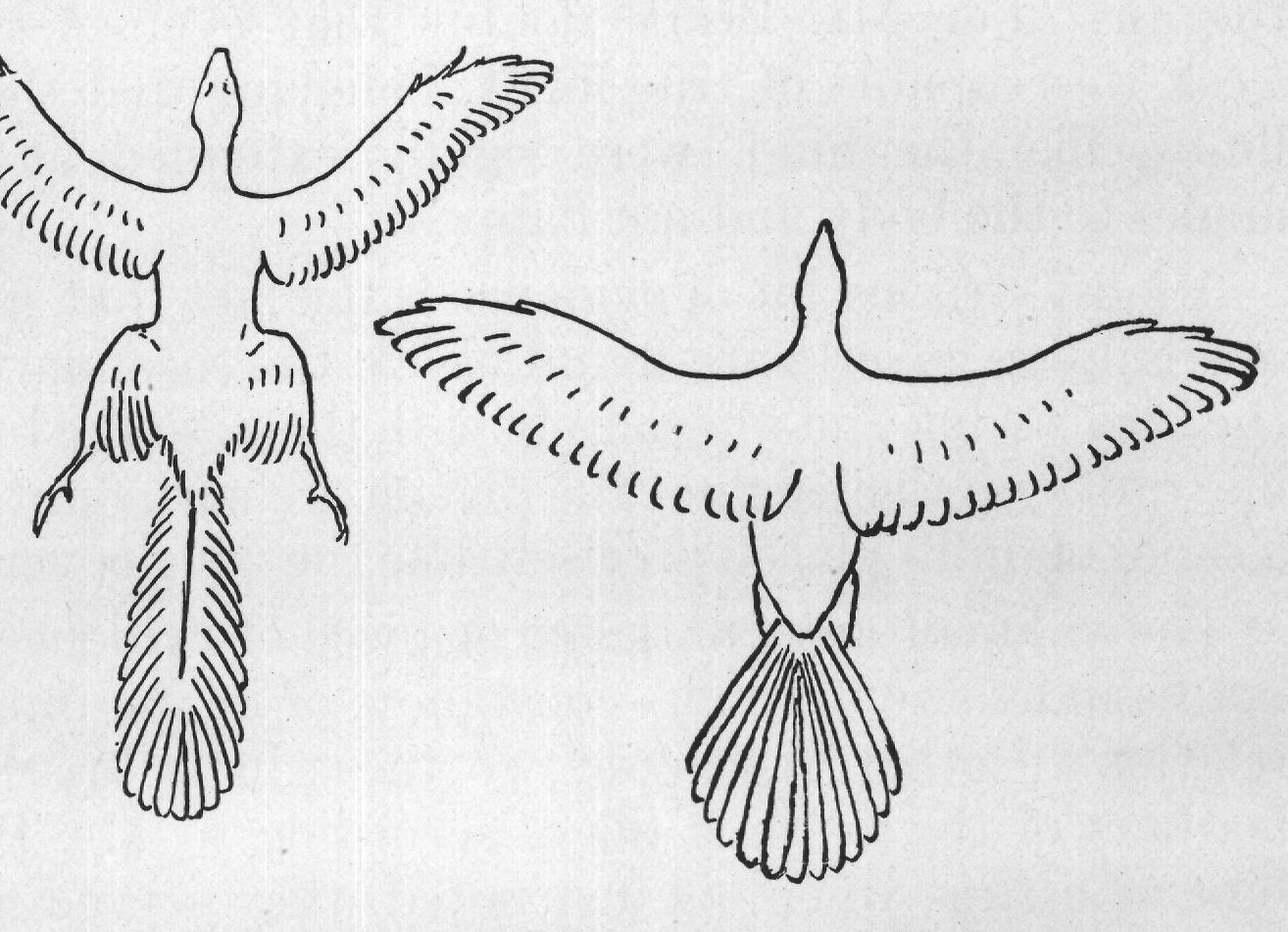
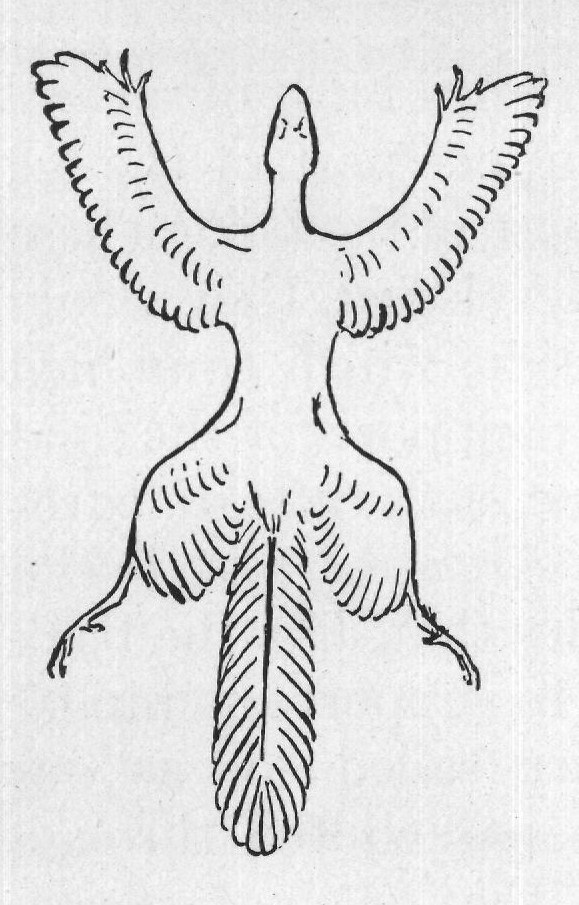
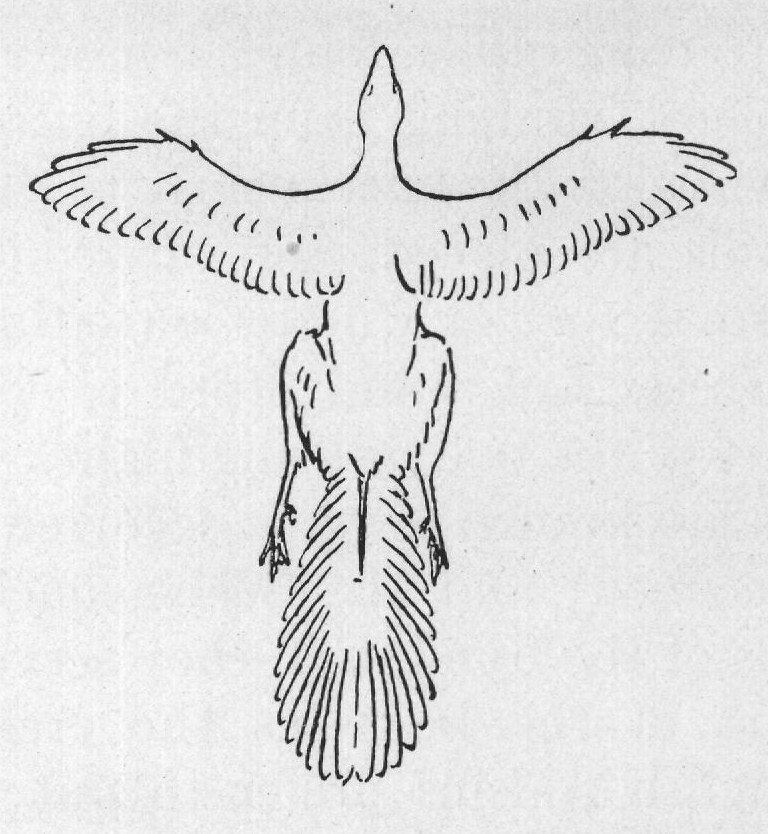
The new evidence that Mr. Beebe brings forward to show that flight began by sailing, consists of a series of sprouting quills, found in newly hatched birds of several species, running from the outer, upper part of the leg just below the knee, nearly to the base of the tail. These quills are placed just where, if developed, they would form a sort of winglet on either side, which combined with the tail would afford excellent support for the hind part of the body during flight. Just such tufts of feathers are known to have occurred in Archæopteryx (Berlin specimen), and Mr. Beebe concludes that, like the back fins of the flying fish, they served to support the hinder part of the body as the creature sailed or as our English cousins prefer to put it-parachuted through the air. For Mr. Beebe doubts that even Archæopteryx was capable of true flight, believing that the fore limbs, like the hind, were rigidly extended at right angles to the body and not flapped.
A most striking bit of evidence is the fact that just as overlapping coverts are found above the secondaries of the bird's wing and alternately with them, so the bristlelike quills on the thigh of the pigeon are surmounted by a series of quills placed precisely like the wing coverts.
The value of any character or piece of evidence does not lie in its size but in its constancy, or in its apparent relation to other characters, so these little bristle-like feathers of the nestling dove, according to Mr. Beebe, hint at a time when, as just noted, they served a useful purpose and were sufficiently developed to support, or help support, the hinder portion of the body. At this stage in the development of birds, which should be somewhere near the lower Jurassic, about seven million years ago, both fore and hind limbs bore feathers; but neither pair of limbs took an active part in aerial locomotion, their function being that of planes, purely passive. This phase of the development Mr. Beebe terms 1111111((い STAGES IN THE DEVELOPMENT OF FLIGHT
Tetrapteryx, Archæopteryx, Hypothetical Stage, Modern Bird. After Beebe. the Tetrapteryx or four-winged stage. At this stage, to quote from Mr. Beebe, "flight was merely gliding, the fingers were too free, the arm bones too delicate, the sternum small or absent, and these facts considered in connection with the small, weak pelvis, make it impossible to picture the creature as flying skilfully about. In succeeding generations the pelvic wings would become more and more reduced. Having arisen from among the surrounding scales, they had for a time volplaned through the air of early ages, a structure passive and, as future centuries would show, of merely transitory function. Yet they were of tremendous importance in allowing the pectoral scales to develop, to become feathers, and then to assume an importance which was to make the class of birds supreme in the air. Yet the function of the pelvic wings had been so passive and negative that no special muscling had been necessary, no increase or coalescence of bony tissue. Little by little the line of feathers and their coverts sank into insignificance and became lost among the body plumage. It affords an excellent example of what Professor Henry F. Osborn would call the phylogenetic acceleration of a character, followed by its gradual reduction. The
Millions of years after they were of use, the feathers of the pelvic wing are still reproduced in embryo and nestling. And for some unknown reason, Nature makes each squab pass through this Tetrapteryx stage. line of feathers along the leg of the young bird reproduces in this diminutive, useless way the glory that once was theirs. No fossil bird of the ages prior to Archæopteryx may come to light, but the memory of Tetrapteryx lingers in every dove-cote."
Thus were scaly, creeping reptiles transformed into feathered, flying birds.
REFERENCES The first discovered specimen of Archæopteryx, Archœopteryx macrura, is in the British Museum, the second more complete example is in the Royal Museum of Natural History, Berlin. The largest collection of toothed birds, including the types of Hesperornis, Ichthyornis and others, is in the Yale University Museum, at New Haven. The United States National Museum at Washington has a fine mounted skeleton of Hesperornis, the American Museum of Natural History another, and the State University of Kansas, at Lawrence, has the example showing the impressions of feathers. For scientific descriptions of these birds the reader is referred to Owen's paper "On the Archæopteryx of von Meyer, with a Description of the Fossil Remains, etc.," in the "Transactions of the Philosophical Society of London for 1863,” page 33, and "Odontornithes, a Monograph of the Extinct Toothed Birds of North America," by O. C. Marsh. Much popular and scientific information concerning the early birds is to be found in Newton's "Dictionary of Birds," and "The Story of Bird Life," by W. P. Pycraft; the "Structure and Life of Birds," by F. W. Headley; "The Story of the Birds," by J. Newton Baskett.
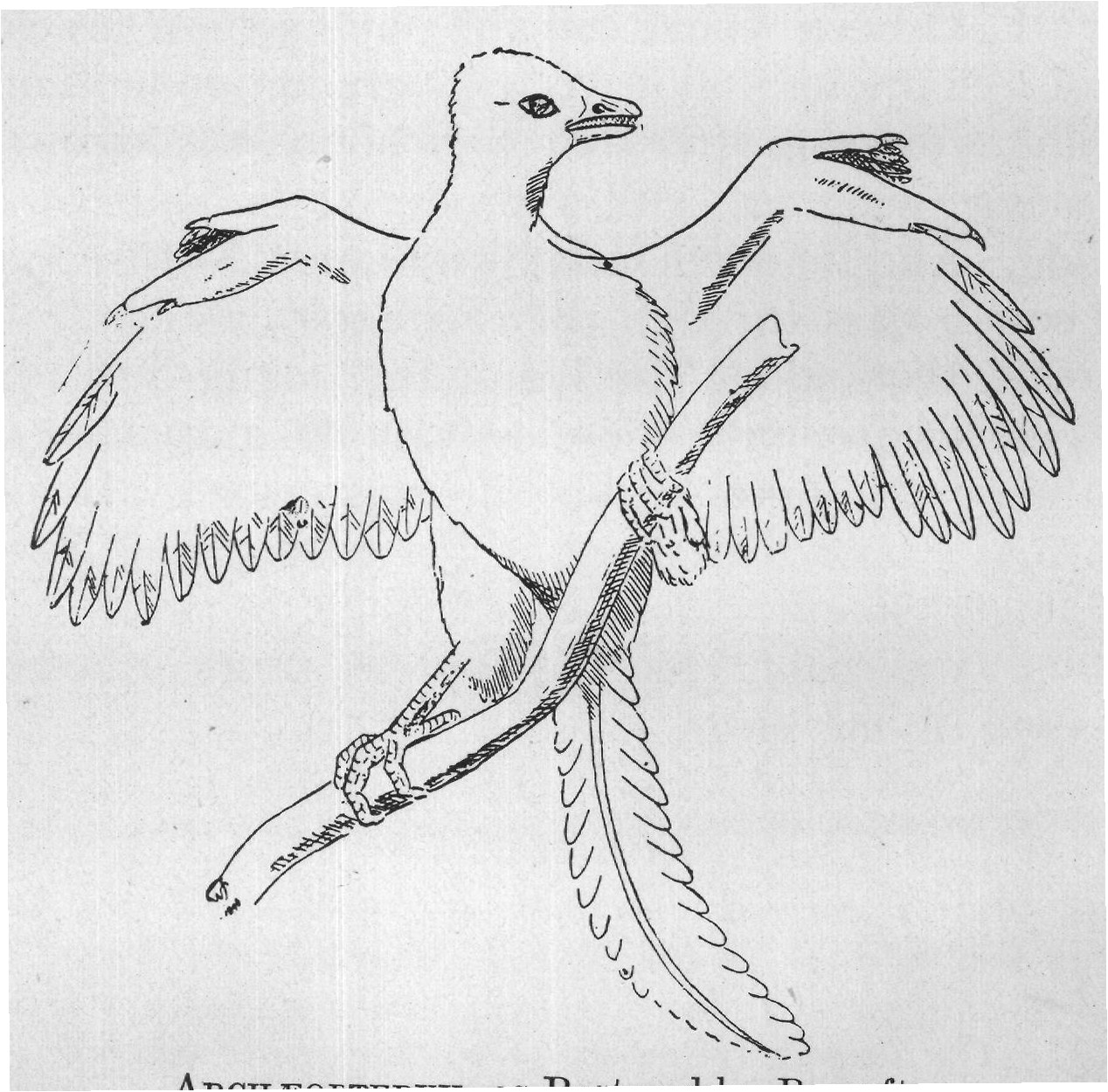
Mr. Beebe's theories of the beginning of flight may be found in Zoologica; Vol. II, No. 2, 1915, under the title The Tetrapteryx Stage in the Ancestry of Birds. ARCHÆOPTERYX, as Restored by Pycraft