Home › Feathered Giants › Feathered Giants: Diatryma
Feathered Giants: Diatryma
The lapse of time has brought to us knowledge or rather information of another "feathered giant" whose existence was hinted at in 1876 by the discovery of a few toe bones to which Professor Cope applied the name Diatryma.
This proves not to be a relative of the ostriches, as was supposed from its size, nor a near relative of the giant birds of Patagonia as I suggested, but, though not unlike Phororhacos in bulk and general appearance, to stand in an order or suborder of its own.
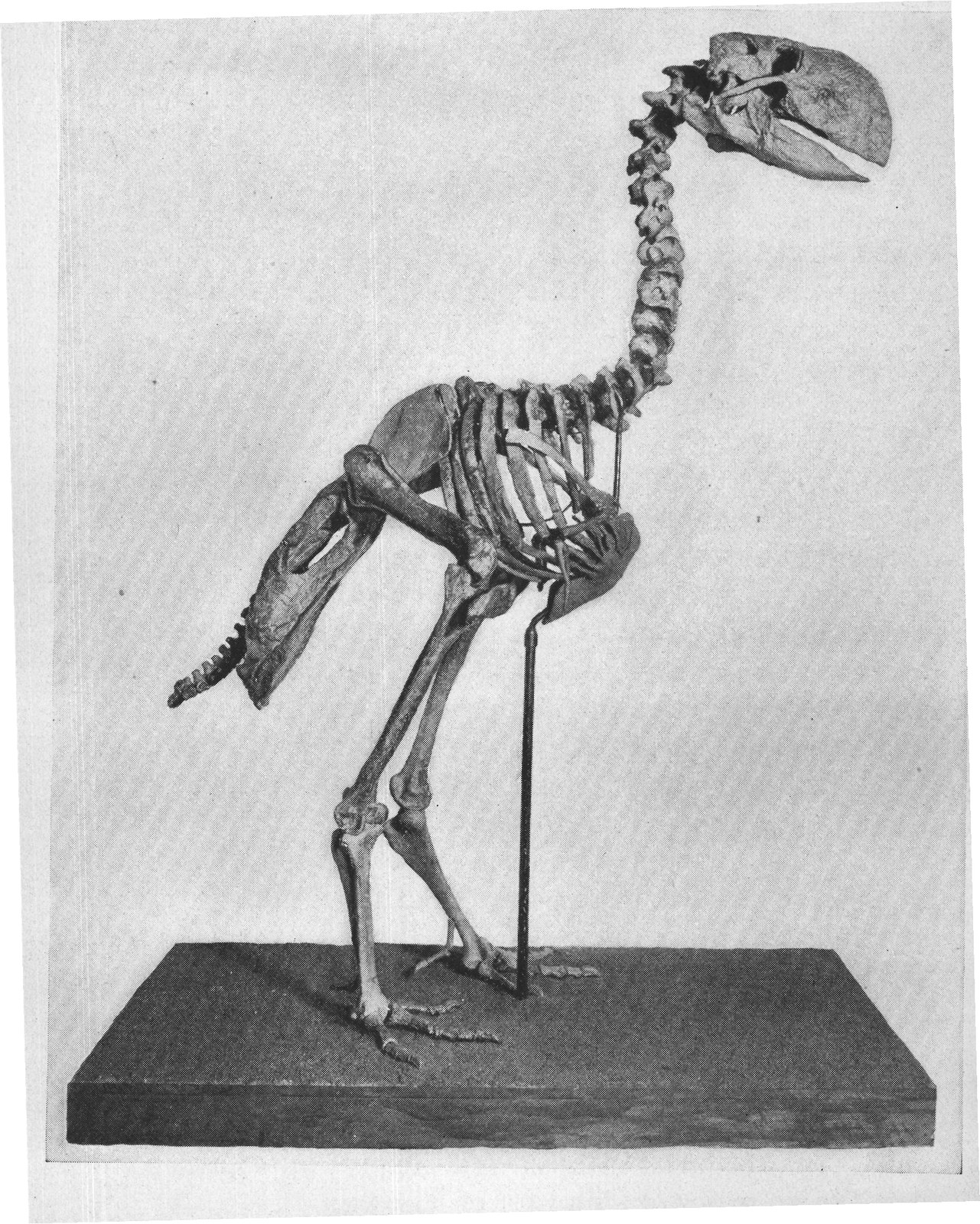
As pointed out by Professor Cope, mere size is not a character and we may recall that the nearest relative of the Sperm Whale is but six to nine feet long and weighs DIATRYMA AN EOCENE GIANT The unique specimen in the American Museum of Natural History. only a few hundred pounds so that his big relation might almost swallow him at a gulp. And Diatryma in spite of its size has naught to do with ostriches though its real relationships are, as is often the case, so obscured by specialization that its real affinities are doubtful, the more that some of the parts that would throw most light upon the problem are crushed and distorted.
Thus in some ways Diatryma is an aggravation; it gives us no help in understanding the inter-relationships of birds, but offers an additional puzzle to be solved: we can only say that it is one of the largest of the true birds, those provided with a fan-shaped tail. At any rate it is the earliest known giant bird and another bit of evidence of the rapidity with which birds developed once they were fairly started on their career.
Something, perhaps, remains to be said concerning the causes which seem to have led to the development of these giant birds, as well as the reasons for their flightless condition and peculiar distribution, for it will be noticed that, with the exception of the African and South American ostriches the great flightless birds as a rule are, and were, confined to uninhabited or sparsely populated islands, and this is equally true of the many small, but equally flightless birds. It is a seemingly harsh law of nature that all living beings shall live in a more or less active struggle with each other and with their surroundings, and that those creatures which possess some slight advantage over their fellows in the matter of speed, or strength, or ability to adapt themselves to surrounding conditions, shall prosper at the expense of the others. In the power of flight, birds have a great safeguard against changes of climate with their accompanying variations in the supply of food, and, to a lesser extent, against their various enemies, including man. This power of flight, acquired early in The their geological history, has enabled birds to spread over the length and breadth of the globe as no other group of animals has done, and to thrive under the most varying conditions, and it would seem that if this power were lost it must sooner or later work harm. Now today we find no great flightless birds in thickly populated regions, or where beasts of prey abound; the ostriches roam the desert wastes of Arabia, Africa and South America where men are few and savage beasts scarce, and against these is placed a fleetness of foot inherited from ancestors who acquired it before man was. heavy cassowaries dwell in the thinly inhabited, thickly wooded islands of Malaysia, where again there are no large carnivores and where the dense vegetation is some safeguard against man; the emu comes from the Australian plains, where also there are no four-footed enemies¹ and where his ancestors dwelt in peace before the advent of man. And the same things are true of the Moas, the Æpyornithes, the flightless birds of Patagonia, the recent dodo of Mauritius and the solitaire of Rodriguez, each and all of which flourished in places where there were no men and practically no other enemies. Hence we deduce that absence of enemies is the prime factor in the existence of flightless birds, although presence of food is an essential, while isolation, or restriction to a limited area, plays an important part by keeping together those birds, or that race of birds, whose members show a tendency to disuse their wings. It will be seen that such combinations
1The dingo, or native dog, is not forgotten, but, like man, it is a comparatively recent animal.
2Note that in Tasmania, which is very near Australia, both in space and in the character of its animals, there are two carnivorous mammals, the Tasmanian "Wolf" and the Tasmanian Devil, and no flightless birds. of circumstances will most naturally be found on islands whose geological history is such that they have had no connection with adjacent continents, or such a very ancient connection that they were not then peopled with beasts of prey, while subsequently their distance from other countries has prevented them from receiving such population by accident in recent times and has also retarded the arrival of man.
Once established, flightlessness and size play into one another's hands; the flightless bird has no limit placed on its size¹ while granted a food supply and immunity from man; the larger the bird the less the necessity for wings to escape from four-footed foes.
So long as the climate was favorable and man absent, the big, clumsy bird might thrive, but upon the coming of man, or in the face of any unfavorable change of climate, he would be at a serious disadvantage and of these two factors has been brought to bear against them the feathered giants have vanished.
REFERENCES
There is a fine collection of mounted skeletons of various species of Moas in the Museum of Comparative Zoology at another in the American Museum of Natural History, New York. A few other skeletons and numerous bones are to be found in other institutions, but the author is not aware of any egg being in this country. Eggs of Æpyornis may be seen in most of the large museums in the United States, the prices ranging from £200 down to £30, this last being much less than prices paid for eggs of the great auk. But then, the great auk is somewhat of a fad, and there are just enough eggs in existence to bring one into the market every little while. Besides, While we do not know the limit of size to a flying creature, none has as yet been found whose wings would spread over twenty feet from tip to tip, and it is evident that wings larger than this would demand great strength for their manipulation. the number of eggs of the great auk is a fixed quantity, while no one knows how many more of Æpyornis remain to be discovered in the swamps of Madagascar. No specimens of the gigantic Patagonian birds are now in this country, but a fine example of one of the smaller forms, Pelycornis, including the only breast- , including the only breastbone yet found, is in the Museum of Princeton University. The only skeleton of Diatryma is in the American Museum of Natural History.
The largest known tibia of a Moa, the longest bird-bone known, is in the collection of the Canterbury Museum, Christchurch, Museum, Christchurch, New Zealand; it is 3 feet 3 inches long. This, however, is ex- This, however, is exceptional, the measurements of the leg -bones of an ordinary Dinornis maximus being as follows: Femur, 18 inches; tibia, 32 inches; tarsus, 19 inches, a total of 5 feet 9 inches. The egg measures 10½ by 6½ inches.
There is plenty of literature, and very interesting literature, about the Moas, but, unfortunately, the best of it is not always accessible, being contained in the "New Zealand Journal of Science" and the "Transactions of the New Zealand Institute."
The volume of Transactions" for 1893, being Vol. XXVI, con- Vol. XXVI, contains a very full list of articles relating to the Moas, compiled by Mr. A. Hamilton; it will be found to commence on page 229.
There is a good article on Moa in Newton's "Dictionary of Birds," a book that should be in every library