Home › Rulers of the Ancient Seas › Rulers of the Ancient Seas: Mosasaurs
Rulers of the Ancient Seas: Mosasaurs
Ichthyosaurus and Plesiosaur played their roles of rulers of the seas in the Pageant of the Past and in due time passed off the stage of life to give place to others. The next group of reptiles to appear on the scene, the great marine reptiles called Mosasaurs, practically extended their empire around the world, from New Zealand to North America.
We properly call these reptiles great, for so they were; but there are degrees of greatness, and there is a universal tendency to think of the animals that have become extinct as much greater than those of the present day, to magnify the reptile that we never saw as well as the fish that "got away," and it may be safely said that the greatest of animals will shrink before a two-foot rule. As a matter of fact, no animals are known to have existed that were larger than the whales; and, while there are now no reptiles that can compare in bulk with the Dinosaurs, there were few Mosasaurs that exceeded in size a first-class Crocodile. An occasional Mosasaur reaches a length of forty feet, but such are rare indeed, and one even twenty-five feet long is a large specimen, 2 while the great Mugger, or Man-eating Crocodile, grows, if permitted, to a length of twenty-five or even
A striking instance of this is shown in some of Dimock's wonderful photographs of leaping Tarpon in which the head is shown bent at an angle to the body that is quite impossible-theoretically.
2It is surprising to find Professor Cope placing the length of the Mosasaurs at 70, 80, or 100 feet, as there is not the slightest basis for even the lowest of these figures. Professor Williston, the best authority on the subject, states, in his volume on the "Cretaceous Reptiles of Kansas," that there is not in existence any specimen of a Mosasaur indicating a greater length than 45 feet. thirty feet, and need not be ashamed to match his bulk and jaws against those of most Mosasaurs.
The first of these sea-reptiles to be discovered has passed into history, and now reposes in the Jardin des Plantes, Paris, now Musee d'Histoire Naturelle, after changing hands two or three times, the original owner being dispossessed of his treasure by the subtleties of law, while the next holder was deprived of the specimen by main force. Thus the story is told by M. Faujas St. Fond, as rendered into English, in Mantell's "Petrifactions and their Teachings": "Some workmen, in blasting the rock in one of the caverns of the interior of the mountain, perceived, to their astonishment, the jaws of a large animal attached to the roof of the chasm. The discovery was immediately made known to M.
Hoffman, who repaired to the spot, and for weeks presided over the arduous task of separating the mass of stone containing these remains from the surrounding rock. His labors were rewarded by the successful extrication of the specimen, which he conveyed in triumph to his house. This extraordinary discovery, however, soon became the subject of general conversation, and excited so much interest that the canon of the cathedral which stands on the mountain resolved to claim the fossil, in right of being lord of the manor, and succeeded, after a long and harassing lawsuit, in obtaining the precious relic. It remained for years in his possession, and Hoffman died without regaining his treasure. At length the French Revolution broke out, and the armies of the Republic advanced to the gates of Maestricht. The town was bombarded; but, at the suggestion of the committee of savans who accompanied the French troops to select their share of the plunder, the artillery was not suffered to play on that part of the city in which the celebrated fossil was known to be preserved. In the meantime, the canon of St. Peter's, shrewdly suspecting the reason why such peculiar favor was shown to his residence, removed the specimen and concealed it in a vault; but, when the city was taken, the French authorities compelled him to give up his ill-gotten prize, which was immediately transmitted to the Jardin des Plantes, at Paris, where it still forms one of the most interesting objects in that magnificent collection." And there it remains to this day.
The seas that rolled over western Kansas were the headquarters of the Mosasaurs, and hundreds-aye, thousands of specimens have been taken from the chalk bluffs of that region, some of them in such a fine state of preservation that we are not only well acquainted with their internal structure, but with their outward appearance as well. They were essentially swimming lizards-great, over-grown, and distant relatives of the Monitors of Africa and Asia, especially adapted to a roving, predatory life by their powerful tails and paddle-shaped feet. Their cup-and-ball vertebræ indicate great flexibility of the body, their sharp teeth denote ability to capture slippery prey, and the structure of the lower jaw shows that they probably ate in a hurry and swallowed their food entire, or bolted it in great chunks. The jaws of all reptiles are made up of a number of pieces, but these are usually so spliced together that each half of the jaw is one inflexible, or nearly inflexible, mass of bone. In snakes, which swallow their prey entire, the difficulty of swallowing animals greater in diameter than themselves is surmounted by having the two halves of the lower jaw loosely joined at the free ends, so that these may spread wide apart and thus increase the gape of the mouth.
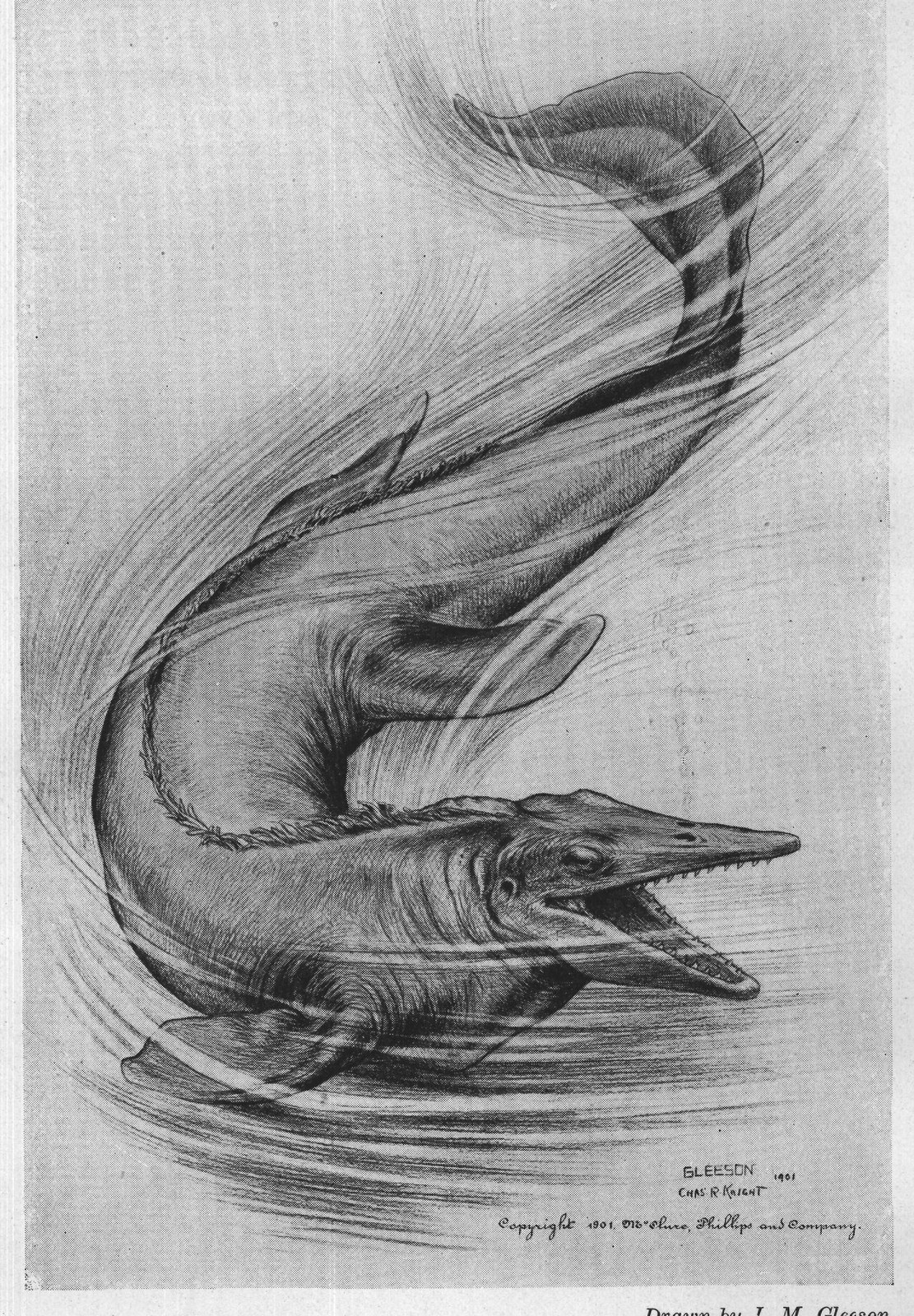
This is also helped by the manner in which the jaw is joined to the head. The pelican solves the problem by GLEESON CHAS R KAIGHT Copyright 1901, 08-clure, Phillips and Company.
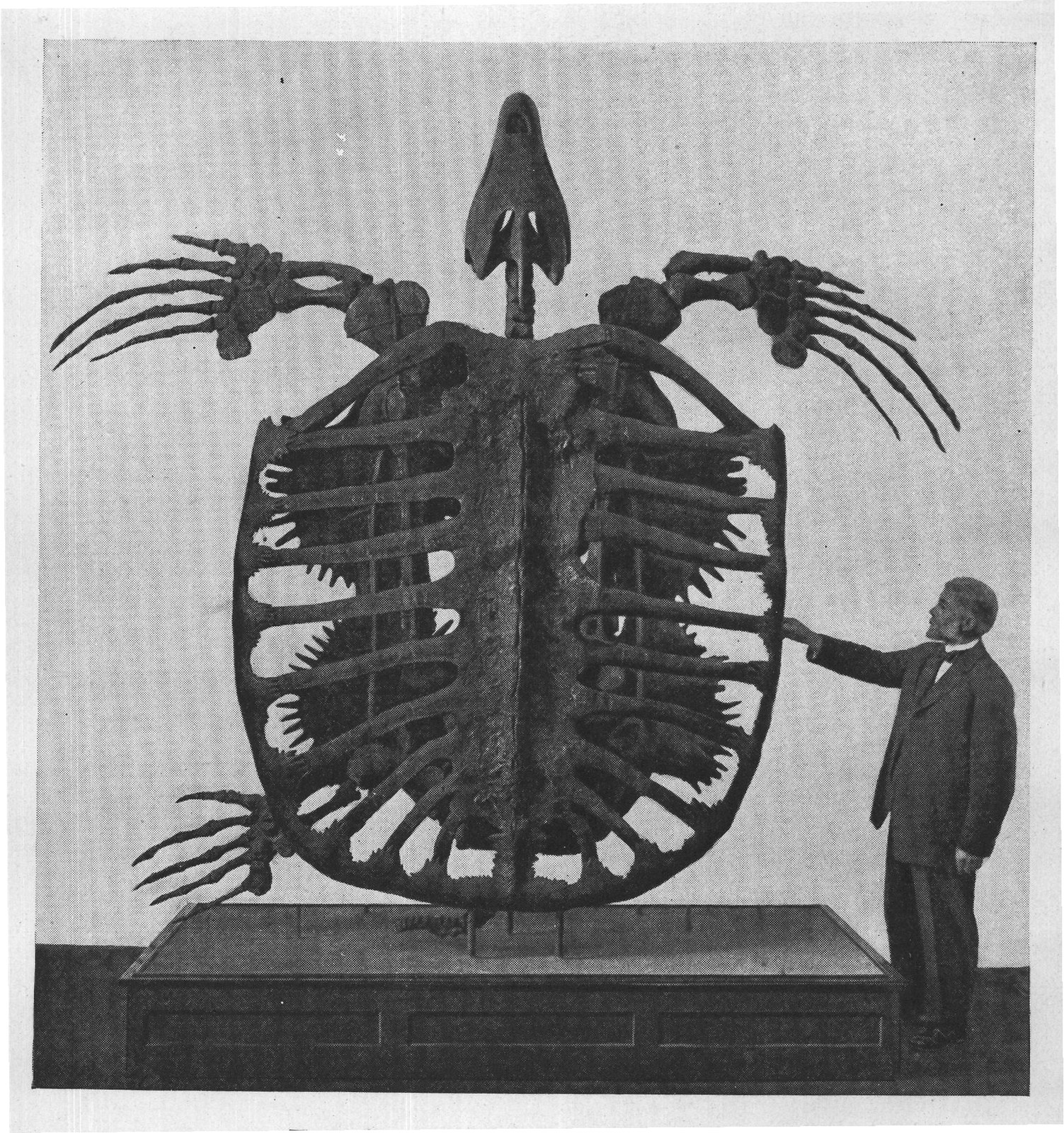
Drawn by J. M Gleeson TYLOSAURUS One of the Rulers of the Cretaceous Seas. the length of his mandibles, this allowing so much spring that when open they bow apart to form a nice little landing net. In the Mosasaurs, as in the cormorants, among birds, there is a sort of joint in each half Jaw of Mosasaur showing the joint that increased the swallowing capacity of that reptile. of the lower jaw which permits it to bow outward when opened, and this, aided by the articulation of the jaw with the cranium, adds greatly to the swallowing capacity. Thus in nature the same end is attained by very different methods. To borrow a suggestion from Professor Cope, if the reader will extend his arms at full length, the palms touching, and then bend his elbows outward he will get a very good idea of the action of a Mosasaur's jaw. The western sea was a lively place in the day of the great Mosasaurs, for with them swam the king of turtles, Archelon, as Mr. Wieland has fitly named him, a creature a dozen feet or so in length, with a head a full yard long, while in the shallows prowled great fishes with massive jaws and teeth like spikes.
There, too, was the great, toothed diver. Hesperornis (see page 58), while over the waters flew pterodactyls, with a spread of wing of twenty feet, largest of all flying creatures; and, not improbably-nay, very probablyfish-eaters, too; and when each and all of these were seeking their dinners, there were troublous times for the small fry in that old Kansan sea.
THE GIANT SEA TURTLE ARCHELON A contemporary of the Mosasaurs From the specimen in the Yale University Museum If they came to the surface they were snapped up by Pteranodon; if they sought safety in deep waters Portheus pounced upon them, while at intermediate depths Hesperornis made their lives miserable and existence precarious; small wonder that, like the huge sharks of later days, all these voracious, highly specialized creatures passed out of existence. And then there came a change; to the south, to the west, to the north, the land was imperceptibly but surely rising, perhaps only an inch or two in a century, but still rising, until "The Ocean in which flourished this abundant and vigorous life was at last completely inclosed on the west by elevations of sea-bottom, so that it only communicated with the Atlantic and Pacific at the Gulf of Mexico and the Arctic Sea."
The continued elevation of both eastern and western shores contracted its area, and when ridges of the seabottom reached the surface, forming long, low bars, parts of the water-area were included, and connection with salt-water prevented. Thus were the living beings imprisoned and subjected to many new risks to life.
The stronger could more readily capture the weaker, while the fishes would gradually perish through the constant freshening of the water. With the death of any considerable class, the balance of food-supply would be lost, and many large species would disappear from the scene. The most omnivorous and enduring would longest resist the approach of starvation, but would finally yield to inexorable fate the last one caught by the shifting bottom among shallow pools, from which his exhausted energies could not extricate him."1
Like the "Fossil man" the sea-serpent flourishes perennially in the newspapers and, despite the fact that he is now mainly regarded as a joke, there have been many attempts to habilitate this mythical monster and place him on a foundation of firm fact. The most 1Cope: "The Vertebrata of the Cretaceous Formations of the West," p. 50, being the "Report of the United States Geological Survey of the Territories," Vol. II. earnest of these was that of M. Oudemans, who expressed his belief in the existence of some rare and huge seal-like creature whose occasional appearance in southern waters gave rise to the best authenticated reports of the sea-serpent. Among other possibilities it has been suggested that some animal believed to be extinct had really lived over to the present day. Now there are a few waifs, spared from the wrecks of ancient faunas, stranded on the shores of the present, such as the Australian Ceratodus and the Gar Pikes of North America, and these and all other creatures that could be mustered in were used as proofs to sustain this theory. If, it was said, these animals have been spared, why not others? If a fish of such ancient lineage as the Gar Pike is so common as to be a nuisance, why may there not be a few Plesiosaurs or a Mosasaur somewhere in the depths of the ocean? The argument was a good one, the more that we may "suppose" almost anything, but it must be said that no trace of any of these creatures has so far been found outside of the strata in which they have long been known to occur, and all the probabilities are opposed to this theory. Still, if some of these creatures had been spared, they might well have passed for sea-serpents, even though Zeuglodon, the one most like a serpent in form, was the one most remotely related to snakes.