Home › Volumes › Fishes › The Tarpons
Tarpon
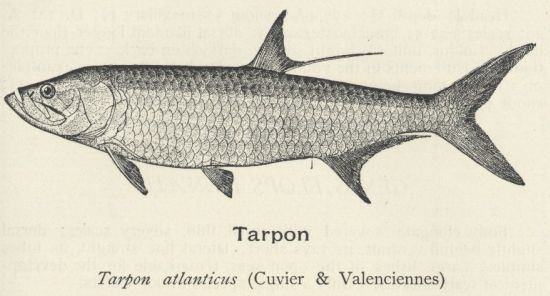
The tarpon occurs on our Atlantic Coast from Long Island to Brazil, being most common southward, particularly on the coasts of Florida. It is a common fish about Porto Rico, where it evidently breeds.
The tarpon reaches a length of 2 to 6 feet and a weight of 30 to more than 300 pounds. The largest one on record taken with a hook weighed 209 pounds, and the largest taken with a harpoon weighed 383 pounds, if we may believe the record; but examples weighing over 100 pounds are not often seen. Among other names by which the tarpon is known are tarpum, savanilla, savalle sabalo, grand ecaille, and silver king, the last being one of its best and most expressive designations.
The silver king is the greatest of game fishes. There is none more celebrated or deserving of higher praise. Only the few fortunate anglers who, happily situated, are able to spend their winters in Florida or elsewhere on our southern coast, have actually experienced the pleasure of tarpon fishing, but every lover of the rod has heard of the silver king and has hoped that he might some day have an opportunity to test the great fish's strength and skill.
Among the places on our southern coast where excellent tarpon fishing has been obtained are along the west coast of Florida from Punta Gorda southward to Indian River and Lake Worth, about Key West, in Mississippi Sound, and at Galveston and Corpus Christi, Texas. Fort Meyers, on the west coast of Florida has, perhaps, been the most popular resort.
Head 4; depth 3 4/5; eye 4 9/20; snout 5; maxillary 1 2/3; D. 12; A 20; scales 5-42-5; branchiostegals 23; dorsal filament longer than the head. Colour, uniform bright silvery, darkish on back. The proportional measurements in the young are somewhat different, in examples of 3 inches long being as follows: Head 3 1/3; depth 4 2/3; eye 3 1/3; snout 4 3/4.
GENUS ELOPS LINNAEUS
Body elongate, covered with small, thin, silvery scales; dorsal slightly behind ventrals, its rays short; lateral line straight, its tubes simple. Large fishes of the open seas, remarkable for the development of scaly sheaths. Only a single species in our waters.