Pratt Institute
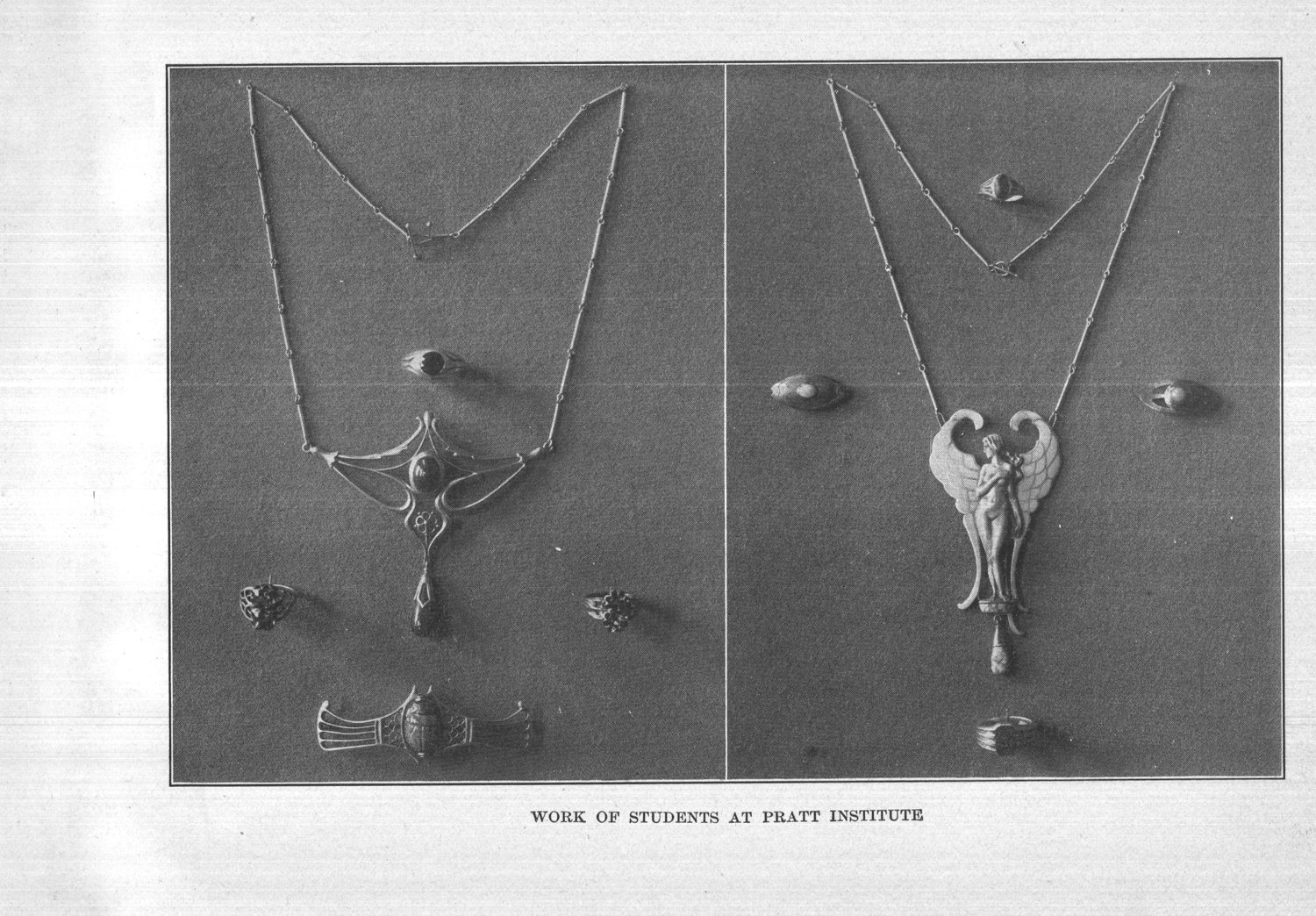
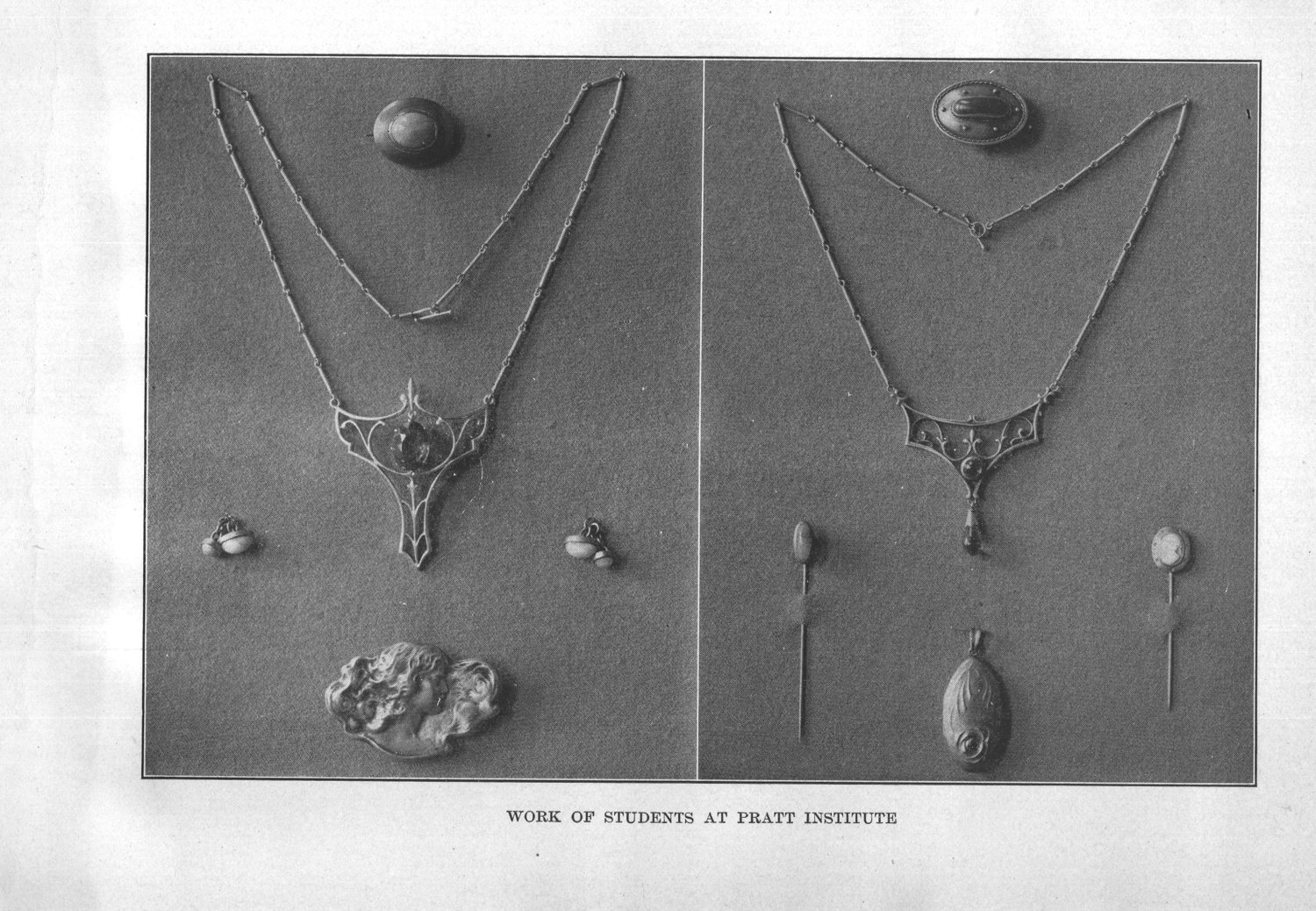
The work of the more expert of the students taking the jewelry course in Pratt Institute of Brooklyn, and at other educational institutions where this department of art and manual training is a serious feature, is a revelation of present attainments, and a hopeful sign that the jewelry of the future in America will conform more to true artistic ideals and serve less as a medium for mere ostentatious display. An exhibition of the work of students in the jewelry course was an attractive phase of the twenty-fifth annual exhibit of student products at Pratt Institute in June, 1908. The exhibits of the class in jewelry and metal-chasing were displayed in two large glass cases, and consisted of rings, pendants, bracelets, stick-pins, brooches, scarf-pins, buckles, and hammered copper work.
A silver medal presented by Mr. Albert M. Kohn of New York City, as a prize for the most proficient student of the jewelry class, was awarded by a committee of trustees, who acted as a jury of award, to Mr. Carl H. Johonnot. The work exhibited by the winner of the medal included a number of fine pendants, rings, silver spoon, and stick pins.
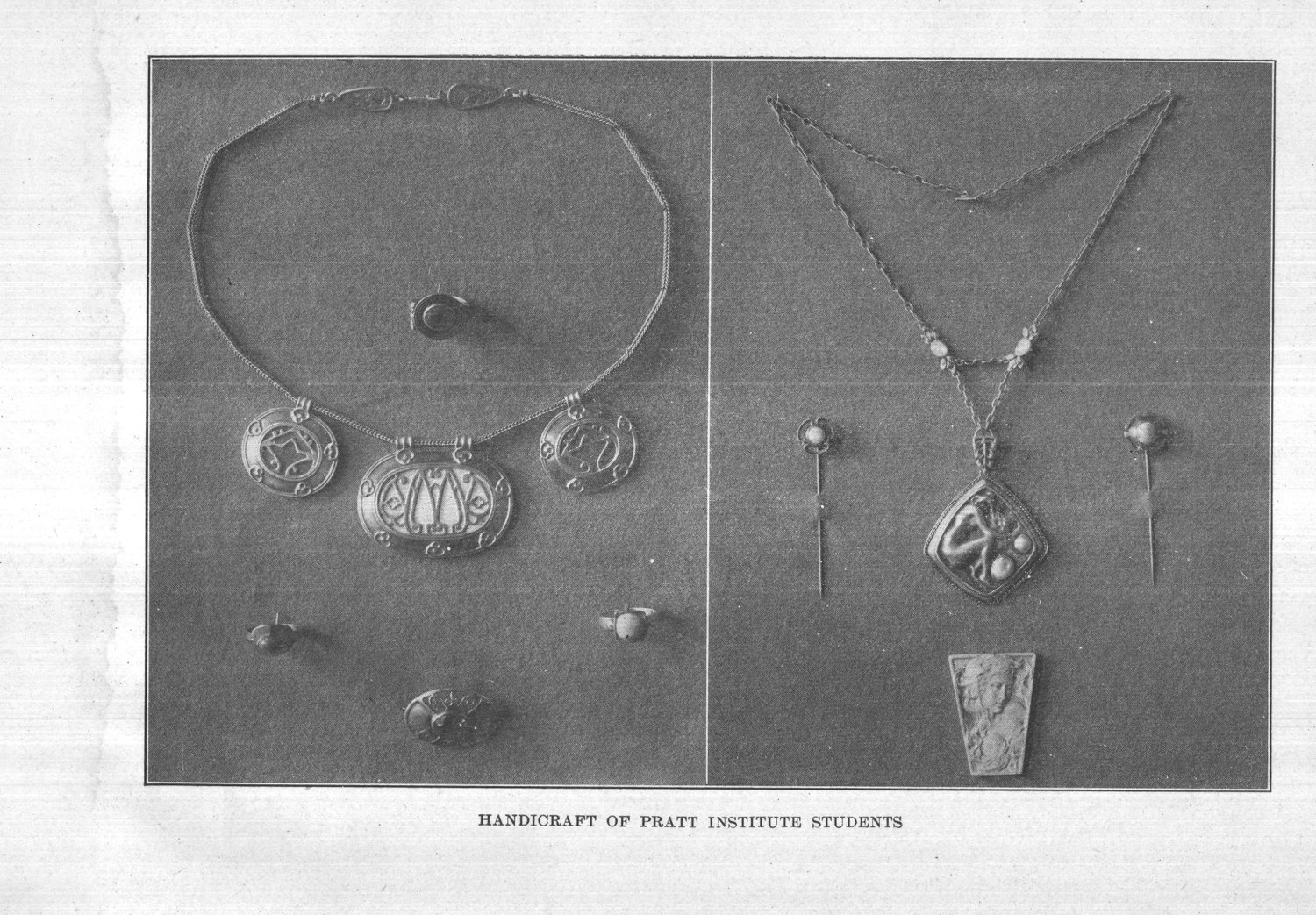
For a description of the class in jewelry designing at the Pratt institute, and also for excellent photographs of finished work executed and designed by students of the class of 1908, credit is given to Mr. Walter Scott Perry, Director of the Department of Fine and Applied Arts, of the Institute.
The first class in jewelry, hammered metal, and enamelling was organised in the Department of Fine and Applied Arts, Pratt Institute, in September, 1900, with Mr. Joseph Aranyi as instructor in day and evening classes. Mr. Aranyi at the time was one of the expert workers with Messrs. Tiffany & Company, New York City. He continued as instructor of the class, until June, 1904, when he resigned his position to accept one in Providence, Rhode Island.
In September of the same year Mr. Carl T. Hamann was appointed instructor in jewelry, and for some time has had full charge of all work of this class. He has proved himself an exceptionally fine instructor, and the quality of work has gained very rapidly under his instruction. Mr. Hamann is an expert jeweller by profession, being formerly connected with Durand & Company, Newark, N. J., and later with Tiffany & Company, New York. In 1889 he went to Europe and studied modelling in Munich for one and a half years, going from there to Paris, where he studied in the Academie Julian and the Ecole des Beaux Arts for two years. After his return to this country he became the head modeller for the Whiting Manufacturing Company, New York. Mr. Hamann was the sculptor of the statue of Justice which was one of the eight statues on the Triumphal Bridge at the Pan-American Exposition at Buffalo. At St. Louis he had a statue symbolical of Wyoming in the Colonnade of States, and he is also sculptor of the figure of Modern Art on the permanent Fine Arts Building. Mr. Hamann is a member of the National Sculpture Society. He brings to the students the knowledge and skill of a professional workman, combined with the originality and artistic appreciation of a professional artist.
In September, 1904, Mr. Julien Ramar became instructor in chasing and hammered metal work in the evening class, and also gave two halfdays to the day class. Mr. Ramar was for several years chaser for Elkington & Company, England, and in America had been employed by the National Fine Art Foundry, the Archer & Pancoast Company, the Edward F. Caldwell Company, and other firms.
In September, 1905, Mr. Theodore T. Goerck took charge of chasing and hammered work in the day and evening classes and continued as instructor for two years.
Mr. Hamann at present is instructor in both day and evening classes. The classes have grown steadily and the work has increased in efficiency. Students have been very successful in securing employment. Many have opened studios of their own and fill orders that come to them from many and varied sources.
The courses are planned to meet the needs of those who wish to enter the trades involving jewelry, enamelling, repousse, chasing in precious and other metals, and the making of suitable tools required in such work. They give adequate training in design and modelling, in the application of designs to practical problems, the setting of stones, enamelling and finishing, and in the methods and practice of technical work in metal. Instruction is also given in medal work and in the preparation of models for reduction.