Cooper Union and New York
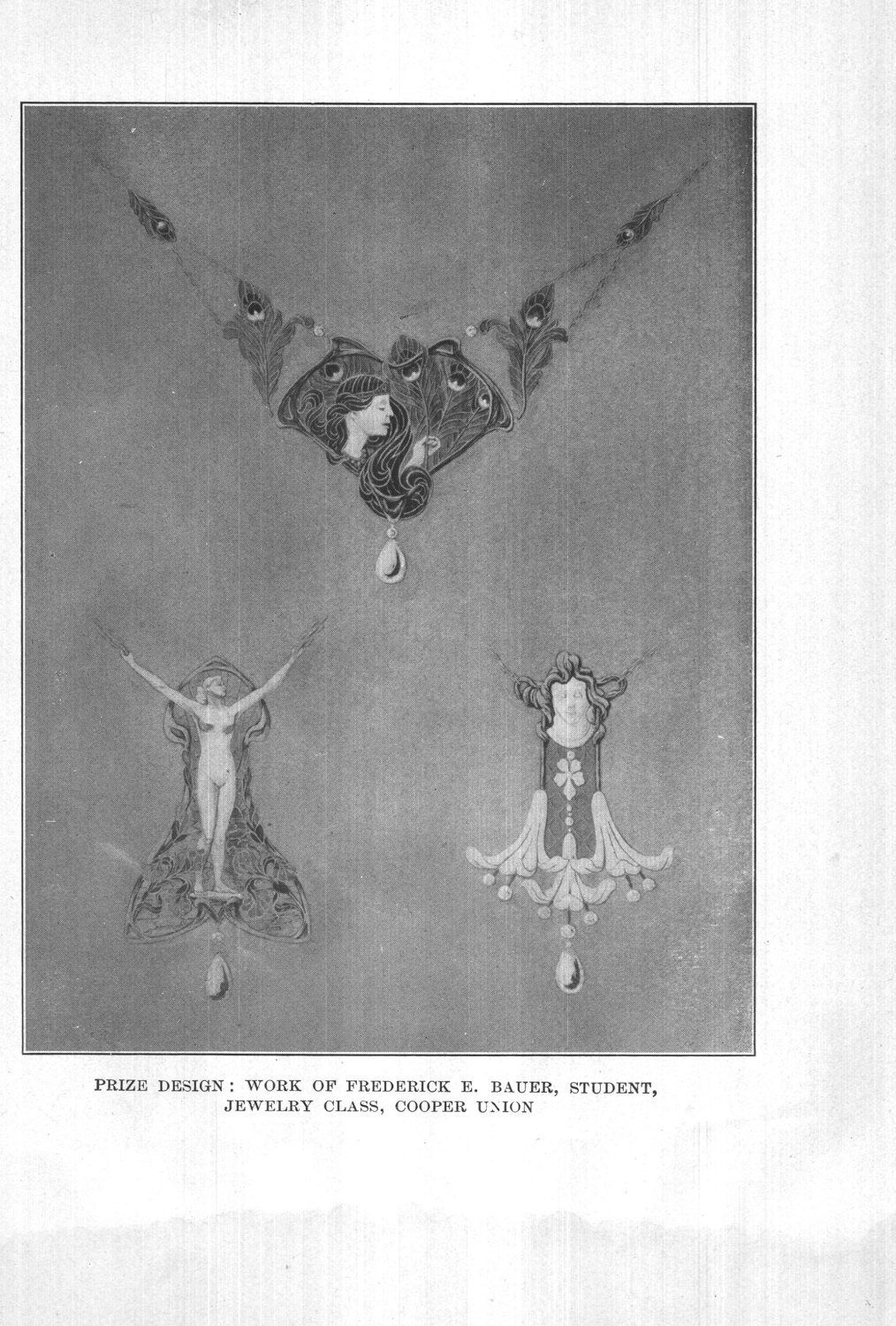
There is a course in jewelry designing at Cooper Union in New York City under the direction of Mr. Edward Ehrle. The Cooper Union class meets tri-weekly, in the evening, for a two hours' session. The work begins with easy geometrical designs; original work by the pupils is constantly encouraged. The school year begins the second Monday after September 15th and ends about May 15th. The full course requires about three years. At the conclusion of the term in the year 1908, a cash prize offered by The Jewellers' Circular-Weekly was awarded to Mr. Frederick E. Bauer for his excellent work.
A resource of value to the artistic designer of jewelry in and near New York City is the Cooper Union Museum for the Arts of Decoration, a subsidiary institution of this famous old hall of education that is now, although progressing in its acquisition of valuable exhibits, of incalculable value to the arts and industries of America; the usefulness of this institution is however restricted, because it is not well known. It is probably a safe assumption to say that not one person in many thousands of the inhabitants of the metropolis is cognisant of the existence of such a treasure-house, which is available to all earnest seekers after ideas, information, and material for the betterment of art, and under conditions impossible to excel in providing the greatest opportunity and freedom to all who will avail themselves of it. The contents of this museum would astonish thousands who are familiar with the broadly advertised contents of the Metropolitan Museum of Art, and the feeling of regret that comes over the appreciative visitor to the Cooper Union Museum suggests the reflection that a little adept yet dignified promotion of publicity would be beneficial to the efficiency of this institution. A strong feature of this working museum is a collection of encyclopedic scrap-books, open, like all else here, to all applicants for permission to use them; the scrap-book covering jewelry shows many excellent designs, fertile in ideas for bracelets, chatelains, clasps, lockets, combs, crowns, tiaras, head ornaments, dress and engraved ornaments, knots and bowknots, ear-rings, girdles, belts, hoops, rings, necklaces, pendants, sceptres, seals, and watches.
While the bibliography presented in this volume is extensive and of wide scope, unfortunately, but a few of the books listed are to be found in the average public or institutional library. A valuable resource for the students at Pratt Institute or Cooper Union, or any one who would delve as deeply as possible into the subject of jewelry, is the Society Library in University Place, near Thirteenth Street, New York City. This, Manhattan Island's oldest library, was founded by King George II., and his representative who was at the time the royal governor of the Colony of New York. The family of ex-President Roosevelt have been benefactors of the library for six generations, and he is at this time an active member of the board of trustees. Although not a public library, the superb collection of art books, selected with special reference to the requirements of artists and handicraftsmen, is always open to designers. There is a large endowment fund for the support of the art book department, which is known as "the Greene foundation."
The productions of designers and workers in jewelry seen in the annual exhibitions now held by the National Arts Club, in collaboration with the National Society of Craftsmen, in the galleries of the club at 119 East Nineteenth Street, New York City, prove the good work that is being done by individuals and members of various schools and classes; these include the jewelry class of the New York Evening School, and the jewelry class of Miss Grace Hazen of Gloucester, Mass.
At Newark, N. J., an industrial city which includes among its industries considerable jewelry manufacturing, there is the Newark Technical School, supported by appropriations from both the city of Newark and the State of New Jersey, which has a valuable course for workers in jewelry.