Home › Contents › The Umbrella Bird
The Umbrella Bird
(FROM TRAVELS ON THE AMAZON.) BY SIR A. R. WALLACE.
T HIS singular bird is about the size of a raven, and is of a similar color, but its feathers have a more scaly appearance, from being margined with a different shade of glossy blue. It is also allied to the crows in its structure, being very similar to them in its feet and bill.
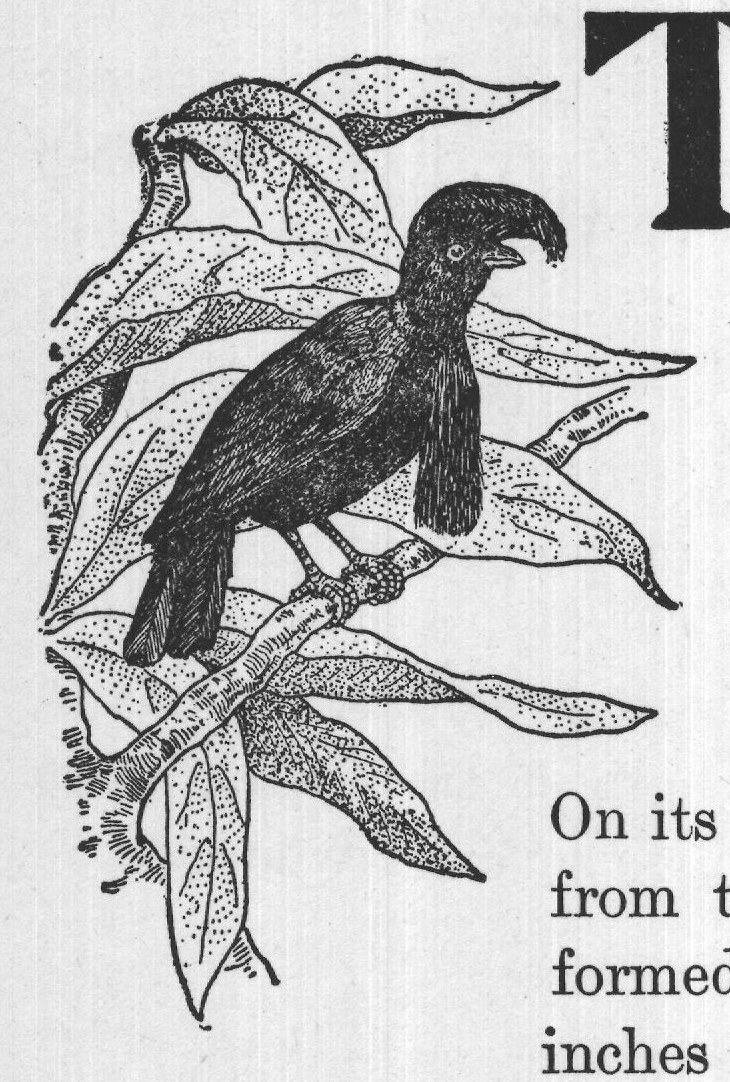
On its head it bears a crest, different from that of any other bird. It is formed of feathers more than two inches long, very thickly set, and with hairy plumes curving over at the end. These can be laid back so as to be hardly visible, or can be erected and spread out on every side, forming a hemispherical, or rather a hemi-ellipsoidal dome, completely covering the head, and even reaching beyond the point of the beak: the individual feathers then stand out something like the down-bearing seeds of the dandelion. Besides this, there is another ornamental appendage on the breast, formed by a fleshy tubercle, as thick as a quill and an inch and a half long, which hangs down from the neck, and is thickly covered with glossy feathers, forming a large pendant plume or tassel.
This also the bird can either press to its breast, so as to be scarcely visible, or can swell out, so as almost to conceal the forepart of its body. In the female the crest and the neck-plume are less developed, and she is altogether a smaller and much less handsome bird. It inhabits the flooded islands of the Rio Negro and the Solimoes, never appearing on the mainland. It feeds on fruits, and utters a loud, hoarse cry, like some deep musical instrument; whence its Indian name, Ueramimbe, “trumpet-bird." The whole of the neck, where the plume of feathers springs from, is covered internally with a thick coat of hard, muscular fat, very difficult to be cleaned away, which in preparing the skins, must be done, as it would putrefy, and cause the feathers to drop off. The birds are tolerably abundant, but are shy, and perch on the highest trees, and, being very muscular, will not fall unless severely wounded. -